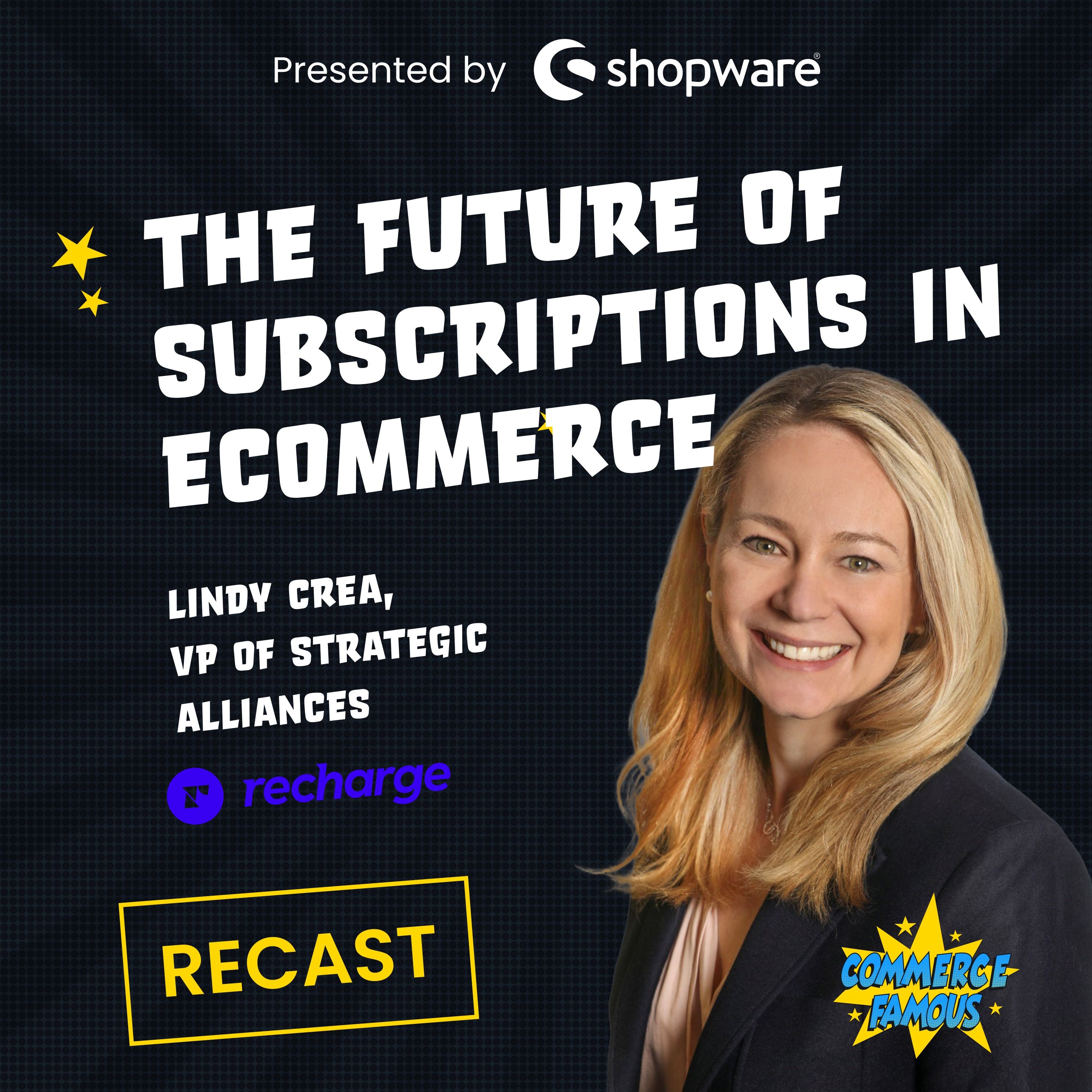
Recast | Lindy Crea | The future of subscriptions in ecommerce
Worum es geht
In dieser Recast-Folge spricht Ben mit Lindy Crea, VP of Strategic Alliances bei ReCharge Payments, über die Zukunft von Abo-Modellen im E-Commerce. Ausgehend von Lindys Erfahrung im Aufbau von Partnerschaften – von der Clinton Foundation über Klarna bis ReCharge – diskutieren beide, wie kundenfreundliche Subscription-Modelle aussehen und wohin sich die Branche entwickeln könnte. Eine besonders relevante Folge für alle, die im Shopify-Umfeld und darüber hinaus auf wiederkehrende Umsätze setzen.
Autor: Commerce Famous Podcast
Zu Gast
Lindy Crea hat sich in ihrer Karriere auf den Aufbau von Partnerschaften konzentriert. Sie arbeitete für die Clinton Foundation an Public-Private-Kooperationen in Mosambik, leitete globale Partnerschaften bei Klarna während der US-Expansion und verantwortet heute die Partnerschaften bei ReCharge.
Folge teilen
Transkript
Welcome to Commerce Famous, the biweekly podcast all about ecommerce and retail. In each episode, your host Ben Marks cuts through the clutter and takes you straight to the stories and experiences of those who shaped digital commerce as we know it today. While their names and faces might not be recognized on the street, each of Ben's guests are famous for commerce or commerce famous. Without further ado, your host, Ben Marks. Welcome to episode nine of the Commerce Famous podcast.
I'm your host, Ben Marks. And with me today is Lindy Kreia from Recharge, one of the biggest names in, in the space, especially around subscriptions. Lindy has a ton of experience, a wealth of experience going back into the early two thousands in businesses in and around the ecommerce space, for spending time, at at Amex, which I can't wait to talk to you about, Lindy, just just looking at their trajectory. And then you've you've had a couple you've had, like, a couple moments where you've sort of gone, you know, into into other industry, but then eventually finding your way all the way up to VP of Partnerships at Recharge. So, Lindy, I really just want to quickly get into, you know, your CV says AmEx intern like circa 2006 And then, boom, you're like manager of corporate strategy and business development for EMEA and Oz.
What was that like? You must have you must have just impressed the hell out of everyone. That's very flattering. First, I'm gonna pronounce my last name for you. It's Lindy Cray.
Cray. As if I didn't know that. You know what? Let's let's go ahead and start this over. No.
Don't worry. We don't have to. Everybody calls me Craya or Craya. Well, is it I lived in Spain, and I was definitely Craya. But I've already like, I've I've I've met you before, and you've already corrected me once, and now I'm embarrassed.
No. Don't be embarrassed. It's fine. I was crayfish. People remembered it when I was growing up because it was crazy, crayfish.
These are the things. Crayola. Crayola. Wow. That that help people to remember because it's not it's it's not phonetics.
That's fine. Well so, Lindy, again, your start at Amex, that must have given you so you were working in multiple markets. And from what I've read, EMEA and Oz at the same time, Australia. Right? So not exactly, similar markets or geographically close.
What was that experience like early on in your career? I mean, it was amazing. I actually started my career at Accenture, and so I ended up at Amex in London after I did my MBA in Spain. And the internship was my MBA internship, which was it it it sounds like a big jump, but it was it was amazing. It was like my first introduction to sales.
And so my my background at Accenture had been very much business process, system implementations. And I joined AmEx and, the business travel sales team to help define sales processes, implementing, the the Salesforce instance, defining the entry exit criteria in the sales process. So it was it was a great introduction. But then when I chose after I finished my MBA to join Amex, I got the great opportunity to roll out a new service offering, our mid market service offering. So that we rolled it out to a bunch of EMEA markets as well as Australia, and then a number of go to market strategies, to to take it to market.
But it it was. It was super exciting for me because my the whole reason for going to Spain to do my MBA was interest in really working in different markets, not just being a tourist and traveling, but really getting the opportunity to kinda dig in and work locally. I've always feel like that's how you really learn about people in any situation is being able to do work and solve problems together. It's the it's the greatest way to overcome barriers with people. I you know, I've been fortunate enough to travel a bit in my work over the years, and it certainly does.
It it shows you that there are so many different ways of work life balance, of of, figuring out how different cultures prioritize different things. And then, to take that experience, but then, you know, be learning so much on culturally and then launching new products. And then I I gathered from from the description that you were actually, you know, you were all you you were bringing things online in in a way that they hadn't been brought. You are you're operationalizing CRM and things like that. So that must have been also incredibly informative at a time when when, you know, these industries were a bit nascent.
I mean, this is, you know, going from and I'll date myself here, but, you know, from the Rolodex days and and then handwritten calendars into, you know, into, you know, shared calendaring and shared, you know, and and and regular treatments for people. And I I imagine that must have been a pretty good setup for, what's what's come later in your career. Yeah. I mean, hindsight is twenty twenty. I think about the first role that I ever had with Accenture was, QA QA ing and user acceptance testing of a CRM system.
Oh, wow. It was it was one of the big insurance companies and and testing. Yes. Very sexy. Very sexy.
When when the developers finished with a bug, you were sort of, like, the end of the line, whether it was 6AM or 2AM in the morning, to then go test the fix. So sitting in a windowless room with computers set up, it was a lot of fun going through these cases. Commerce famous is proudly presented by Shopware, the leading open source ecommerce platform for mid market and lower enterprise merchants. More than 50,000 clients already process over 25,000,000,000 in annual GMV through Shopware. Find out more about Shopware and the best value in ecommerce at shopware.com.
I remember from my agency days, you know, some some later nights, but, boy, nothing that fortunately, I guess I was I was not part of UAT. So those, those those poor folks. Yes. At the sort of at the mercy of the of the developers to get stuff done and then, you know, coordinating with the with the customer to find out, hey. Is this actually the resolution that we need?
Well, you know, you so this gets us up through '20 basically, 2010. The early the early two thousands are done. And then you end up at as as a senior program manager with the Clinton Health Access Initiative in, in supporting Ministry of Health in Mozambique. That and that that was, that was about five years. I'm I'm really curious because where we're headed is, of course, you you know, your experience in ecommerce on both sides of the equation.
But I'm I'm curious how, well, it sounds incredibly fulfilling, but but how much learning and experience that you had there applies to what you've you've done since then? Yes. It wasn't a straight path. And and, yes, many, including the VP of sales that I worked for at AmEx was like, what are you doing? I'm moving to Mozambique.
But I'm definitely motivated by creating value, whether that is revenue value or, improving systems. And that's what I went to Mozambique to do. I I think, you know, early in my career, what I really wanted was to experience the world and experience people. And so when an opportunity presented itself, it seems silly to say no. So, yeah, I went to Mozambique to implement, systems in partnership with the Ministry of Health Mhmm.
With Mozambique, and working with the Clinton Health Access Initiative, which was a spin off of the Clinton Foundation. And the projects were the the main project that I worked on was an early infant diagnosis test system. So infants born to mothers who are HIV positive need to be tested, with special lab equipment, especially at the time. And in Mozambique, there was only four labs that could do the special testing. And in order to overcome the infrastructure challenges in Mozambique of getting the test results back to these labs and then, back to the health facilities where the children were, we implemented systems that leveraged the mobile health system so that you could transmit the the results over the mobile health network to a very simple receipt printer in almost a thousand health facilities across Mozambique so these babies could get their results quickly.
And if they needed to be put on treatment, be put on treatment quickly, and live healthy and sustainable long lives. Well, so incredibly important. And and, honestly, that kind of work seems to turn down the volume a little bit on on, you know, optimizing ecommerce operations. But I'm what I'm what I picked up on on your description there is that this is this was a study in in multidisciplinary pursuit. Right?
Because you're you're you're dealing with sort of of a fulfillment fulfillment channel of of getting the information to the right place and having set things up in in order for that information to have been gathered in the first place. And then you have handed me one of the easiest segues I've had so far by bringing up partnerships. Now this is in a government context, so that must have that that must be something quite different from, you know, partnerships in in pardon the term, but, you know, the Western world, but, like, looking at how partnerships operate in Europe and North America. What what what what is that like having to, you know, work from a nonprofit perspective and and then gain the trust and gain support. And I imagine setting things up for for for future future growth and and function with a with with a government agency.
Yeah. I appreciate that you see the partnerships in it because I always feel like that was where I cut my teeth on partnerships was with my work in Mozambique. And we called them public private partnerships. So I was working with the Ministry of Health, but I was also working with, international agencies like Gavi for vaccines or UNICEF, who was funding some of our work in Mozambique. Irish Aid, for example, was funding some of our work.
So I think the the important thing was was recognizing all of those partners and what they were trying to achieve both as organizations and individuals. Yeah. And that's not different at all to what we do today. Right? Exactly.
It's a very good point. I mean, you now your your your your partnership acumen is is top notch. Right? Because from from from there, you end up you go to Klarna, global partnerships, right, when when Klarna's, experiencing tremendous growth. Now you've brought some great experience to bear, but how did that how did that jump actually happen?
Well, I was very it was very serendipitous. In one of my journeys back from South Africa where I was living at the time, I ran into my old boss from Amex who had since gone to Klarna Ah. In Heathrow. And so he told me about this interesting company that he was working for. They just entered The US.
I'm sure you and I can talk endlessly about European companies entering The US. That's familiar. But it sounded really interesting. So he said, let's let's stay in touch. You know, maybe there's maybe there's some opportunities together.
So I actually, did some consulting work for Klarna, go to market consulting work, working with their local VP of sales, and it was super exciting. It became very clear that this very successful Swedish European company, if they were going to make fast inroads in The US, that partnerships was gonna be a key to doing that. And so, fortunately, I got to come on and lead that effort. That's, but certainly something we found to be the case. You know, everywhere I've worked in this industry, the partnerships, partnerships really do move the needle because at the end of the day, they're the ones that have the relationships that that will help drive your business.
Now so so, Klarna, so you were there at a time, you know, entering, you know, Swedish company coming into coming into The US market, and you were what kind of growth did you all experience during that time? I mean, it was a it was a heyday of sorts for for BNPL, wasn't it? I I mean, the first couple years were not did not feel like a heyday. So I remember going to my first ever, Magento Imagine. And at the time, it was Salesforce Exchange before it was Salesforce, Connections.
And I was I was kind I was the only partnerships person on the ground in The US at the time. So I went to these conferences on my own and just went around and spoke to everyone at every booth to understand the ecosystem because, again, I was I was new to the ecosystem. I was new to ecommerce, and I really wanted to understand what do they know about Klarna? What's their feeling on payments? And at that time, it was like, Clark Klarma?
Clark? What? What's that? And and in in terms of payments, it was very much like, we don't we don't need a a new payment method. Americans use credit cards.
They're everywhere. It's ubiquitous. There's not another solution needed. And the buy now, pay later as it exists today wasn't wasn't around except for Afterpay in Australia. We didn't really we didn't have it.
So at the time, Klarna was, very much an invoice solution as well as a checkout solution. Well, that that gets us up, you know, 2016, 2020, that gets us up into where you are now, at Recharge, who you know, folks, if you if you don't know Recharge, really, if you if you're doing subscriptions in especially in the Shopify world, you know, Recharge was there's a way to do that. Right? So and and now, of course, you have seen that shift in your time. You and your partners have seen the shift in how this is done and and what's available.
So joining Recharge, how did you how did you decide to to make that jump? And I'm gonna go back. Don't worry. I'm gonna go back. I wanna talk about your ecommerce endeavors as well or commerce endeavors, I should say.
But but what, yeah, what was that what was that like to make that jump? Well, like you said, Klarna went through this incredible growth story with buy now, pay later. And at that stage, there was, you know, success. There was a great success trajectory already happening in The US. And I was very interested in building again, but I really wanted to work with a a local company, and one with a value proposition that I that really resonated with me.
And Recharge and I met, let's say, and the the subscription and recurring value proposition made so much sense to me. I think, you know, at the time, it was August 2020, so we were in the middle of a pandemic, and everybody was ordering online. I'm I'm a mother. I am probably, you know, responsible for 90% of our our household spend, personally. And so I could I could really appreciate the value of the convenience of getting everything that I order on a regular basis and products that I love, that I am committed to delivered to me on a timely manner and and being able to manage those orders.
You know, similar to Klarna, the value proposition is about managing your personal cash flow. With Recharge, it felt like being able to manage my personal household inventory. That's an that's a really interesting perspective. Right? And I think maybe that was the the early BNPL naysayers weren't understanding that there was this there was this demographic out there that would, in fact, appreciate, you know, and and and, you know, and I'm not saying this is like some some, you know, homogeneous population.
This is this is these are people who really it really is about cash management. And then the idea of subscription as as, you know, household inventory management. I I know we have very few things because our kid is all grown and gone. But, you know, but we have the pandemic puppy, and pandemic puppy has her subscription deliveries from from Chewy on a regular basis. Right?
And that's and it's it's interesting because somehow they know because it's not even it's not even just a set schedule. They somehow seem to, inform their subscription offering, and and we get we either get timely messages or, you know, the the peanut butter box is here. So so And do you like it, though? Oh, it's you know, we've had we've had one where we we, you know, we had, like half a bag left. We forgot.
We were I think we were out of town or something. And we had, you know, we stashed the pup with someone else. And but looking at, you know, looking at what recharge did in terms of facilitating subscriptions in in the Shopify ecosystem and, especially at a time, well, even, you know, I say at a time, but but even subscription and subscription revenue, that kind of rock solid, dependable stream of income or more, I would say, more robust stream of income. Now that the the growth that happened in there and then consumer expectations in consumer expectations, merchant behaviors, merchant expectations, You all must have seen over the over the the you know, for several years, and I'm I imagine we're still seeing today the shifting attitudes of on both the consumer and merchant side of this equation. Can you can you speak a little bit to that?
Yeah. I mean, we you and I talked about it before. I think, merchants and any business owner loves recurring revenue. Predictable recurring revenue allows you to manage your business more effectively, whether it's the inventory or distribution to your ongoing buyers. So I think for merchants, recurring revenue is it's just a no brainer.
And so I think what what Shopify and the Shopify ecosystem and those direct to consumer merchants that are so so prevalent in the Shopify base, you know, we're really the first to see the opportunity around subscriptions and consumer friendly subscriptions. I think if we go back, I'm gonna date myself now to some of the subscriptions I had, you know, the the fitness center in the early two thousands where they lock you in. That that's not what it's about. It's really about having friendly consumer solutions that allow them to manage their subscriptions and, like I said, kind of their household inventory. Well, so and and I I would be remiss and I point out that, you know, your it was your characterization of the robustness of revenue that that that even made me say it that way.
So I don't wanna I don't wanna claim credit for your for your idea. But, you know, but there again, my next question that I was gonna ask, and you've you've predicted it beautifully, is, you know, looking at, the relationship that consumers have. I mean, because what what has happened in the last few years, this proliferation of of subscriptions. And then all of a sudden, there are these services, you know, whether it's they they tie into your bank account, your credit card accounts via, you know, Plaid or whatever, you know, whatever, infrastructure is driving that where they where the you know, these tools are getting gaining insight. Say, oh, well, you have wow.
You have two Netflix subscriptions. You have, you know, you have two of these. You're did you realize you're paying this? Did you realize your subscription amount went up? And I remember thinking that these tools were absolutely superfluous until they weren't for me.
So, you know, with with consumers, when we get you know, of course, we're we're a we're a enthusiastic but ultimately fickle bunch, and we get used to the convenience of a subscription offering, especially when it's, you know, somewhat diffuse, if it's if it's just kind of a a service offering. And but may giving empowering consumers so that they don't become angry and feel like they've lost control of their of their subscriptions, that must be a a pretty delicate line. I can't does does does recharge how does recharge help merchants in this regard? Yeah. I mean, Recharge has a number of tools available so that merchants can tailor the customer experience that exactly as you said, empowers the customer to manage their subscription.
So that might be messaging. Recharge integrates with, the likes of Klaviyo. We have our own SMS service that allows merchants to notify their customer that an order is coming up. So do you wanna make it allows you to make changes. Do you wanna skip or swap or pause a subscription?
Likewise, you might wanna add to. You're having guests coming or maybe there's a new product release that also gives us the opportunity to upsell additional products to you if you wanna try something new from from your favorite merchant. Commerce famous is proudly presented by Shopware, the leading open source ecommerce platform for mid market and lower enterprise merchants. More than 50,000 clients already process over $25,000,000,000 in annual GMV through Shopware. Find out more about Shopware and the best value in e commerce at shopware.com.
Right. So it's it it kind of transcending this idea of a relationship. It's just or I'm sorry, of of a subscription. It is it's all about a relationship. Right?
And just saying, like, oh, hey. You know, I know we hang out a little bit, but but maybe you you seem to like this offering, but we've got something new, or maybe you like more of what we have to offer. And I always appreciate just as on the consumer side, I don't have I don't really do a lot of physical subscription subscription, like physical item subscriptions, but one that absolutely indispensable to me that I really, really like is Cometeer. And Cometeer is is for me is a great example of of of doing it right because they they're they're not trying to just hope that you've forgotten that you have this this this subscription out there. They proactively, hey.
You've got another refill of of coffee coming. You know, sign in here. You know, just click this link. We'll take you straight away, and it usually comes in SMS. Yep.
Click this link. We'll we'll take you straight into your subscription. You can you can pause. You can you can delay. They give you they give you a full control, so it's sort sort of they put the consumer in the driver's seat, whereas, you know, some of the subscription models of past really have been.
I I wouldn't say predatory, but but they were certainly they're very, very much one-sided in terms of the benefit. Are you seeing are you seeing trends out there where this really is becoming the norm, or do we see just a lot of the status quo? So I think it's it's the x it is our expectation and and best practice that merchants are going to empower their customers. That's how you're gonna keep somebody longer. And and what we've seen in our own data is that when you when a customer is able to take an action on their subscription, their LTV is actually four times longer.
So by allowing a customer even to pause or to, you know, make changes, they do feel empowered. And with that flexibility, they're much more likely to stay longer. But with that, you know, hazard of the job, I subscribe to a lot of physical products because I want I wanna understand the customer experience. That's my experience Right. Right.
For shopping. So I also subscribe to a lot of products where, you know, we might be talking to somebody about moving to recharge. So I'll subscribe to understand their customer experience. And there are a lot of there's a lot of subscription services out there that don't offer the flexibility, that are really hard to cancel. You know, you have to call.
You can't even just take the action. And consumers today do not wanna have to pick up the phone and talk to someone to take action on their subscription. But you'd be surprised at how many how many still exist that way in the interest of, you know, retaining that customer, but what a terrible experience for the customer. Yeah. I actually there is a a very, very well known newspaper brand in The US, and I'm I and I'm familiar with them because they had been a customer of my my my previous employer.
And I, you know, subscribe was especially during I think it was during the pandemic. I was just, you know, just really just consuming a ton of news. And I, yeah, went to I went to cancel the subscription, which I had created online via this utility. And, oh, no. You can't.
You have to call in. And it was impossible to get ahold of someone. And I I figure if that were prevalent enough I mean, all it takes is what? One senator, you know, a representative who can't cancel their subscription, and then all of a sudden, we're gonna have we're gonna have legislation that fixes this. But it it does it is it it's great that that the subscription platforms, such as Recharge, are likely saying, like, hey.
By the way, we've got the data. And and if you actually treat your customers well, yes, you you might have a little bit more churn on the front end, but guess what? You have you're probably gonna have higher NPS among your your your the customers that you've acquired and retained. And then, yeah, you're you're gonna you're gonna get more money out of them on the long on the long term. And and that's that's a really indelicate way of putting it because at the end, it's really if if somebody wants something and they wanna continue paying for it, why not make it as as easy and as amicable as possible?
Right? Is that kind of a a way to state the recharge philosophy? Yeah. Absolutely. I mean, it it does it's no different than if you're going into a storefront.
You know? And if you were to go to to a store down the street and you were to say, you know, I'd I I wanna return this. You're gonna build so much goodwill. And usually when you interact with people in person, that's what you experience. And we should we should try and extend that same experience to our online shopping experiences.
But I think that's just table stakes. Right? That's a good customer experience that's building trust. Customers will stay longer. And then beyond that is how how can you delight your customers?
And I think that's really what subscriptions are about. That's where I have fun. You know, when you think about the clothing subscriptions or the cosmetic subscriptions, you know, food and wine. Like, this is really about fun and being able to bundle experiences and add content and education to your subscriptions is where you can really engage customers and then ultimately build loyal customers. So it's not about having necessarily a subscriber.
It's about building to somebody who is loyal to your brand. Well, I can absolutely see why partnerships work for you because you seem, you know, you seem fully invested in in the space and and understanding of, you know, of all sides of the of this equation. So with that with that, preface in mind, what do you see what is what is the future of subscriptions? Where are we where are we headed with this? I mean, do you see any are there any trends coming down the pipe?
Are we just seeing things shift because of, like, you and I were speaking the run up the, you know, the the elimination of zero interest rate phenomena? What is what is coming? What should people be paying attention to both, I would say, as consumers and then and then merchants and brands? I think it's it just goes back to everything we've talked about, which is one, it's about your customer journey. And subscriptions is could be one part of that customer journey.
But, ultimately, when a when a customer comes to you, you wanna be thinking about how do I how do I keep that customer, how do I delight them, and how do I move them into becoming a loyal customer. And so the way that Recharge thinks about it is, you know, what are the tools that we can provide that are going to allow the merchant to continue to delight their customer, understand where they're at in the relationship with this customer in terms of the ultimate end goal, which is creating a a loyal customer and a community around your product. So I think that's where it's going. You and I talked about before, just this recurring revenue as customer acquisition costs continue to increase. Retailers need to think about how many times is this customer gonna come back and buy from me.
And so the more that we can offer that customer subscriptions or methods to bring that customer back into your store, the better you're gonna be able to justify that customer acquisition cost at the front. Right. Right. That makes makes a lot of sense. And as we've, you know, as an industry, I think we've we've figured out how to relate better and better to our customers.
And and, you know, and in aggregate, that makes it a little bit more difficult to get, you know, piece of their attention and a piece of their, you know, share of their wallet. So when I think about when I think about this industry, and and I was actually just looking at a a prospect, sites technology earlier today and and realized just just how regularly I'm seeing sort of the sort of the return life cycle part of it. I could even see this as as kind of fulfilling, fulfilling part of that that relationship and really, you know, taking control of, taking control of of of a of an experience where this is you could see the circle of, like, having the subscription, the stuff shows up, maybe, maybe I don't want this right now, bringing it back. I mean, are there are there I'm not gonna ask you all for your for your for your plans for the future. I'm I'm sure there are no.
You know? Having chatted with, Oshian, I'm I'm I'm sure there's there's some interesting stuff coming. But do you see do you see other, other approaches, technologies, areas, whatever you wanna call it, tying in really well into the subscription space? I mean, you've already call you've already called out, like, engagement CRM and making sure people are aware of what's going on and are empowered to do something. Are there other technologies and vendors out there that you all see?
Like, hey. They really they really tie in nicely with with with this, and they add value. Yeah. I mean, the sky is the limit. Right?
The better that you know your customer and they love and use your product, the more opportunities there are to offer them something more. So, I mean, I think an an adjacent industry, that's super interesting is the Internet of things. You know, we're seeing which this was not, I would say, not a good business model. No offense. It was BMW, I think, that wanted to charge a recurring recurring for their the The seat warmers.
Seat the heaters. Yeah. Which is ridiculous. If I buy a BMW, the seat heater better work without a subscription. That's crazy.
But I think there's there's a lot of other areas, where there's there's an opportunity for the Internet of things or, you know, even your your coffee machine to know when you're out the smart smart products and stuff. So I think the sky's the limit when you think about, you know, how often you return to buy a product over and over again. Well, then it does it does. The example you cite, and I know that one, and then I'm actually you know, we're remodeling a place, and then then and it's gonna be a a new home and looking at okay. Well, probably wanna do some smart monitoring, security, things like that.
And looking at looking at the history, you know, some some yeah. The BMW example, I'm sorry. That was just egregious. Right? And and I remember the their positioning.
I was reading about this. Their positioning was, well, you know, it's just it's so much cheaper. It's really it's really the consumer who benefits from all of this because it's so much cheaper for us to just put seat warmers in all the time and not, you know, not have our factories set up to do, you know, now this one gets a seat seat heat heater or not. And then we just turn it on or off. Like, well, yeah, you can do that without a subscription.
I mean, literally, if someone just doesn't want a seat heater. But in the end, that was that was that that played so poorly with con with their with their consumers, with their audience, that I believe they've they've they've gone back on that now. Right? So they they I think they just announced that they're not gonna do that. And and then looking at, you know, my I don't have to worry about that with my my old Toyota.
But the you're looking at the alarm space. Right? The the alarm monitoring, that kind of thing. You know, I get I get paying money for a human being that has to sit there and see alerts come up, and it's a chaotic world and you don't know, is it a bumblebee flying in front of your your doorbell camera, or is someone hacking away at your front door with an ax? These require different responses.
AI may help here. But I I was interested to see one of the vendors that I was dead set on that built their brand around. Hey, man. You can do whatever you want. You can kinda run things yourself, and and you can get the live monitoring and stuff.
Of course, we have cloud feature, and I I I get charging subscription for cloud cloud connected storage and things like that. It's not free. But they had actually they've really looking at them, and I, actually, I think I met their, I think I met their chief revenue officer at a conference, earlier this year. And and it seems that that person has really, influenced the strategy away from this do it yourself or, you know, empowering the customer to have their own choice. And, ironically, like, I've now started investing in a, like, a one of the, like, most famous brands, Ring.
Right? Mhmm. Because their offering is actually I think it strikes a pretty decent balance between, hey. If you want these features, these this is the modest amount you're gonna have to pay. Now we'll see how as time goes on because the IoT example is great.
You end up building this little ecosystem, and then if someone wants to start charging you for it or, basically, you have a bunch of dumb devices, well, you kinda have to you're either you're trapped. You have to pony up. But that is just an example of poor, sort of a poor relationship with your customer where if you just keep them happy and understand what they want and not and more than just what they want today. Right? It's on a long going long going term.
I mean, you all must have some interesting statistics about how long it takes to, like, what what a what a what is a good length of time to hold on to a customer? Is it is it forever? Is it is it one year, two years? Does it depend on industry? It definitely depends on vertical.
So we see health and wellness, stay around for a long time. I think when you think about supplements and some of, those types of products, they often take a lot longer to see the impact. Right? And that that also comes with education. So if, you know, some of our collagen or, other supplements where, you know, you have to actually take them for a while before you can see the impact.
When a customer goes to cancel, it's often very important for that merchant to educate the customer on how long it it they should expect to wait before they see results. So I would say with subscriptions, they tend to be, four to seven x as long as the one time, buyer in LTV. Very, very in And that's a combination of length of time that they stay and, obviously, average order value they tend to spend And I would gather, you know, health and fitness, big boom every January. And then the see, maybe maybe taper. That must be right.
You you all have a completely different, or a more informed perspective, I guess, on on customer life cycles than than about any business. Now we should wrap up soon. I'm keeping you late, but, wanted to just just call out to another fascinating thing from your CV. 2016, you know, your love of South African wines, and you and I were speaking, before the show that, you know, my wife and I have been. And, yes, they are amazing and incredibly affordable.
But but, you know, here, like, in here in The US, you know, you you you there's a stable of brands. Right? But there's there's so many excellent wineries, and vineyards all throughout, all throughout South Africa. So you're cofounder and advisor of Baobab Wines and, you know, with with the the the purpose of bringing these, different appellations into into The US where they where they haven't been. How much fun is that, and do you have any spare time at all?
No. No. No spare time at all for sure. But South Africa, we are very passionate about the wine from South Africa and really excited about what's happening there. So for those, you know, many Americans aren't that familiar with South African wine.
Europeans drink a lot of South African wine. We loved it when we were in South Africa. It's considered new world wine but the vineyards are old. You know, the French Huguenots established vines in South Africa in the 1600s. So it's a very very old wine culture but coupled with that, they're doing really exciting and interesting things.
So you see a lot of urban wineries, a lot of people entering the wine business who previously didn't have access. You know, you had to be a farmer who grew grapes and now there's some really exciting winemakers. So it's a really, really fun space. I fortunately do not get involved in the day to day because Recharge keeps me very busy. But I really do appreciate being close to that business because it gives me a real sense of what my merchants and our customers at Recharge go through.
So the challenges that we face in terms of supply chain and warehousing and fulfillment, definitely a lot of the challenges that came through the pandemic with, you know, the ports. Mhmm. You know, I can really, really appreciate all those things. It's very, very close to home. It's what we what we talk about over the dinner table.
So I feel like it keeps me well rounded to really have a deep empathy for our customers. Like, just pulling your hair out knowing that we've got we've got an entire container of wine sitting in a port baking in the sun? Oh, my gosh. That would Yes. My wife a long wife would have a stroke.
Be ironic, right, because of the whole wine and red wine. And now, you know, so and it is interesting the history there. I didn't really I didn't really appreciate the full history. You know, we had French Huguenots here in Charleston where I live. But, but, yeah, like, I saw one of your one of your, one of the brands you represent is, you know, it goes back to seventeen o four.
And I think it was on their property that they have they have so many different they have different facing slopes. They have so many different conditions and elevations that they can really they can really go to town with with getting some variety and personality that I imagine couldn't be recreated at any other single vineyard. Yeah. That's true. And and South Africa in general, because you have such a diverse landscape and terroir, You have the cool climates, near Hermanus in the sea, and then you have very warm mountain climates.
So it's not different from California. I would say it's almost even more diverse. And then even the the different minerals in the in the, soils, you get all different kinds. But I highly recommend South African Chenin Blanc. If you're gonna try try one and start with one and you never tried South African wine, South African Chenin Blanc is amazing.
We we remember that fondly from our trip. Well, it is time for me to let you go. Thank you so much for a fascinating conversation and for your perspective, you know, fairly unique perspective on, on this business, especially as it goes to, you know, making sure you're valuing customers and taking care of them and how that relationship then takes care of the business. And the only thing I really want to leave you with is I guess I have to get to work finding you a distributor in South Carolina for Bubba. Oh, that's true.
You know that I gotta go to North Carolina. So, Lindy Cray, absolutely great to catch up with you again. I look forward to, running into you sometime, maybe out there in the world at a trade show. But, absolutely great conversation. Really appreciate it.
Great. Thank you, Ben. Thanks for having me, and I'll see you soon.

Veröffentlicht mit CiteCast