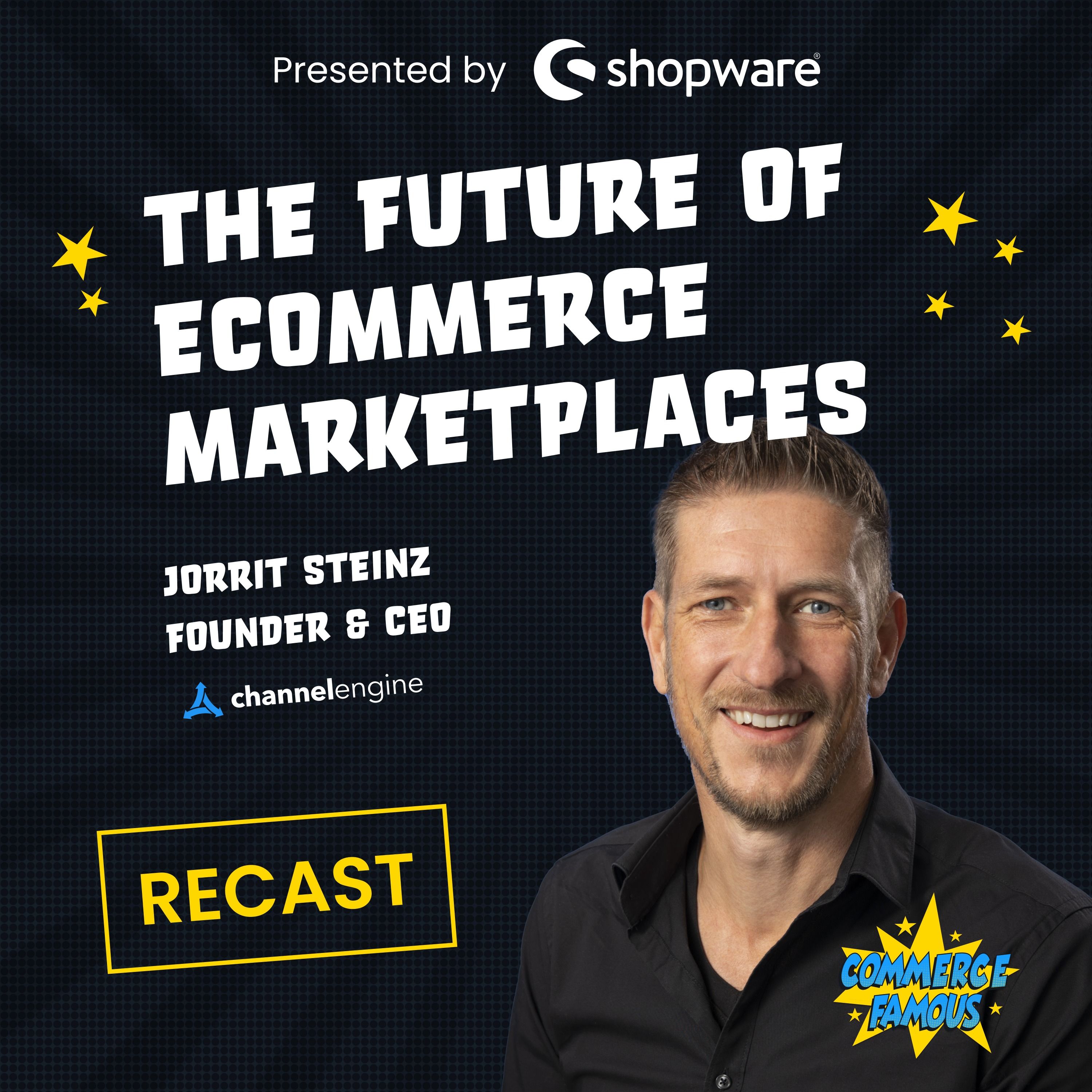
Recast | Jorrit Steinz | The future of ecommerce marketplaces
Worum es geht
In dieser Recast-Folge, ursprünglich aus September 2023, trifft Ben einen der führenden Marktplatz-Experten: Jorrit Steinz, Gründer und CEO von ChannelEngine und Serienunternehmer. In einem temporeichen Gespräch führt Jorrit durch seine Karriere und die sich ständig wandelnde E-Commerce-Landschaft. Ein rasanter Einblick in Marktplätze und die Zukunft des Online-Handels.
Autor: Commerce Famous Podcast
Zu Gast
Jorrit Steinz ist Gründer und CEO von ChannelEngine sowie Serienunternehmer und gilt als einer der führenden Marketplace-Experten. Er begeistert sich für die Entwicklung und das Wachstum neuer Geschäftschancen.
Folge teilen
Transkript
Welcome to Commerce Famous, the biweekly podcast all about ecommerce and retail. In each episode, your host, Ben Marks, cuts through the clutter and takes you straight to the stories and experiences of those who shaped digital commerce as we know it today. While their names and faces might not be recognized on the street, each of Ben's guests are famous for commerce or commerce famous. Without further ado, your host, Ben Marks. Welcome to episode seven of Commerce Famous podcast.
I'm your host, Ben Marks. And here with me today is Jorg Stein, CEO and founder of Channel Engine dot com. He's also done a lot of things in this space, during the whole time that ecommerce has been around. So we're gonna take it all the way back, all the way back to some of the earliest days, 2005. So, Yore, why don't you tell me a little bit about your experience with all of these brands that were, aggregated under as bcommerce?
Yeah. Sure. Thanks for having me, Ben. Yes. I've been around for a long time in the e commerce space.
I think the first e commerce site set up was back in 2003, building e commerce solutions for all kinds of companies. And then as a sort of a side business started as b commerce with one shop with one of my customers. Had some dinner and beers and that's where the best ideas come from. So in the end, we ended up with more than 75 e commerce stores running on one big back end, different brands. And that was in a period of time that it wasn't very easy to optimize for the search engines because Google wasn't populated with all these Google AdWords on top.
There was no Google Shopping. So all we had to do is register a very cool domain name, make sure we have relevant products, and do link building on there. And then we also recognized that we didn't have a big brand. So we started doing all kinds of white label shops for well known platforms for our social media network in The Netherlands before Facebook came in and ruined it all. E commerce store for a TNT post.
It's a gift store with television commercials and stuff like that. And we had to build everything from from scratch because back then there was no good solution available. So I think there was always commerce around. So we built everything from ecommerce solutions on the front end to warehouse management, automatic purchasing system, etcetera, etcetera. And then we'd only start our own marketplace, and then we started selling on marketplaces.
And that's a little bit of the bridge towards to what I'm doing now. So helping others connect to marketplaces. Yes. So you you I mean, that's just an amazing story already that that you you all solved the problem and immediate and these these are some of my favorite solutions in this space, whether it's, you know, hosting or some other adjacent technology. There's a problem to be solved.
Like, we don't really have a suitable platform to work with. Okay. We'll build our own. Oh, we don't have a WMS. We'll build our own.
And then as word gets out, people say, well, hey. They've already they've already built this infrastructure. Let's let's just jump on what they have. And so that that was kind of I guess, that was the path to the 75 b to c web shops that ended up underneath that banner. And and you that kept going, until 2015.
Now do you happen to remember what was your what was the stack like or the the various stacks? Was it was it, dot net based? Was it PHP? What was dot net based? What we did back then, it was all one big solution on one database, with lots of ecommerce sites.
So nowadays, you would have all the solutions we had back then, inventory forecasting, sales forecasting, purchasing, all in different SaaS solutions that you connect. Back then there was no option. So we had to build everything ourselves, which is a good learning as well. So but we work continuously in a sort of a beta version, continuously deploying and testing and stuff like that. Hey.
Google Google approved that mode work. You know, beta mode works really, really well. I think Gmail was in beta for I don't know how many years. But, you know, for the for the for the young ones listening in, you know, you might it might sound strange that that all of this would be part of a of a of a super monolith, but you have to realize in 2005, like, cloud computing wasn't a thing. So there there was there were there were no commodity deployments.
I mean, if you wanted to put something in what would eventually be known as kind of the the cloud, which is just, you know, some functional endpoint somewhere in someone's data center. Yeah. So it was real real physical boxes in the data center. I remember the very early days when we had a big outage at our hosting provider, and then we wanted to move to a new hosting provider, new data center anyway. So it was out for a long time.
We drove there, got the servers on our back seat, on the highway. And then a customer calls, like, why is your side down? And say, yeah, the servers in the back in the back seat. We're moving data center. Commerce famous is proudly presented by Shopware, the leading open source e commerce platform for mid market and lower enterprise merchants.
More than 50,000 clients already process over $25,000,000,000 in annual GMV through Shopware. Find out more about Shopware and the best value in ecommerce at shopware.com. How do you how do you fix like center. It's like, yeah. It's it's a benefit from a disaster.
But then afterwards, we were we were up and up and running again. This I had I had Rick I had Rick Watson on not too long ago, another great personality in the space, and he he actually had a similar story about, you know, it was time to upgrade or they they needed they basically had to take the server physically from the corner of the office and drive it over to a data center. Amazing to think about all of that value and information just just riding along, strapped in, hopefully, into a back seat. Yeah. Like our VP product in Texas, never waste a good crisis.
So if it's done anyway, just just let's do it. That's and and always a lesson to be learned. And and like you said, this was this was just tremendous this was hands on experience figuring out probably a lot of what didn't work, things that would work, and preparing you then for, you know, for this this journey into, you know, what would become the future of of of commerce deployments with, you know, with cloud being a thing and with the need to connect stores to multiple marketplaces because, of course, stores have to go where the customers are. And over time, I don't I'm not as familiar. I think this was a lot, this was mostly in and around the Dutch market.
Is that correct? Yeah. It was a bit early in the market back then because our ecommerce stores were in the the VanLuxe market. Yeah. By that time, we had 30,000 different SKUs with all kinds of products ranging from telecom accessories to home and living products to barbecues, etcetera.
And then we started selling on Amazon and eBay and Bovlitzcom in The Netherlands. And then as a company, what I saw, our teams were building all these custom integrations with the marketplaces. And biggest challenge then is that the commercial teams don't have any option to do filtering. So we didn't want to sell everything everywhere. We had 30,000 SKUs.
Some brands we're not allowed to sell. Some weren't profitable. Some barbecues, selling them to Belgium will yield a lot of returns because they have different fittings for gas connectors. If you send bedding to Germany, you will get all of them returned because in The Netherlands, it's open on the other side. So the thing is broken.
So you need to have that commercial layer that was missing in a marketplace. So instead of, just building everything custom made, we decided to build a SaaS solution. So in that period of time, I sold my previous company to really focus on channel engine, to build a platform that's super scalable. And then I already knew that a lot of companies have their back end systems, ERP systems, warehouse management, they're not going to replace that. You need that flexible layer to connect to basically anything because everything is moving towards, interconnected, sales, whether it's a marketplace, social media becoming a marketplace, whether it's your shop as one of the channels and you want to synchronize everything.
So I was, the idea was relatively simple. Just build one connection to many and then build a layer in between. And, naturally, it takes a lot of time to redeem build a mature solution out of it. So that's what we did over the over the last couple of years, Back then, a bit early in the market. So first, the deal was ten years ago.
So spoke to brands. Yeah. Yeah. Challenge. And I mean, this is this is 2014.
Right? So this really was prescient to see, hey. This is this is probably the direction this is going. You know, these stores, they have their they have all their their data online. They have their operations probably more and more, connected into the cloud as opposed to, like, running on, you know, running off AS four hundreds in a warehouse somewhere.
Not to say that there aren't still We actually have customers on AS 400. We connect that to the new world. Yeah. This has been a recurring theme on this podcast as as I've lot lots of people have talked about. Yes.
They're still AS four hundreds because they're bulletproof and they're just they they they just don't go down. And they just sit there, and they just have a nice little, API, and and connect in. So, you know, but you all were at the forefront of this. And then at the same time, I'm actually gonna step step over to the side a little bit because you have also, was it TriTek? Is that that's how it's pronounced?
Yeah. TriTech. So Yeah. And and and from what I can tell, it looks like so this is this is solving, you know, b to b, b to c, brand to consumer needs for some some really substantial brands. And, if I saw it correctly, you know, it's it's sort of it's it's going into the the land of PIM now.
Right? Is that is that a Correct. Fair way to characterize it? What what what is that what is that journey like? Yeah.
Basically, what what I started doing was, at the very early beginning, we were, launching a concept called website lease. Fixed monthly fee for a website or a webshop. Well, you know, I'll call it SaaS. And that was the early journey. So we started building commerce solutions for smaller companies, bigger companies, then started building warehouse management systems, or connections to warehouse management systems, and that started growing.
Later on when we were running our own e commerce operations, we needed more and more functionalities. So we launched Channel Engine as a platform. We were missing BIM capabilities, so we built out BIM capabilities. And instead of building all these custom ecommerce solutions, we started transitioning into what is the most scalable need in the market. And that's building BIM, that's building a marketplace integration layer, and and really building it out from there.
Also with all the learnings from the past, because we did all kinds of custom solutions, and custom solutions are not very scalable. So we went into how do you do this at scale worldwide, from the get go, multi language, multi currency, making sure the world can be connected. Because in my opinion, borders shouldn't exist. You should be able to transact and work anywhere in the world, and that's what we see our customers doing at the moment. So instead of having all these different boundaries, before you start selling somewhere else, you need technology to solve that or partners that can solve that because they already did it.
Back then when we started, we had to build our own warehouse. We had to reinvent everything ourselves. Now you can just plug in a three p l somewhere or use Fulfilled by Amazon or Fulfilled by Zalando instead of us. Just connect it and start selling. So it's much easier to scale at an international level.
And I see, you know, and I see some of the other some of the the many, many things that you are you're working on. I mean, they've I've I've met at least one person who I could have called mister marketplace, but I think you're you're really you're taking that to a whole new level. But I it was really interesting what you said about, you know, borders shouldn't exist. And, I mean, I we can see that as as, you know, impediments to checkout. We can see that as, you know, commerce cross border commerce.
But I also see you working on, solutions like you're you're, an investor and advisor at at, Tapper. Right? So using, QR and NFC tech to, you know, really my my takeaway from the description is is is to remove, you know, yet again, another impediment. Just make make the the buying journey, make the interactive journey more seamless. Is that a is that a fair way to characterize that?
Yeah. It's definitely. So in very near future is going to be an obligation to have product passport. So you can trace the whole product journey. But one of the biggest opportunities is for brands that sell direct to consumers.
It's like we've got the customer data. We can remarket them, get them in our flow, our marketing flow, then you start selling on marketplace. It's what you do then. Like, you get some data, you get the address information, but it's hard to remarket them. So what you can do is with the NSE tag or QR code, get them back into their funnel, in your funnel, see their whole customer journey, and then drive traffic again to that specific marketplace where they bought to do more sales.
And that sounds counterintuitive, but if you drive traffic to that marketplace itself, you can boost your sales velocity. So you start selling more and more. And the higher you boost your sales velocity, the easier your products will be found on those marketplaces and generate more organic traffic. So it all ties into each other. But it's really to to get that whole customer journey.
So in my opinion, if you're selling, whether you're a retailer or brands, you need to be there where the consumer is and then Yep. Make sure you can reengage with them through any channel possible. Now I'm I'm curious because, you know, for for many years, especially when I was traveling a lot around Asia, interacting with developers and stuff, you know, blockchain when it came out was just the it sucked a lot of the oxygen out of the room, I think, in terms of where where where where people were ending up and the kind of work they were doing and where they were innovating. Is this is this a use case? Is blockchain figure into, to Tapper at all?
There are some use cases there. It's too early. So we, tested out things with the blockchain. A lot of for a lot of brands is one step too far, but the traceability of blockchain for product passports definitely one of the super important use cases. And it's something you will see more and more in e commerce.
Now nobody talks about, cryptos or at least way less than they did a couple of years ago when it went up because everybody felt like they were a genius because they were making money. And I was like, my portfolio is underwater. Mine too. But time time to buy. But the the underlying technology is super interesting.
So instead of having one centralized database, keeping track of all the logistics around the globe, is, is an interesting development. Yeah. It was just, there was an, on National Public Radio, there was just a a feature on it involved Beanie Babies and, you know, just talking but but talking about it from, I think, a modern perspective in terms of stores of value, and it does make sense when something comes out and people believe it is a store of value. Yeah. The the the exponentiality of the the hype around that.
You know, it's it's it is good that it's come back to Earth, and maybe we can find some some good uses for this, for this space. But wanna jump back into the the marketplace discussion because I think a lot of what we're talking about here could be it could be seen as a little bit like infrastructure. And I've seen this emerging, more and more. So I've had a pleasure of meeting, Chris Bach from from Netlify and, the Mach Alliance and, you know, chatting with him, chatting with with Kelly from Mach Alliance and, and Commerce Tools, you know, really looking at the emergence of of how much infrastructure is now a part of it, a part of a of a of a solution a solutions value. I mean, of course, SaaS was, I think, the original approach for providing, for bundling infrastructure in with a feature set.
But as we start to as we start to tease out and separate systems, but put them, you know, bundle them together, the orchestration is the only thing holding us back. Right? So you look at you look at, for example, microservices philosophically, what a, you know, what a fantastic approach to have everything nicely siloed, but with with full capability to, be composed and interact with with, you know, however it needs to interact with other features. But that comes at a tremendous cost of overhead with orchestration. And so I see any solution like channel engine that is, that that offers a really, you know, a seamless, you know, almost one stop integration.
Like, you you all have you all have created the connection and, you know, really reduced any kind of impediment for someone to have, you know, not just product data, but, you know, the the channel engine. It integrates your, warehouse information and everything else into the solution and it's updating updating prices, and and keeping that consistent look look and feel. So no matter where a consumer and let me know if if I'm if I'm pitching Oh, you're doing well. Channel engine correctly here. So when a when a, you know, when a consumer wherever a consumer encounters a brand or the brand's products, whatever channel they're in, social media, on a on a marketplace, they're going to get the same information.
They're gonna see they're gonna have a very consistent, product, presentation. And and I would I would think that as brands, especially larger brands, figure out more and more that they have they have got to provide their their product, their catalog, and services in all these different places, they're gonna pull their hair out without a solution that seamlessly unifies it. That that has to be was that always the vision with what you saw for channel engine, or is that something that has evolved over time? It has evolved over time. The vision was there to help brands do that because I saw everything shifting towards marketplaces a bit early.
So a lot of brands saw marketplace as something that their resellers were doing. A lot of retailers saw marketplaces competition. But at the moment, it's inevitable. All brands need to embrace marketplace and not even just for revenue, but they need to be in control of the content. So like you said, it's not just the infrastructure connecting an API or your back end system or your PIM system to any of the channels.
You need that orchestration layer that is super focused on doing this at scale. So there's always a big difference between your data source and what a marketplace needs or what a social media needs or what a workshop needs. And the transformation of data, you can do very focused in channel engine at scale. So if you don't have that, it's going to be very hard to manage all your content everywhere to make sure all your stock levels are synchronized, etcetera, etcetera. So that's that's why we built this platform.
But it's not just for marketplaces. Anything you want to put as an endpoint to the API, you can use. Yeah. So even we've got customers using it to feed their apps or to connect to their in store, portals or stuff like that. As long as it's product content, orders, pricing, shipments, so basically everything ecommerce, and you can manage through a single solution.
And one of the critical points if you do ecommerce at scale, you wanna reuse different logistics locations. So if you have 10 items, stop stop and you can sell it on four different platforms. As As soon as you sell the one, you want to take it off the others. Otherwise, you do double sales. Other stuff, if you wanna sell something on a marketplace, I don't know, the disc cup, way too cheap if you sell one.
If you sell a six pack and a bunch of plates, makes sense. So create virtual bundles. So that's that's stuff channel engine does at scale. And then you can leverage a large network of third party logistics providers because if you're a brand or a retailer and you want to sell in a new region and you don't have logistics, how easy is if you can just plug in a three p l, just ship a container like you're used to, and then have them ship to the end consumers. A lot of these bits bits and pieces to to build it for them.
Commerce famous is proudly presented by Shopware, the leading open source e commerce platform for mid market and lower enterprise merchants. More than 50,000 clients already process over $25,000,000,000 in annual GMV through Shopware. Find out more about Shopware and the best value in ecommerce at shopware.com. Wow. So half of the things you mentioned were not they they they sound, of course.
Yep. That's what I say to myself. Of course. When I hear you say them, but thinking about, oh, wow. Yeah.
Different marketplace, it would make more sense to bundle things, you know, get your average order value up, get your, you know, sort of your your Per power. Logistics cost for We've got we've got fast moving consumer goods companies, selling coffee cups and dishwashing powder and stuff like that. That's not profitable if you sell it one by one. So if you create new bundles, new virtual bundles, that's like one ASIN or AM code on a on a platform, then it makes sense. And we keep track of all the underlying stock.
And because we launched this, there's all kinds of solutions. We've got beer manufacturers having six different kinds of special beers in one package, selling it as a gift, barbecues and covers, plants and pots, and stuff like that. So super fun stuff coming up. And we just launched, generative AI, of course, to generate titles and descriptions to make it easier to launch more and more of these bundles. Super effective to increase the the top line as well as the bottom line.
Yeah. I mean, I'm I'm really excited for the, you know, Shopware was, who who who is my employer. We were we were, I think, first to market, actually, among all of the ecommerce solutions. We were first to market with something even beyond generative AI where we, released, I think, eight eight AI features back in May that were, even I was a little bit nervous when I heard us talking about AI because, of course, again, this was a moment of hype for everything. But you dig into the features, and it was really just just just practical pragmatic.
This is AI iterative approach to, supercharging what the merchandisers, the store ops folks can do. Basically helping their job, helping them do their job Faster and easier. Yeah. With AI and and and at a practical level. And I think I think back to the orchestration point, orchestration, integration, infrastructure, AI will, I I see a lot of investment and a lot of a lot of stories being told in this space.
So I think we are going to see, just just a little bit you know, it it we won't even feel it doing its thing. It's just all of a sudden somehow a these these endpoints are gonna they're gonna work a little bit more smoothly, and the the orchestration of services, is just going to happen naturally because someone was able to say, oh, hey. We need we need this. Or I, you know, I I could see, sometime in the near future, we're saying, okay. We're gonna have a flash sale.
We need to, you know, we need to up level our our service so that we can we can deliver without falling over. And you very well may have, you literally just naturally communicate this into a system, and the system handles the rest. So that I'm I'm I'm really excited about, but it's it's interesting, you know, something you you just said about, it not just marketplaces. It's really, you know, it's it's it's really endpoints. And so there, I'm starting to see, wait, you know, this isn't you this isn't like, you know, like a a miracle or or some other market placing solution.
This really is an integration environment. And I think that that, you know, with the rise, we're see we're seeing a rise in interest in integration environments, and we're having some great conversations with these iPaaS providers. But it sounds like you all just naturally built your product in that direction. Has that been a little more recent, or was that just kind of always there? It's always there because we use it ourselves as well to just pop in new data feeds or make sure you have a custom channel because there's always a a customer that wants to connect something.
It's like we've got the product information, we've got the orders, we've got the stock levels, pricing, so why not just connect anything? And the fun thing is our network has grown also because marketplace that are smaller that didn't fit on our roadmap, they connected to us. So we are growing a massive network at the moment because they can benefit from it as well. Lots of great sellers on our platform, so if a new marketplace connects, they get more sellers that are already used to selling on marketplaces at scale. And there there's a big distinct distinction.
We also work together with iPaaS solutions to connect the back end system. The layer in between, what we have is super focused on ecommerce, profitability, pricing, competition, content. So it's completely focused on doing ecommerce at scale. Doesn't matter what kind of channel it is. And a channel can be a marketplace, channel can be your own DTC sites, we've got social commerce connected.
Basically, anything that can be transactional and everything will be transactional can be connected. And I have been speaking about social commerce for a very long time, and I find it gets some traction, especially in Southeast Asia, but also a lot of retailers. A lot of brands I spoke to many years ago said, no. Just sell b to b orders to a retailer. What we've seen happening over the years, especially last year, these retailers are buying less because money is expensive, so they don't want to run that risk on their inventory.
So they're all launching marketplaces, many of them on miracles, some on marketplace, etcetera. And they're pushing their brands to sell on their marketplace. So now the brands have to do it, but it's a massive opportunity for some retailers as well because if you have very niche or great products, just push them on other people's marketplace. We actually have marketplaces using our solution to sell their own white label products on other marketplaces. It's insane.
Everything is becoming connected in in ecommerce. The money is always you know, there's always money to be made, you know, on on two sides of of bundling bundling or unbundling. Right? Yeah. And this sounds like we are in a we are at a period where, it just becomes because of, I guess, the direction and because of the technology, it just becomes easier.
If you can figure out a few key things about your operations, you can just push on to other people's infrastructure and just do what you need to do and say the top and back what you were saying earlier about making sure that everything is optimized. Optimization necessarily means better sales, better sales. It's this virtuous feedback loop. You'll perform better. Your products will probably be placed higher within each of these marketplace environments, you know, and you get more sales and and so forth and and so on.
Maybe maybe one thing is super interesting. If you look at brands and retailers, it's not about just doing more sales. It's more about regaining control. So if you look at brands like regaining control of the content on all different marketplaces, who is selling it as well? Are your resellers selling it?
But also determining whether your new product launch is available. So you have a new product launch, typically you rely on a vendor manager buying it from you. If they don't buy everything, you don't have your full collection life. So if you're not on the marketplace and able to ship it yourself, then you don't have that control to determine what is available, what pricing are set, etcetera. And then you can leverage the infrastructure of the marketplaces, for instance, Fulfilled by Amazon or Solana fulfillment service in combination with your own logistics.
And if you nail that, then you're in full control because sometimes you will have ports too much yourself and then you have Overstock. And maybe you want to dump that on a specific marketplace in a different country to not hurt your own retail channel locally. Or maybe you just want to launch in a new market where nobody knows you and you want to position your products in between other brands. So there's so many opportunities once you have this infrastructure and this orchestration layer in play to determine what to sell where, how to make it profitable, but also adjust if you get less purchase orders from a specific reseller, etcetera, etcetera. So massive opportunities.
So interesting. I guess that's putting, you know, so maybe the way it was before or as brands first dip their toes in the waters of of marketplace, you know, they're they're really just having to take educated guess. Basically, they're they're not as close they're not as close to the transaction. They're not as close to not as close to the customer. And so they're having to take best guests and and and deal what they deal with.
And then and then, you know, deal with the reporting out so that they are they are a little bit disconnected. So you're you're you're both putting them closer, and then you're also, sort of normalizing, the the, you know, the international markets, right, it wouldn't it wouldn't occur to me like, oh, yeah. Well, well, we something's happened, and we have all of this stuff sitting here in Benelux. But this is a whole new category that that's not there in South America, Central South America. So we can let's let's throw it in the container.
Let's let's launch here. And the cost of that launch is literally is basically nothing because we're already plugged in with this vendor that's made the world accessible to us. That that's incredibly powerful. I mean, how do you how do you is there is there a lot of education that goes on for your for your customers that where you where you show them you show them the way? Because it sounds to me like you guys are leading, you know, you're at the forefront of all of this.
Yeah. There's a lot of education also internally. So new people coming in, the amount of opportunities is massive. So helping them make the right decisions is is paramount because you can spend a lot of time on one marketplace. For instance, a lot of companies starting the marketplace journey always start on Amazon because most consumers are on Amazon.
The thing is, to be found with your own products on Amazon, you have to compete against 600,000,000 products. So sometimes it makes sense to just sell on, I don't know, on bolt.com in The Netherlands or start selling on Macy's or on Zalando depending on your products vertical because it's easier to rank there and have really good results, and then start on Amazon. And if you go on Amazon, just create a subset of your products where you can really win instead of just dumping everything on it and then hoping for the best. So do it strategically, and that's what I've seen happening in the last two years Instead of everybody just using this as just testing it out as a beta, it's like, holy shit, our business is gonna change massively. We need to nail this.
So all of a sudden, everybody's involved, and then some companies need to restructure their internal teams as well. As I see internal competition between somebody incentivized on b to b orders and then direct to consumer and marketplace come in and they start colliding internally. So there's a lot of changes, and that's where we we help some customers as well. How do you structure that? How do you do this at scale well?
I I mean, for, you know, for an individual brand to do this, even even an enterprise sort of brand, that would be I mean, that would just it's it's a whole different skill set. It is, it's an almost impossible amount to learn. And and really, you know, whereas there is something like channel engine that exists, I think it would be hard to justify that. I mean, if you have to explain to a board why you spent, you know, a billion dollars figuring out how to, you know, homogenize the experience for, you know, across the lands, and they're like, well, yeah, but you could have spent this much over here, and it would have been done for you. And by the way, it would then be continuously improved because that's their business.
You'll be amazed how many large companies still do Excel manual updates. While midsize we see some awesome midsize companies, that are just connecting it. We've got one customer doing massive amount on over 50 marketplaces with two people managing all these marketplaces. Yeah. It's insane.
So but they are executing extremely well. Yeah. We see well, and and we see for for, you know, our our customer profile, we really find a lot of value and benefit, and fit with with the mid market. So, you know, as you're dealing with the, you know, fifty to a hundred hundred hundreds of millions of dollars worth of revenue, in large part because it seems like in that in that stage, even if the even if that's a company that is growing its way to, you know, billion plus revenue, you you have a lot of you have a lot of bright people who are really focused on, you know, executing incrementally better and better, more efficiently. And so they're gonna find the right tools.
They're gonna they're gonna find the right practices, and, and they need to be able to iterate quickly. And I'm gonna guess that that's another advantage of a, of a of a channel advisor is you you can test out these ideas. You can test out new marketplaces and new, new geographies without a significant investment. Right? You're not you're not having to invent all of this stuff from scratch.
So So you could say, hey. We think this will do well. Okay. Let's have the experiment. Okay.
That didn't do well. What did we learn? Can we increment and and win there, or do we just now have a good lesson and a better understanding of our product market fit that we can take, those learnings elsewhere. And and and sometimes it's also good to realize it's not an isolated thing you do. So we've got customers that launch in new retail stores in a new country where they're not known yet.
And what I started doing is loading their products on, in this case, Zalando, in between very well known brands. And you saw the halo effect of people ordering online in the stores. So that way you can just really load your brand, utilizing the traffic and the amount of interest on these marketplaces. So don't look at your p and l just purely from that specific one time sale, but look at the whole region where you start selling. And like you said, there are different teams sometimes.
We've got customers with a couple of million per year in ecommerce sales to billions, and there's a huge range in between. And sometimes the 10,000,000 company is doing way better than a couple of billion company because they have to restructure everything internally, everything goes slow. But sometimes you've got a few couple of billion companies that have a tiny, very innovative team, and they're executing extremely well. So I think that's my biggest advice for bigger companies. Isolate your team, make sure the goals are aligned, and give them freedom to execute on this on a global level.
Not regional. Otherwise, you have to do a lot of politics to get this stuff going. Create one superstar team. It doesn't have to be super big, and then let them do this. Okay.
Well, that that sounds dangerously like, you know, advice for success and a prediction in the, for the future. So what do you see, what do you see in the come coming down the pipe? I mean, is it just going to be more and more marketplaces, creeping in everywhere? Is it gonna be something else? I think this is gonna be a marketized war.
Everybody wants to get the transaction. So there is gonna be more and more marketplace. There will be a lot of marketplace not succeeding. So I see them as well, that don't get the traffic. So I think the bigger players that do this super well, and invest on it, whether it's a retailer that became become a marketplace or brands or retailers that leverage marketplaces, make sure you have a superstar team.
It doesn't have to be super big, but they need to be trained. They need to have some, autonomy to do this well. And try to avoid internal competition, if you wanna avoid all the politics of somebody working against them because it hurts their personal bonus. So make sure the goals are aligned. Otherwise, you're going to lose out because consumers are searching on all these different platforms.
You need to be there. And it's not super easy to do because it's not just Amazon. If you go into Southeast Asia, you need shopping in Lazada, and you need to be there. Southeast Asia has a lot with vouchers and discounts and stuff like that. US has different marketplaces.
Latin America, different marketplaces. Europe, massively, in different marketplaces, different languages, but you can leverage the same logistics flows, the same customer service flows, etcetera. So small, super smart teams, good technology, you can do a lot. Yeah. So so, basically, so my takeaway is is yeah.
Yeah. Stay stay nimble, empower the right people. Yep. And, if I can take it maybe one step further, maybe maybe pick a solution that allows you, you know, rather than putting all of your eggs in, you know, one marketplace basket, why don't you pick a solution that lets you treat these different marketplaces almost as a as a commodity to your own success? Absolutely.
Well, you're I think I think this was a this was a this is a great conversation. I've learned a whole lot about the the marketplace perspective and, you know, and so just the advantage of relying on, the people who who've helped maybe invent some of this category and, who are continuing to to innovate in this space. So, really, thank you so much for your time, and just congratulations on what has obviously been a a career filled with, tons of interesting work and some really good successes, and I'm really looking forward to, to seeing what, what you all are doing in the future. Thanks a lot. And we're just getting started building this network and stuff.
I can say that. It was a pleasure, Ben. Really enjoyed this conversation. And, folks, you know, I will say this. If you don't know already, when a Dutch person says something, they mean it.
There is no more direct culture on the planet. So, take take everything at its word. Yore, it was great having you on, and I look forward to catching up with you sometime in the near future. Thanks a lot, Ben.

Veröffentlicht mit CiteCast