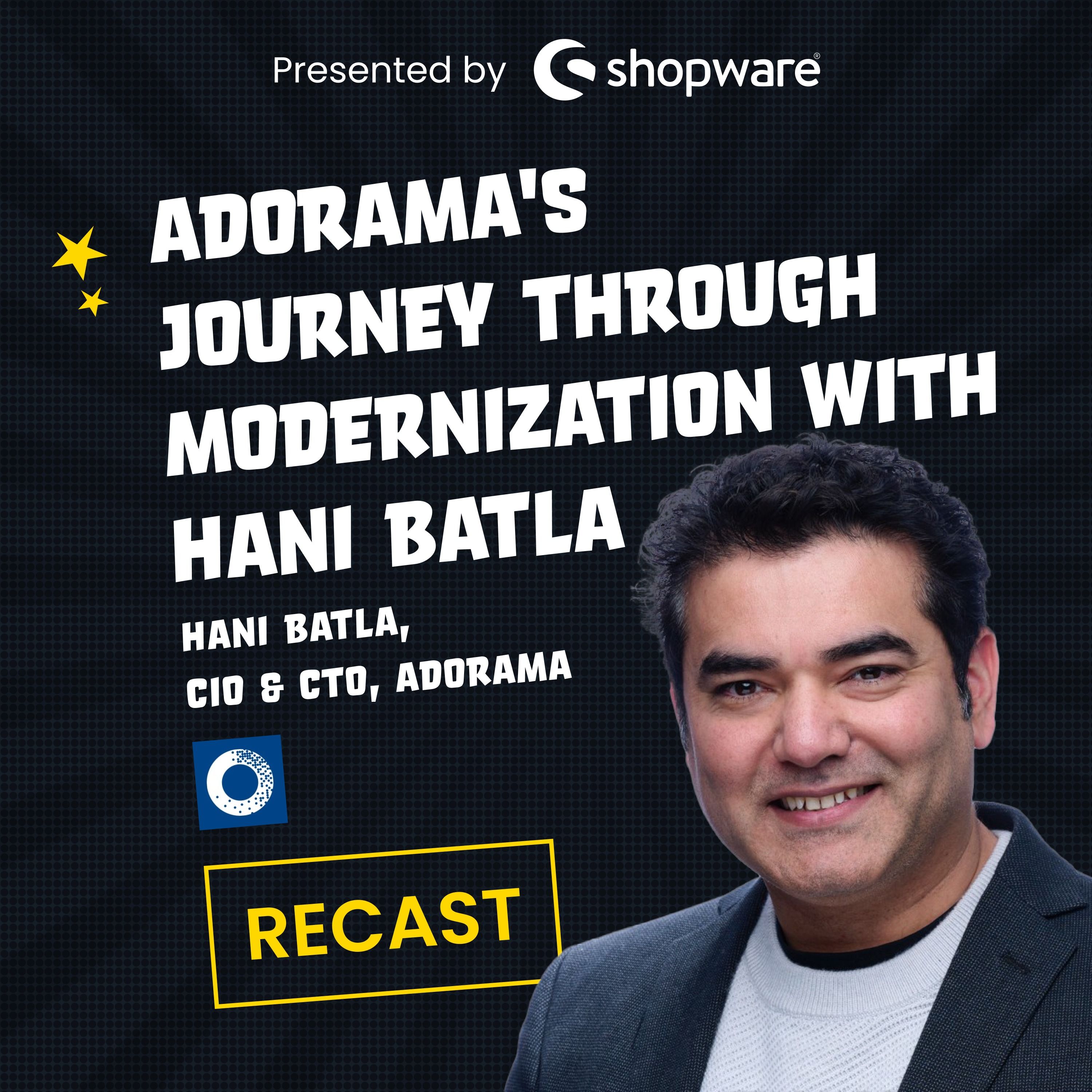
Recast | Hani Batla | Adorama's journey through modernization
Worum es geht
In dieser Wiederveröffentlichung von Commerce Famous spricht Ben Marks mit Hani Batla, dem CIO & CTO von Adorama, dem bekannten Einzelhändler aus New York City. Hani berichtet über seinen Weg von Medienkonzernen wie Verizon, Comcast, Ericsson und HBO hin zum Handel und darüber, warum er zu einem Retailer wechselte. Im Mittelpunkt steht die Frage, wie er die Modernisierung eines Unternehmens vorantreibt, das bereits seit Ende der 90er online verkauft.
Autor: Commerce Famous Podcast
Zu Gast
Hani Batla ist CIO und CTO des New Yorker Händlers Adorama. Seine Karriere führte ihn zuvor zu Unternehmen wie Verizon, Comcast, Ericsson und HBO.
Folge teilen
Transkript
Hey, everyone. Ben Marks here. As we prepare to launch season two of Commerce Famous, we're revisiting a couple of our favorite episodes from season one. Back in episode five, we featured our first merchant guest on the show, Adorama CTO, Hani Bhatla. We dove deep into how Adorama evolved from a neighborhood retail store into a cutting edge ecommerce giant.
Hani shared insights from his career on many topics, such as the importance of customer experience, leveraging AI for product discovery, and building a strong community. Tune in to hear how Hani and Adorama are constantly innovating to meet customer needs and stay ahead in their very competitive landscape. Enjoy. New episodes launch in June. Welcome to Commerce Famous, the biweekly podcast all about ecommerce and retail.
In each episode, your host, Ben Marks, cuts through the clutter and takes you straight to the stories and experiences of those who shaped digital commerce as we know it today. While their names and faces might not be recognized on the street, each of Ben's guests are famous for commerce or commerce famous. Without further ado, your host, Ben Marks. Welcome to Commerce Famous podcast. I'm your host, Ben Marks.
I'm here today with Hany Batla of Adorama. Hany comes to us after a long career in multimedia and deep tech. His background has really taken him through, through the intersection of of media, retail, and then some of the infrastructure that actually pulls this all together. So this is gonna be really interesting discussion today. So, Hani, tell us about your origins starting back in o two at Moxie.
Oh, well, you're gonna make me go way back. I I I figured it'd be fine. Well, I'll give you the short version. I used to be in finance, and that's the part most people don't realize. I graduated the finance degree from Stern.
Yep. And I did a bunch of finance jobs, and I ended up at a hedge fund. And then after I paid off my debts, let's call it that, I decided I wanna do something creative and create value. I always had a passion for telling stories, sharing experiences with folks. And so when I started on Moxie, it was more really about just doing that.
And I lucked out and I found companies I did commercials for and documentaries and training videos. So it really was that. It was that desire to tell stories that got into it. And I used to do filmmaking and photography a bit on the side myself back then even. Wow.
So so you went you went to Stern School, and then you just decided, hey. My passion is over here, and this is where I wanna work. So you you completely opted into this into this space. Yeah. Well, finance does that too, man.
What can I say? Yeah. My my dad my dad's a banker. I'm I'm familiar. Alright.
So let me if we go through if we go through your history. So so, you know, you started you had this you had this venture, in the in the early two thousands. You quickly moved on. I've moved on, moved up. I mean, you you ended up you ended up basically working in the in the world of Disney World and Universal Studios.
So this was o o four to o '7. But you were, you know, you were you were working in, IT point of sale so that the the whole retail experience at a time when this industry was really just beginning to figure out what it meant to have sort of the classical POS, but with that online sensibility. What was that experience like? Well, going to Orlando, Florida was not high on my list of place I wanted to, but I followed it for love, which not the woman I ended up with. Let's put it that way.
But it was interesting because I ended up in a very nice company that was a specialty retailer, and it wasn't just the point of sale. It was everything. Warehouse management, order management, taking a company that literally operated on pen and paper and taking them to that next level with rolling out a point of sale system and a warehouse management system. So it's interesting because back then, even then, we were just starting to talk about how do you take all this data, how do you make smarter decisions whether it comes to buying or understanding our customers' patterns for purchasing, anticipating demand? And then more importantly, how do you lay the groundwork for making all of that available on the web?
So that was actually the the the the founders of that company actually were visionary enough to go, hey. You know what? We have a great product. We have 15 physical stores all around Disney World. We're we're the dominant player in the space, and now we want to see what else we can do with it.
So it was a it was a very interesting and an educational experience. It leveraged my tech background, which was something I picked up since I was 10 years old. So Yeah. It was an easy fit. It was a it was a good job and paid well, and it got me to where I needed to be at that time.
And so that's how it was. But it was an interesting time period. Yeah. And to give you know so, I mean, this was this was Oceanair Enterprises. And and to give people some perspective here, I mean, this was this was 5,000,000 plus customers, you know, across all these locations, and that that's per year.
So so this is this is this is volume. This is intersection of retail and online at the very beginning. And and I've it's interesting to hear you say that you had this you just always had this affinity for for tech. I think that's, you know, that's certainly part of the the Shopware story with both brothers being being tech interested from the beginning. And from there, you you you jump up again.
You spent time at Verizon working on Fives TV projects. I mean, you spent time hitting, like, some of the biggest media companies in the world, Verizon, Comcast, HBO, you know, looking at basically, managing these these massive projects, you must have you must have you must have made an impression, and you must have learned some amazing lessons along the way. Yeah. So I'll tell you how I ended up at Verizon. This goes back to my finance days.
I used to be the guy whose specialty was understanding things like dark fiber and optical switches and early days mobile technologies like TDMA and all that stuff. People won't even know what those things are. But the point is, I was self taught on all those tech things. And by the time I ended up moving to New Jersey to Basking Ridge, that's it was for love because I had married a woman of my dreams. And that's when I took Verizon.
And the first question they asked me, do you know what Fios is? And I'm like, do I? I've only been following all your tech and everything you've been doing for two years. So that was a fascinating project because that was one of Verizon's big bets back in the day, $24,000,000,000 or something they had bet on the future of Wow. What what how they would build out a optical fiber network across America to provide TV and Internet and and so there was a fascinating time.
The the things again, I I wanna tie it back to the the larger thread of my life is it was something I was passionate about. I love TV. I was on the Internet from the early days in the early nineties. Right? And I still remember when you didn't have a graphical browser to access the Internet and you it was all text based Archie and Gopher and all that sort of stuff.
So I'm dating myself here. And then the story here is being part of that, my mission then was to really build something that it would have would be lasting and would I know this is gonna be a cliche, help change make the world a better place. And so back then, my joke with my wife used to be, I'm building these networks, whether it's Verizon or Comcast, whoever, was was that one day, there'll come a time when everybody will need these things, whether kids who are going to school or college or people need to work from home. And it was an alien concept back then because people are like, what? And and she had she had a she came from a family of doctors.
I'm like, yeah. You're a doctor family. They can save couple of lives here and there, but these networks, this tech will change the world. Thankfully, COVID happened, and I got to tell her, I told you so. So that was fun.
Well, in I mean, kind of and when maybe even ironically like this, we've seen a move movement, especially during COVID, of, you know, telehealth. Right? So so a lot of the work that that you and and the the businesses that that you did the work for, they that that absolutely made that possible before before most most people realize it was happening. Yeah. That's that's incredibly impressive.
So, you know, you you know, some of these projects, we don't have time to go into all of them, but it's really I I I can imagine. I've I've had friends who've worked on, like, on the PHP side of things for companies that do, that that worked on portals for, service providers. And the insights that they had, and also many of them, the lack of hair that they had left, just just shows you how complicated it is. And then as, you know, as media companies then started pushing their content out directly through these service providers, sounds like, you know, you worked on on those kind of projects specifically. And then, you you, you know, 2012, 2015, Verizon Media, you work on Edgecast, the world's fastest CDN, and and it's delivering content globally.
And, again, for for for 25% the world's traffic. Sorry? At one point, it was carrying 25% of the Internet traffic. Right. And and for for people playing along at home here, if you think about it, like, this is I mean, commodity compute computing had had had come along already.
Right? So that really that really came into its own end of the twenty tens. But having delivering content at the edge worldwide, again, I feel like this was a pioneering solution that that that you were you were working on. Is that accurate to say? Yeah.
I was lucky to work with some really, really smart people back then. So, yeah, the idea was, again, simple. This was, again, at that point in in the world where media companies, everybody was trying to figure out how do you cater to customers' growing needs, right, for content? And streaming was just starting out. I mean, we all remember the day when you hit play on a video on the Internet and it would take Buffer.
A long time to work. And then the science started coming out that for every two seconds of delay, you lose 40 you 20% of your audience or something. Right? 20 to 30% of your audience for every two seconds of delay. And so we were trying to solve that.
That was it. Well, and that's really interesting that you bring that up because specifically part of this project, was the the analytics piece. Right? So you all not only not only were you, you know, dealing with, you know, this this nascent stage of of streaming analytics, but you're, like that's also I have to imagine the volume of data that you were having to deal with was, you know, you're looking you're again operating at an edge of the tech space. And you must have had some creative creative solutions and maybe some late nights figuring out some of these problems.
Yeah. I mean, look, this is back in the day when you couldn't just go to AWS or Google Cloud or Azure and say, hey, I just want to pipe my data and run some analytics on it. Right? You had to build the infrastructure yourself. So we basically built our own Spark streaming platforms and Hadoop clusters and really had to get into the guts of it.
So, yes, there's the technical challenges, and then there was a challenge of, well, once we get the data, what do we wanna do with it? And so my job, and I enjoyed that part the most, was really trying to figure out how best to leverage that data to give what we called back then. And now it's such a common term, actionable insights. Everybody's like data, ah, reports. But, no, we were saying, you don't want just data and reports.
We want you to do something with that data. So at that point, also, we were just already starting to think about the next phase of how does that data in real time change experiences for people on their player. So, you know, I I lucked out, and a friend of mine and I ended up even getting a pattern on one of those things where we said real time data can influence players in a certain geographic area, so it optimizes the quality of the stream for everybody. Nowadays, these things would seem almost like Very obvious. We had to figure that stuff out.
But, yeah, back then, we had to think about how these things would work, how people would watch, how would it impact experience, and and how do you make it scalable and global. Right? And so so it was a fun time because it it's like folks who talk about the early days of the PC revolution, but we got to talk about the early days of the global network and how do you make the world even smaller and bring everything together. And today, you know, we we live with it. Everything we do, whether it's now in ecommerce and retail or or media, you know, these fun underlying technologies are basically were were essential building blocks to the world we currently take for granted and no longer even think about.
Yeah. I mean, we are we are rapidly approaching the the moment where kids have been born, you know, the kids born after after the iPhone came out. Right? Like, they for for them, everything has always been available in the palm of your hand, and that has a lot to do with with all of the work that came before in terms of building out these networks. But this this this always on, always accessible, and always kind of immediate.
Everything everything is is is pretty proximal rather than distal. You know, the world is, in fact, very small, and it's it's it's really it's really interesting to hear, hear a little bit about how this happened now. So after some of this work, you you jumped into the IoT security product space with Canary. Mhmm. I'm I'm really curious about that because here we here we kind of make make the cross back from your tech work into, you know, into products that the consumers are buying.
But then if I were if if if I recall correctly, you know, within two months of your arrival there in 2015, you built out a subscription service. Right? And this subscription service was we all know the subscription play, in terms of in terms of increasing, increasing and ensuring the value that you get out of customers that you've acquired. But I think you had some you had some just amazing statistics around churn rate as, you know, again, in a in a fairly nascent corner of the world of of of of industry, this IoT thing, which I think now I don't even know that we talk about IoT anymore because everything we just know everything's connected. Yeah.
Exactly. That and you hit the nail on the head. Right? Back then, IoT was a buzzword. It was like the hottest things.
Like today, it's you know, today we had for a while, it was crypto and all that stuff and Web three. And back in those days, the olden days, IoT was the thing. Like, it was a novel concept for devices to talk to each other and stream data. So that's why I wanted to go from the big companies to finally get my break into a startup, and that was my opportunity to go in. And what was nice about Canary was they built a beautiful product, and it was a Kickstarter funded product.
It had massive community behind it. They it was honestly, it was ahead of Ring back then. And, you know, I look back at that time and be like, hell, we could have beaten the ones that could have beaten Ring to be the dominant connected security platform out there. And we were for a while. We were actually beating them for a bit, but, you know, we made some bad choices and whatever.
But long story short, IoT was fascinating. And back in the day, it was also fairly evident to someone like me who'd come from a big company that subscriptions were the real deal. Right? Hardware, great, one time sale, you know, but it's not a sustainable business. Once you get valuations, you get investments.
You really need to have a recurring revenue model to really keep the business growing. And so subscriptions was an idea that the founders of the firm had. They talked about it, but they really didn't know how to execute it. So my job was to come in and really bring in that, you know, big company sense. Like, how do you monetize your users without offending them?
How do you make them realize value in what they're subscribing to? Because the subscription shouldn't just be, oh, here's stuff you used to get for free. Now you have to pay for it. Right? Yeah.
And so that's kinda how it was when we, I thought, did a really good job of building a platform that, service that was really value add to what the customers had. Yes. We had to make the hard choice of offsetting some of our cloud storage costs for all the video we were capturing and and add some storage tiers and all that stuff. So that's yes. We did take away some unlimited storage and said, oh, we have to monetize that piece because it costs us too much, right, on AWS.
But the bottom line was we added a lot more. We invested in AI. We invested in machine learning. We were already at that forefront even back then to say, okay. We need to be able to recognize cat and dog so that it doesn't trigger off your security camera when when you're not home and your your pets are moving around the house.
Right? Or and today we take these features for granted because now you can say, oh, my package is on the porch. Right? Your your Ring doorbell or whatever will tell you. Right?
But these things were early days and we were still tracking the challenge of data. How do you collect it? How do you process it? How do you make it real time enough so you can act on it? And so if you notice, there's a thread there again.
Right? It's all about real time action, real time, not getting rid of that latency. When I said when I started out trying to solve the problem of how do I make that player not buffer, well, later on, it was just a problem of how do I make sure that when there's a security event, you're not waiting ten minutes for that something triggering to tell you what went wrong. You want to know in the moment and then learn more about what's happening. Right?
So those things continue throughout and pivoting to the modern world, the world I live in now, e commerce, those same principles are at play. You don't want your customers waiting. It's about frictionless. It's about fast. It's about being efficient.
It's about giving them the optimal experience when they want it in the moment they want it. Right? And and we used to joke about it. We spoiled generations of people who never understood what buffering was. And that's the reality today.
Right? Commerce famous is proudly presented by Shopware, the leading open source ecommerce platform for mid market and lower enterprise merchants. More than 50,000 clients already process over $25,000,000,000 in annual GMV through Shopware. Find out more about Shopware and the best value in ecommerce at shopware.com. It's a perfect segue into into Adorama.
So I wanna give some people, I wanna give people some background on on Adorama here. So if you're if you're of a certain age, Adorama has always been there. Right? Especially a certain age online, Adorama's always been there. But as part of my research for this episode, I I I found out that Adorama went online in 1998, which I've I've in the past, I've spoken about the history the history of of of connected or online commerce, and it goes all the way back actually into the into the eighties with with with Viewtron and some of the early efforts of, like, direct dial, you know, via modem into a, you know, a server somewhere in maybe California.
And this this early ideas of of, you know, an online mall, this is all just text based. You know? So you you go forward a few years, and and things are relatively stagnant until the Internet comes or comes along. And well, I'm sorry. Specifically, the web comes along.
And, you know, '98, you know, like, this is the era when when Netscape releases the the SSL protocol that allows transactions. And even up until then, commercial commercial transactions were were expressly prohibited on the web because the the the early the early folks just didn't want it to be commercialized and and corrupted. We won't get into the current state of things, but I do think it is important to note just how, just how long Adorama have been in this business. So you joined Adorama in in 2019, you know, full twenty years into their evolution. And their their company history, folks, if you don't know Adorama, it's it's it's, yeah.
I mean, some people, I guess a shorthand would be, oh, it's where you can get photography and lighting and then pro audio. And but, you know, it started as a neighborhood retail store. You know, it was just our neighborhood photoshop. You know, they kind of they called them they were known as the photography people on on 34th Street. This is back in 1974.
And just through, I guess I guess through them being, you know, the the founders being excellent, they built this this community, you know, just this community of customers. And, you know, those customers, I guess, some some of those customers got better and better at what they were doing, and then they attracted enough attention that that the that that they really became a go to place for pros. And so in the eighties, Adorama opens up a, you know, like a a rental shop rental facility, rental shop, pro gear, pro features, and, and then end up moving. And that that was on, I think, 18th Street. Mhmm.
And then later on in the eighties, they opened up a learning center, and then, eventually got the whole operation into today's, like, flagship store. But but there again, I'm I'm a huge fan of of community. So I I love I love anytime I hear it mentioned because I think community is key to any, you know, to any brand success. And and so over the decades, what you see Adorama do is just deliver more and more you know, be more than just a place where you go to buy gear. They're they're out there educating, advocating, creating, and and then most importantly, I think creating space for these creative minds to come together and network and teach each other and grow and find opportunities.
And then in the February, there's, there's a warehouse established in New Jersey that allows, you know, that allows fulfillment to, I think, be really properly operationalized, modernized. Moving into the 2010s, you have the more than a camera store concept, right? Adorama, they have a street fair. They add in. They sort of expand their media reach into into pro audio.
In fact, I'm pretty sure one of my microphones here is is I got from Adorama. Good. And then creating and then creating, again, even bigger bigger and brighter spaces. And then you and I in the run up to this in in the run up to this this recording this episode, you know, you mentioned that, one of the things that Adorama are doing now today is serving as connective tissue for creatives to between the creatives and the brands that that that they admire and the the, you know, the manufacturers of the equipment that they use. And I have to believe that there's a ton of magic coming together, you know, when you know, in this space and around this brand.
But, you know, what are the what are the challenges? What are the things that you've you've accomplished at Adorama, you know, that that that you would call out? And and then what are the what are the challenges that you're looking at today? That's a very loaded question. There's a lot there.
I don't know if you have I think I don't think you have enough time on this podcast to cover it all. No. So let's talk about it. Right. So, yes.
So I like to tell people the reason I joined Adorama first was because I myself was a loyal customer of the company for thirteen years. And as a customer, I recognized the value of what Adorama had to offer, to creators. Right? That's our biggest, community that we cater to. Right?
So, yes, professional audio, video, and photography, but today we're also the largest reseller of drones for both commercial and consumer uses. We we we we got into music, how we even built our own music private label brand of guitars. One's right behind me. Oh, wow. Right?
You know? So we we really started leaning into it. And, in addition, of course, we have several other businesses. We have a business called scuba.com, and that's the number one destination for all things. Scuba diving online, leisurepro.com, which is more an outdoor camping, hiking, lifestyle.
So that's our other community, right, adventurers. And we kinda said, listen, all these communities kinda play well together. And you said it well, we are connective tissue, but, yeah, we're connective tissue between the brands that people love, like the Nikons and the Canons and the Sonys of the world and and the lighting brands that they love and the, professional audio brands that they love. Right? But the thing is we serve more than just connective tissue.
We're the guys who are also then taking those communities and those people who make those investments and purchase and and and these things that we sell are investments in most people's cases, right, because you may end up spending 4 or $5,000 on a camera with no problem, right, and and when you get that, we feel that the most valuable thing you can do at that time is to help you unlock the value of the investment. How do you make take your game up to the next level? Whether you're a professional or you're just an enthusiast, our job is to make sure you're then equipped with the right knowledge, the right, experiences because we do a lot of those ourselves now. We we host events all the time. As you mentioned in the past, we used to do street fairs and all, but now we've taken to the level where we bring folks in and we hold classes with real professional photographers, award winning photographers who share tips and and and help people take their game to the next level.
We believe that just bringing photographers together is a positive. Right? Because Yeah. Now two people who share the love for the same camera or same kind of photography can talk to each other and learn from each other and and partner up and do projects together, whatever. Right?
So that's kinda our thing. So going back I know I'm going off your question a little away from your question, but the bottom line is Adorama's core focus has always been about the customer. And we every single day, our biggest challenge is how do you make it better. Right? And everything comes to that.
That's our North Star. So whether it's it's it's our warehouses, our distribution centers, which today we don't have one. We actually have two that can hit 94% of United States within one to two days. Right? Yeah.
Wow. Ground. We we sell on across all these different brands, right, that sell such diverse products. And the common underlying platform that ties it all together is my team's platform that, as you called out earlier, we got in the Internet game in the late nineties. And believe it or not, there were remnants of that technology still at play in our company for a very long time.
I believe it. Including including probably a fifteen plus year old dot net monolith at one point when I joined the company. But our goal was to, again, focus with customers, and then it was all about speed. It was by reducing latencies, about bringing stability. It was bringing scale, growth.
Right? That mindset allowed us to modernize pretty much all aspects of our business. So whether it was our ecommerce platform, which is was completely custom because our founder was a visionary in his own right of investing and and using tech even as early going even further back than the nineties because he brought in his first IBM IBM AS 400 system in the, I think, in the late seventies or eighties or something from what I'm told. So he was a big believer in data and and having all that stuff. But bottom back to this time, we took the investments that we made and we started rationalizing how do you build the better experience for today and for the future.
Yeah. So for us, that meant taking our custom platform and modernizing into a microservices architecture, running in Kubernetes on Google Cloud. You know, it's it's also finding ways to ease functions of every person in the company. Right? Not it's not my my customers are not just the folks outside buying stuff from me.
It's the internal customers. Yep. So it's folks in marketing, folks in web merchandising, folks in, the the the merchants of the org, the finance folks. Right? Each MV constituent is my customer.
So our goal was to about to make them all efficient, make all of their experiences more magical because when they're happy doing their job, in the end, it leads to a very positive atmosphere, right, that ends up unlocking really good experiences for the end user, the end customer who we're all catering to. And and the way we started thinking about it was, why are we making these investments in events and community and education and content? And, you know, I would I would do want to give a shout out to our content team. They make some amazing content and we have a million plus subscribers on YouTube or on Twitch and Discord and all these things. We engage with folks wherever they are and and we work with them, right?
But the beauty is we do these things because at the end of the day, we know that our job is not not just to sell a camera. Our job is to do more. Right? It's it's it's it's engaging them, breeding loyalty, making them wanna come back to us because they'll see us as not just someone who sold them a piece of gear, but someone who actually cares about them and and helps them grow their skills or their talent. Yeah.
And and it's it's a nice place to be. And that's one of the reasons why Adorama is special. Right? Cause all of our different businesses sort of tie together. And then, you know, you think about it, we can then tie experiences across our various brands too.
And I talk about it a few times that folk may have heard me talk about it. But to us, someone who's investing in a camera, a really nice camera for land and a lens for landscape photography is not gonna sit in their apartment in New York City taking pictures of their dog. They need to get out in the world. Yep. They need to go hike.
They need to go Yeah. Kayak, whatever. So we can equip them with all that gear also. Right? And you can flip the same script around.
And someone who's out in the world camping or hiking will realize, hey, my iPhone may be amazing, but maybe I need to do more. I wanna capture some different perspectives. And they may buy a drone or something else or hell, even a guitar to play at the campfire. Right? So, you know, so those are kinda how our thinking is and it's how we we always like to think about how do we take the company forward.
We've been around for forty eight years and how do we survive for the next forty eight, right, or more. And it's kinda that mindset that's been driving a lot of our technology and experiences and how we talk to our customers in the content we create and the community we build. So, man, that this is absolutely fascinating. And and it and it seems like I I now understand the, you know, the current, like, mission statement of Adorama, equip your creativity. That absolutely explains the, you know, jumping into drones, jumping into outdoor, because these are naturally adjacent.
These are the environments in which your creatives are operating. I mean and I guess it makes sense that you all would have excellent content. You're in the perfect business to, to to elicit and solicit this kind of, you know, this kind of content that becomes engaging and more than just engaging, though, I think inspiring. I mean, you all really are facilitators of inspiration when it comes down to it. And it sounds like you got you and Adorama as well take it as as a, you know, as a personal mission to make sure that that people remain inspired and that they they that that you're you are helping them grow in their expression and and and grow their expression out into the world.
That's that man, that's a really that's a really cool business to be a part of. And you seem to have you seem to have found a a good a good home for everything that you've cared about and all the experiences that have gotten you here to this point. Now I I wanted to to to ask you a couple more pointed, like, commerce commercial questions. You know, you have the you have the perspective of someone who has, if we go back go back to your time at at at Ocean Air Enterprises. Right?
Early days, point of sale, connected or connecting to to to online. What what are the what are the challenges? Well, I should ask, are there similar challenges back then that still exist today as you all continue to operate retail locations and then look at also your your expanded footprint, you know, across The Americas? I mean, a lot of the problems from back then seem very simple and and no brainers today, but I think at the core, some of the key challenges that exist then are still the ones that you always any retailer at any time in history of retail would have experienced. Right?
It's about having the right product at the right place at the right time. Yeah. Then you need to that's the biggest challenge even today, right, for us, I think. Back then, it was simply harder because you all you had to do was manual counts and Yeah. And and before we had digital registers that counted every piece of item sold and reported on it and talked to the warehouse system and all that stuff.
Right? Those things still exist today, believe it or not. Right? Today, we have even now, the at around a a good chunk of our, infrastructure is still a lot of legacy investments in in IBM m IBM I, platform. But we have a lot of great custom code that makes it all work, and it's stable, and it works.
And so those challenges still exist. You're you're always held back of what you wanna do, right, in the end for the customer and for the business by, by legacy technology or processes, and we constantly work on that. So my biggest challenge is not so much, oh, I have a whole piece of software, right, or infrastructure. It's more about how do I how do I take things forward, and and take the people who are working on those things or rely on those tools and help them accept change and be part of that change. And those things were true back when I first started out at, Oceanair and those things still true.
So in the end, the challenge is really not technology or anything. It's people, it's processes, it's bringing people along for the journey. It's by educating them and wanting them to be wanting making them want to be a part of the journey Yeah. That I like to be on. And as you so kindly pointed out, you know, I've been at at the forefront of a lot of cutting edge things over the years.
And and, you know, that's part of my own problem. I myself have to sometimes learn to slow down and go, oh, I got you know, I'm thinking about that, and they're still trying to deal with this. And and I you know, I'll give you a perfect example. Right now, my biggest obsession is how do you you know, everybody's got chat GPT on their minds. Right?
So to me, how do you use generative AI to unlock that next experience for product discovery, for customer service, for all those things? Right? We're actively looking at proof of concept internally to play around with it, but the power point is I'm trying to make is we still have the simple challenges that exist in basic retail. Right? You're still trying to figure out what's the right product mix, how do you get it in the right warehouses, how do you get it to the customers in time, how do you delight them so when they, buy something from you from the moment they reach to our website to the moment they open that box that shows up at their doorstep, And then beyond, once they've opened that box, how do you unlock that next level experience?
And those are the things same challenges we're still trying to solve every single day, and I think there's always room for improvement. And we've never really there's never gonna be a mission accomplished banner hanging in our always, you know? So it's it's ongoing, and it's what what I work on every single day with my team, of course. They're a fantastic team. That's I mean, that's one of the that is one of the fun things.
One of one you know, I I never planned on a career in in ecommerce, but but commerce in general, you know, these problems are never solved. They only they only evolve. You know, sometimes we we solve some problems, but we immediately find new problems to to entertain us. And and and maybe along that along that that route, so, I mean, I wanted to ask, how how big is your is your team there, if you're at liberty to say? Like, all the ones the ones the ones behind the scenes making, you know, making all of this stuff work for your operations folk and for your customers.
So, I mean, Adorama is a fairly decent size. I mean, we have we have about 600 people everywhere in Adorama. My team itself is is a is a really amazing team of folks right here in The United States, in New York, and and I have a good chunk of folks out in Ukraine who continue to work with us even despite the war that's going on there. Just incredible. But my team itself is is a humble, you know, I I'd say 50 plus people right now.
Wow. But we cater to six companies, and we manage all these different platforms and build these amazing experiences. So, you know, it's it's, it's humbling to lead a dynamic team like that and and and do some really big things, you know. Like all retailers or ecommerce companies, we're always pressed for wanting to do more with less. And Yep.
That that's always been a fun fun journey. I like one of the things that that you called out, and this is for me, it's it's also just an essential theme to remember. Of course, I come at it from a platform a platform or ecommerce solution perspective. But, you know, your your customer the customer isn't isn't the tradition isn't always the traditional customer. The customer, that is that is transacting with you, that is buying stuff, whether it's another business or something else, That is what most people think of.
But I am always I'm always interested. And it sounds like you all have have had a lot of success at, at making your operations really efficient. So when you're thinking about the merchandisers and the people who have to, pick and pack, so, you know, the solution or, in your case, many, many, many solutions of varying age, all coming together to make those job make make make those individual roles much more seamless. Like, that is a that's a that's a real accomplishment. It's a real accomplishment even if you're if you're if you're, your stack overall is simple.
But with everything that you've described, all these legacy systems and systems in general coming together, that's quite a feat. How do you how do you from a project standpoint, how do you pick the right project and how do you introduce and manage change? Because I imagine there are all sorts there could be all sorts of knock on effects as you try and iterate in one area without, you know, but but there are all sorts of dependencies on how, you know, that stack or those processes work. What what is that like? I can't even begin to imagine.
I mean, look, Basically, you're asking how do you how do you pick and choose out of the gazillion amazing projects and ideas that you have to to make things better or move things ahead? And and and, you know, at the end of the day, I could I could start by saying, I don't think we've cracked it, but the way we like to do it internally, I could say, is there's there's a bunch of different, factors you take into account. Right? There's always the what is the payoff for doing this? And that payoff is means different things to different folks.
Right? To to to the owners of our company, that means how much revenue is gonna generate. Will this help with conversion? Will this add to the bottom line? Right?
But then at the end other end of the spectrum, there's folks in customer service who are like, oh, this will really improve the experience for our customers. It'll make them delighted, and they'll give us nice reviews, and they'll come back. Right? Our marketing folks care who care about loyalty, and friends of mine who've built this amazing loyalty program within Adorama really do care about people who are just engaged and wanna come interact with us and be part of our community. So when we think about how to prioritize something, I think it's it's a simple thing.
Right? It's a balance between, what is best for our customer. That's like I said before, it's our North Star. So we always look at it from there, and we say what's gives the most value to them. But then we go one step after that, which is what's good for the business long term.
And then beyond that, we then look at from another the lesson. I gotta put my CTO hat on. Right? What's good for our long term for our platform and systems and what brings more, stability and and less overhead, and we don't have to maintain it as much. And is there something that can allow it to unlock more efficiency and productivity at at a lower cost premium?
Right? And so these are the ways lenses we look at it, and then we, of course, we think of investments and all. And then we have a conversation with internal stakeholders to say, what do you think is critical? Right? And we always have room for that, and it's carved out capacity just to work on those things.
And then on the side, we'd like to reserve at least 10 to fifth 20% of our capacity to work on those critical infrastructure projects that we know may not have an immediate payoff in the next two or three years, but five and ten? Absolutely. Because, you know, when I joined the company, there's a lot of systems here that could have used a little love over the years, and they they were sacrificed at the altar of immediate returns and gains and growth. Right? Yeah.
We said we need to balance that a bit. And so I think we've worked hard to get strike that balance between long term and short term gains and investments. And I think, you know, I I gotta thank the the leadership of the company, my boss, the CEO, and and the founder of the and and and the president of the company who owns the company. And they have they too have the vision to now invest in the future and ensure that Adorama is around for the next fifty plus years. Right?
So it it's that balance. I think the like like I said again, I don't think we've cracked it. I don't think we're special or that we have the answer to all the questions. We we too sometimes make mistakes, but that's good, right, because we learn from those. And we continue to just try to do our best and and make things better and and pick the right things that we think will pay off short term and long term.
Yeah. That is the, the perennial challenge, you know, balancing long term long term investment and opportunity against, you know, the the need for, the need for some immediate results. So, you know, I've got maybe, you know, a couple more a couple more things I'd like to to to talk about. What so you're an advisory board member, at is it, ECOS AI? ECOS.
Yeah. Yeah. Can you can you tell us a little bit about that? Because it it certainly sounds it sounds interesting, you know, again, to me as a as a community person. But the idea of an all in one engagement platform and and tying together, you know, tying together, communities.
What's that like? What attracted you to that project? I think it goes down to it's not that I have too much time on my hands to do all sorts of things. It really comes down to I like helping people. And so, you know, I was introduced to the founder of Ecos, by by someone I'd worked with in the past.
And and I really connected with, the founder of Ecos, so it was Melis Duro. And, you know, I felt she had a great vision, and she was trying to solve for something that was, you know, I think we social media companies do, but she was trying to focus on the professional side of things. And, you know, you think, oh, LinkedIn's there. Right? But, no, hers was about taking that one step further and unlocking real value and it's the same focus on community and bringing things together and sharing of ideas and folks helping folks and and providing a platform for individuals and professionals and companies to kinda all come together and be that connective tissue.
So I think all those things you talked about earlier, I think ECOS was trying to do that and my you know, I I just like helping really smart people who have a great idea. And if I can if if an hour of my day in in a month or even more or less, right, helps them on that journey, I just feel good about it. And that was really the motivation behind it. And, you know, over the years, I may have done more, helped out folks by giving them a little guidance here and there, but never in that official capacity. Here, I I they were kind enough to say, well, you're you're on our advisory board.
I'm like, oh, great. Yeah. Over time, of course, I I do enjoy being part of forums and whether it's ecos or you know, today, I'm also on PayPal's customer advisory board and Microsoft's and all these things. But the the idea is I personally enjoy the interactions I have with, folks who are part of that. And and it's my community, and I get to swap ideas and learn from them.
And and if I can help them anyway, I try to. So it's it's really just that. Right? We we do this work because we we enjoy it. We love what we do.
And and when you find other like minded folks who share and enjoy the same passion as you, I think it's just it it is about enriching your life, and that's really it's very selfish, I guess, in that sense. That's why I do it. Well, I mean, it sounds to me like you you, you know, you you understand your passions, you pursue your passions, and you never reach the end of that. Right. You just continue to expand out and follow along with that.
And that, to me, is also an an important message and something maybe to remind myself, you know, about occasionally. So I guess I have one one closing question. I mean, I really should say thank you again very much for your time today. It's been it's been a fascinating discussion and and truly interesting to to to speak with someone who's been such a big part of so many of the you know, driving so much of the experiences that we all have today. But, really, the burning question on my mind is what do you what are the odds that that that AS 400 is still running somewhere in a closet?
Because those things have been bulletproof. We actually still have it running in our in not in the clubhouse, in a very well maintained data center in New York, in Lower Manhattan. But, no, it's it's there. It's it's a workhorse, man. It it does there's a lot of great function that that that still does, for us.
I have a fantastic gentleman who's been with the company for twenty plus years Yeah. Who who owns that and has a fantastic team that runs it. But the nice thing is even something like the IBM I system, right, today has been modernized and we use Python and Java and all those languages in addition to the traditional RPG to write code and have that system talk to our microservices. And, hell, we use PubSub off of Google Cloud to now send data in and out of that system. I mean, it's it, you know, it it is resilient.
So that to your final question, yes, that thing is there. It may still be around for a little while longer, but that doesn't hold us back from also getting that to talk to and work with some of the most advanced tech on the planet. So Man, that is good. I look I look forward to, I look forward to to meeting up sometime, having a having an in person discussion. But, again, I have to thank you so much for spending time with us, and and I I hope everyone got as much out of this conversation as I did.
Adi, it's been a real, real pleasure. Thank you so much. Thank you, Ben. It was, it was fun talking to you. I can't believe you brought up so much of my past.
It's like it's one of those episodes like, oh, do you remember that time? I'm like Folks, we'll leave it here. Look for us coming soon for episode number six. Thank you.

Veröffentlicht mit CiteCast