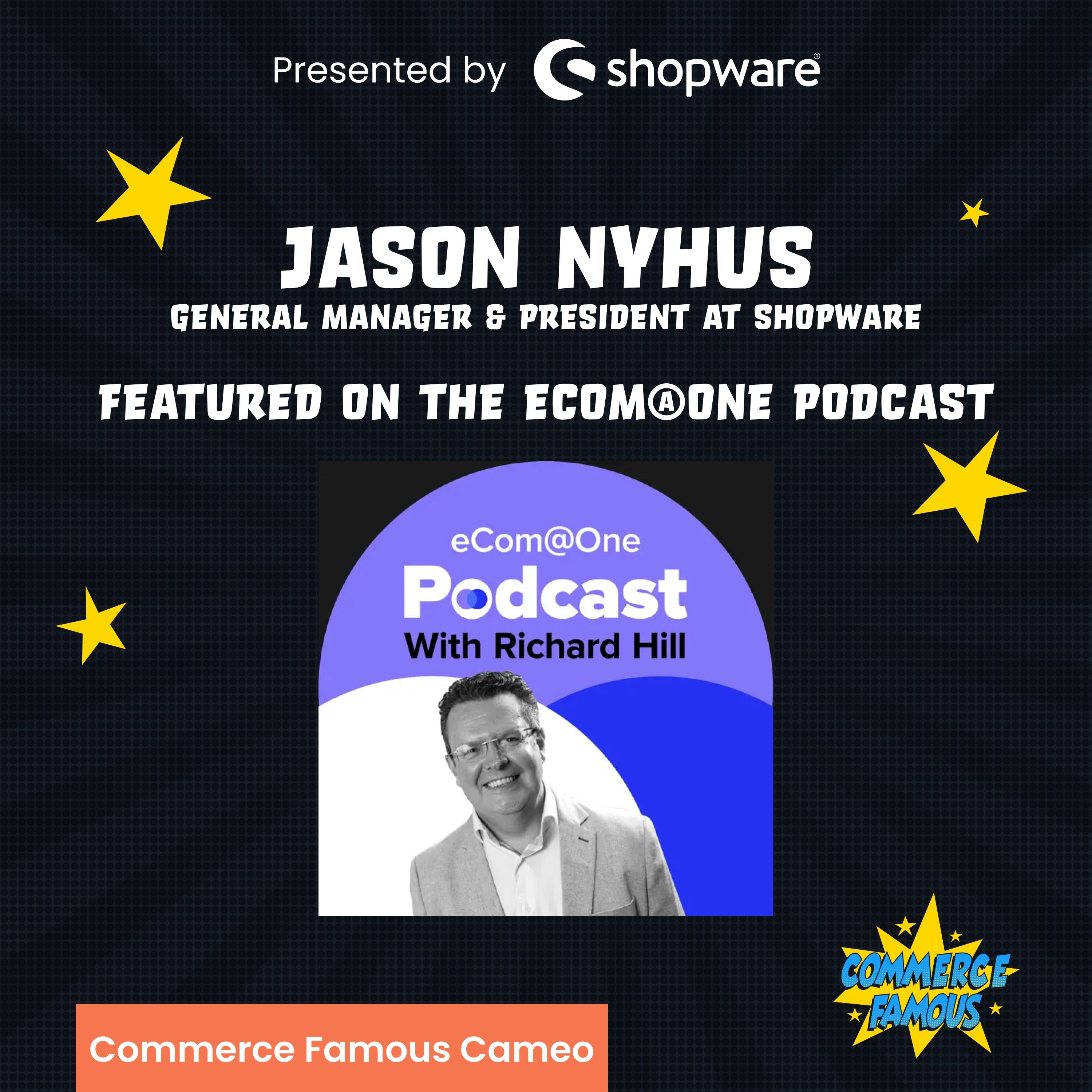
Cameo | Jason Nyhus at the eCom@One Podcast | Commerce Famous Cameo
Worum es geht
In dieser Commerce Famous Cameo-Folge ist Jason Nyhus, President und General Manager von Shopware, zu Gast im eCom@One Podcast mit Richard Hill. Er teilt Erkenntnisse aus dem von Shopware in Auftrag gegebenen und von Rick Watson durchgeführten „Forgotten Mid-Market Report", der sich mit den oft übersehenen Mid-Market-Händlern befasst. Nyhus spricht über seinen 20-jährigen Weg im eCommerce, die Auswahl von Software-Anbietern und darüber, wie Technologie Kundenerlebnisse und Profitabilität verbessern kann.
Autor: Commerce Famous Podcast
Zu Gast
Jason Nyhus ist General Manager und President bei Shopware und bringt über 20 Jahre Erfahrung im eCommerce mit, wobei er sich in seiner Laufbahn auf Softwareentwicklung spezialisiert hat.
Folge teilen
Transkript
Hey, everyone. This is Ben Marks, host of Commerce Famous Podcast. This week, we're doing something new. We're introducing Commerce Famous Cameos. This is our chance to, share with you some, content from the broader ecosystem, still connected, occasionally to Shopware.
But, this first episode features Jason Nias, president and, general manager US from Shopware. Give it a listen. Hi there. I'm Richard Hill, the host of Ecoma One, and welcome to episode 180, one eighty in the bank. So in this episode, I speak with Jason Nias, president of Shopware.
We cover what we call the mid market, the 10 to 250,000,000 turnover. It's about 50% of the actual ecommerce market, so a huge market, which all Jason's advice to mid market companies right now and why our midsize companies are more risk averse. How can senior mergers get buy in from above when trying to transform digital operations? And the overall appetite right now for moving platforms and the core things to consider over the timeline and planning phase. Now if you enjoy this episode, hit the subscribe or follow button wherever you're listening to this podcast so you're always the first to know when a new episode is released.
Now let's head over to this fantastic episode. Hi, Jason. How are you doing? I am wonderful. Thank you for having me, Richard.
No problem at all. Thank you for coming on the show. So I think best thing to do is let's crack right on and, introduce yourself to our listeners and how you got into the world of ecommerce. Yeah. Absolutely.
So my name is Jason Dias, and I'm general manager here at Shopware. It's a it's a company I'm sure we'll get into, quite a bit later. But I've been in ecommerce for twenty some odd years. And, for the listeners, my hair looked a lot like yours when I started, and now it's not a lot different. It's a stressful industry, but, man, has it been a great ride.
Yeah. So twenty years, that's, that's a hell of a ride, isn't it? It's almost from the beginning, I think, pretty much, maybe five years short. So, obviously, you've seen quite a lot of different things come and go and things change and, obviously, a lot of things, a lot of crazy growth with different companies that you work with. But, I think, million dollar question on a lot of, growing ecommerce store companies and and merchants is, you know, choosing a platform.
You know, it's usually there. You know, we've had we've had all the platforms on, I think, on the podcast, and they all have their lovely take on life and towers. You know, and I think, you know, we've had you know, we were chatting just before you came on and, you know, we were dealing with some of your very, very, very first merchants in The UK with with with Shopware. But, obviously, there's a few options out there. You know, how can a a growing ecommerce store make sure they're sort of making the right choice for them, you know, whether it's Shopware or an other platform?
Yeah. Well, the first thing I think we should talk about is the fact that there are 18 different commerce platforms on the Gartner Magic Choir. And if you are a merchant who really focuses on building great products and services and marketing those, to look at the Gartner Magic Quadrant has to be incredibly intimidating. I mean, how would you even know who to talk to and why? And so, you know, the first thing I would tell you is that every one of those providers, us included, is purpose built for certain types of companies.
And and, you know, we we like to call that the ideal customer profile or the ICP for short. Yeah. And, you know, Shopware is actually very, very purpose built for the mid market. And that's really unique. Brands who do, you know, between 10 and $100,000,000 in GMV are largely left behind by Yeah.
Traditional commerce businesses. You know, there are plenty of platforms that built for the masses. Think SMB, and there are plenty of platforms who build for the megas. But there's not many who build Yeah. Purposely for the mid market.
Yeah. So that mid that mid market size have got very unique challenges, makeup to that, size of business. You know, whether that's sort of infrastructure, the sort of, a level of capacity going through the the website, all the different channels that, a store may have. But what are some of the key levers that you see been the sort of decision why they choose maybe Shopware or why they choose a certain platform when you sort of when you're doing, you know, twenty, thirty, forty million, what are some of the key things to be thinking about? Yeah.
Well, first of all, you know, the old the old the the way that the track we all fall into is we talk about merchants by how much gross revenue they do online, and it's the laziest way that you can possibly do it. And we we do it too. But the fact is the real the real kind of decision point is around complexity, and it's around how you wanna pay for it, whether it's an app, an OpEx expense or a CapEx expense. It's around, the number of people in your in your company who have to interact and touch this product to make it do what you need. Those are the real kind of decisioning factors, more than just how much revenue do you do.
You know, we like to say that that Shopify, as an example, is one of the greatest boxes ever invented for commerce. And if your fit if your business fits nicely in that box, you should probably buy from them. They give, they give merchants that that are really small the economic scale of a business that's much larger. K? And so for those reasons, if your business fits in that box, you buy from them.
Shopware does an amazing job for the merchant who has enterprise expectations in terms of capabilities, flexibility, supporting their complexity, but they have potentially the budget of an SMB. And it's that that conflict between what they need and what they can afford. That's who the Shopware merchant is, and that's where we really excel and do a great job. Yeah. No.
It's a good good market. That's a lot of our a lot of our clients, and there's more of a customizable, you know, bigger thinking. Like I say, it's not just about revenue, is it? There's so many different levers there, whether there's, you know, you might be talking you know, you might start off with one or two channels, running Google Shopping in one country, but next thing you know, you're you're running 50 channels. That's a different game altogether, isn't it?
A different requirement of complexity with 200,000 SKUs and, you know, maybe 20 countries and fifty hundred channels running. Shopify out of the box is gonna have a have some fun and games with that, isn't it? I would imagine. Yeah. Well, you know, like, I this is this is why another example of why GMV or gross merchandise value is not a great measure.
You know, there are you know, take the Kardashian brands that I think some of those run on Shopify. We're talking about eight to 10 SKUs, a small number of countries, and a really simple buying experience. Even though they do hundreds of millions of GMV, their complexity does not necessitate anything different than a Shopify. Yeah. Yeah.
Yeah. That understood. So yeah. Sorry. Carry on.
Oh, I was just gonna say and then you have examples of brands who may do 25,000,000, but they own four or five different brands. They serve, they do b to b and b to c, and they serve 10 to 15 different countries. Well, if you get to that level of it's a factorial problem. Well, then to buy a solution like a Shopify, where you have to pay kind of per channel and country and you have to manage them all separately, well, that no longer makes sense. It doesn't fit your business problem.
And so, really, the complexity is is a better measure. Yeah. Yeah. And I like it. So I know you've published recently the the forgotten mid market report.
So what does that sort of say around the sort of state of ecommerce at the moment? What were the key findings from that? Well, so the the report is called, The Journey of the Mid Market Merchant, and it was published by Rick Watson, RMW Research. It's a really great report. And and it was not published by Shopware, but funded.
The research was paid for by Shopware. And the reason we went off and did that is because a lot of a lot of software companies go out and try and do thought leadership, but the thought leadership always comes back with a piece that talks about a total economic impact study that always paints the the platform in an unbelievably positive light. That's because they control all the the inputs. Yeah. And, you know, we didn't wanna play that game.
We wanted to start a new conversation about the mid market merchant that simply wasn't happening. And so the research really goes in and starts to take a look at the market forces that have contributed to where how we got here. The fact that in 2016 was supposed to be the year that commerce grew up. K? This is the year that big software was gonna start to take over ecommerce.
So what happened in and around that year? Adobe acquires Magento. Salesforce acquires Magenta Demandware. SAP acquires Hybris. So in the leader quadrant that year, you've got Salesforce, Adobe, SAP, IBM, and Oracle along with my previous employer, Digital River.
So what happens then in the bottom left, again, in on the Magic Quadrant, the one box you don't wanna be in is the bottom left, the niche player. K? 2,016. You see players like Shopify and Big Connors. My employer, Shopware, wasn't even on it.
K? Yeah. So the the reason we commissioned this research around the journey of the mid market merchant was all those solutions I talked about before, all were purpose built for the mid market. You guess what happened? Big money came in, took those solutions, raised the price, raised the security, raised the, the selling team, you know, blah blah blah.
And now those products really don't serve that market at all. Yeah. And what the market really told us was that they really valued the simplicity, easy to buy, easy to run, easy to own of the BigCommerce of the Shopify. And so fast forward to today, what you have left is really the forgotten middle market. You know, you've got roughly 50% of the ecommerce market falls in the range of a revenue of between 10,000,000 and 250,000,000 of GMV.
50% of the market. Yet nobody's explicitly marketing and selling and providing services to that category. So that's that's really why we did it and a little bit about the insights, related to it. So what would you say were a couple of the key takeaways from it then? So we're saying that it's like a forgotten area, and I agree.
I think it's, doesn't get talked about too much, but it's a huge part of of the overall market. Would you say 50%? So that's a 50% of the revenue, I I am assuming. Obviously, that is a huge part of any if you're in the if you're a tech partner listening in, obviously, that's a huge a huge area to be in. You know, that's gonna be potential clients or customers that are, they're not used to paying.
What is it? $49 for Shopify a month they're used to paying, whatever it may be, you know, for, you know, various services if you're doing $2,030,000,000. What would you say are some of the, you know, the the key takeaways then from the actual report? Obviously, there's there's this market. There's this there's these these players, but what is some of the takeaways from it?
Well, a lot of it really centers on what's happened post acquisition to things like Magento and Salesforce Demandware. And it doesn't explicitly say it in the report, but this is kinda what I when I read it, it's kinda how I imply. You know, the companies who acquire these businesses, again, backed up Hybris, Magento, and, Salesforce Demandware, Again, all those products were purpose built for the mid market. When they got acquired by ERP, CRM, and experience management companies, if you have contracts with any of those companies, what happens is they've found ways to increase how much you pay over time, on all of their core services. And in commerce, what's happened is everybody's kind of moved to cloud serve cloud delivery mechanisms.
Everybody's kind of moved to a percentage of GMV model. And what's happened is the percentage of GMV has actually retracted over time. And so if you're a Salesforce, Adobe, or SAP, senior executive trying to make decisions around the product road map and where you put your r and d as a company, you put it towards the things that have expanding margin and expanding growth, and you take it away from places that don't. And in this scenario, commerce has been that. So what the report really starts to highlight is the fact that some of these these players that used to be the market leaders have really lost a lot of share over time.
And and it's really because they haven't delivered new features that have really addressed the needs of the mid market merchant. And here's a question I ask analysts and and and merchants who are running these platforms. In the last five years, tell me your favorite net new features you got out of these commerce platforms. Not Yeah. Apps that you can now extend and pay money to run services.
Again yeah. Yeah. What added value have you got? Yeah. Yeah.
Yeah. But, you know, most of the most of the research and development has gone towards making them run maybe optimize a little bit better, but not gone towards delivering new features that allow you to compete with your competitors better. Yeah. And so that's what the report starts to highlight. It's when there's no money, when there's no focus, when there's no energy, there's no value being delivered.
That's really what it says. Yeah. No. I I I get it. And I think, that's the thing.
You know, people can get a little bit complacent, can't they, or companies can, when, you got these big retainers in place. But, ultimately, there's always other brands nipping at your heels that, you know, they are developing, adding value. You know, if you're, let's say, 50,000,000 revenue, you can't just sit on your existing tech stack and expect to you know, what works in that tech stack now. You know, hang on a minute. We talk we talked about, you know, different channels.
Well, if that tech stack is only enabled in is any, you know, the the feed technology that works with your platform only works in certain countries, hang on a minute. You you'll discount a whole country or You know, they're you know, if it's just very difficult to launch other channels, whether that's shopping, Amazon, or the wider, you know, different countries have obviously got you know, you've got a lot of big channels in The US that, you know, if you open up from a UK as a UK merchant, you know, it might seem quite alien when you're at two or 3,000,000, but they're the sort of channels that you need to be in when you're hitting the ten, twenty, thirty, forty, fifty million, you know, and and shipping all around the world. But if you're not able to do that if you're not able to do that, you know, the b to b piece well, that user experience around flipping from b to b, b to c to b to b, you know, and you've gotta then pay another whatever, $2 a month for it, for this, $2 for that, $4 for this, whatever it may be.
Yep. It soon becomes quite costly, doesn't it? Yeah. I just wanted to introduce you very quickly to our sponsors, Prisync. Now Prisync is a competitive price tracking and monitoring software that can dynamically change a product's prices on all sales channels.
They work with brands such as Samsung, Sony, Suzuki to increase their online revenue. Now if you run Google Shopping, which I know a lot of you absolutely do, this software is absolutely key to accelerating profits. One of the reasons I recommend pricing to my clients is because you can find out your competitors' pricing and stock availability all in one simple to understand dashboard, giving you a huge competitive advantage. Now if you have any inquiries and questions about this software or you're ready to get cracking, we have worked out a very, very special deal for our listeners where you can get a free month's trial and then 25% off for the first three months. Head to econ1.com pricing and complete the inquiry form, and we will connect our listeners to the pricing team.
Right. Let's head straight back to the episode. Big software used to go in and say it's gonna cost this amount, and it was a big number. And SMB software went in and said, well, the headline rate is really small. But if you want x, y, and z, these are all the add ons.
And then the app stores that they they force you to use, a payment provider or a cross border or an email, and they get big rev shares off of those. And so, you know, you kinda come from two different spots, but you end up in a very similar one, which generally favors the platform. And so this is this is this pricing thing is a really big lever that we play, and, frankly, we win, when it comes to the mid market merchant. Yeah. I mean, it's very frustrating when you, you know, you see these headline numbers of x amount a month or x amount for this.
We had we had a similar experience, couple of days ago. A potential tech partner wanted to work with one of our clients, or with our with our clients, and they did a lunch and learn to our team with their pricing, you know, and and and, obviously, that overview of the platform. We've had a very good lunch and learn, about that tech. And then we introduced them to a client, and it transpired that, you know, the pricing wasn't really what they presented to us for the full for the full fat version, if you like. So I was like, oh, man.
So we got one of the guys came to see me. He said, well, you know, I've introduced him to our client, a very good client of ours, and it's twice the price as what we were led to believe on the initial sort of lunch and learn. So that was that's probably gonna be a very short lived relationship, unfortunately, unless, you know, that can just be, you know, just be very straight on the pricing. But, yeah, stacking all these different add ons and bolt ons can be very frustrating. The market, the the software providers have really done a good job confusing the market.
So the first thing we talked about is the fact that there's 18 people who think they can do what you need. So how do you choose? The second thing is you now have to think about, well, do I want, the I have to think about the delivery method. Do do I need SaaS? Do I need a platform as a service, or do I need to sub manage this myself?
Well, that's a Yeah. Another confusing chop topic. The other topic that's confusing is gonna be around architecture. Do I need a do I need a full stack? Do I need just the, components?
What's the most modern? Like, what do I actually need? And then, you know, you've got, a skill set gap. Do you wanna do you wanna do something that's fully controllable via, an admin, or do you want pure APIs? And so the amount of complexity and choice along with the complexity and choice of pricing really, really makes it hard for a mid market merchant to kinda cut through the noise.
So a lot of this market confusion Yeah. Benefits the commerce the the software companies. And and our goal is to try and cut through that noise Yeah. And really provide a lot cleaner options so people know what they're choosing. Yeah.
I guess, so if you're a mid market merchant listening to this now, you know, what would your advice be, You know, they're they're maybe looking at, you know, what's next for them in terms of, you know, replatforming architecture tech stack. You know, they're sitting at they may be sitting at 10 mil, knowing full well that their board and team are looking to scale to 50 over the next three or four years. You know, what advice would you give to those guys? Yeah. You know, without being too self serving, I really think that you you gotta get multiple points of view on, you know, your problem.
And I'm a big proponent of of using so let me say it really plainly. Software companies are relatively desperate for your business. 2023 for the industry was a relatively tough year. It's probably the lowest amount of companies replatform off of something different to something new in the last twenty years. K?
Yeah. The net effect of that is a bunch of bad behaviors. A bunch of software companies trying to answer RFPs and taking a little bit more being a little more liberal with the process and say, yes. That's in the box when I know for a fact, in a lot of cases, it's not. Yeah.
Yeah. And we do our best to really hold the line and and and try and and be as honest and open as we can. One of the things I would ask for or I would tell people is find a trusted adviser, an agency, or someone with experience that you can lean on and make sure that they can help you sort out all of these all of these answers. That's point one. Point two is any contract you sign with a technology partner get a failure to launch provision.
If they are being honest and open with you about their ability to serve your needs and aren't willing to sign up that they've answered all these answers correctly and they're willing to say that if it doesn't go well, you're not gonna pay us, Question whether they're doing it, what the incentives are driving what behavior. So those would be the two pieces of advice. And, obviously, the third is you should include Shopware in your evaluation. Just to be purely self serving. Let's go.
No. I think the first two are brilliant advice. I thought you might have that thought. No. We we've have we have many clients on on Shopware.
So, but, yeah, obviously, having that trusted adviser and getting getting different viewpoints, spending time, obviously, at that level. You know? It's not just, we're just getting started, and let's let's figure this out. You know? It's a huge decision.
So getting, you know, spending you know, we we're working with a client at the moment. They've been working on a sort of their next step for about a year. You go there on a custom bill. They're doing about £25,000,000, probably $30,000,000 a year. They're on a custom bill.
They've been with a long time, you know, good relationship with the with the company that that built that, but they're looking for their next step. You know? So they've spent about a year, I think, now, and I think there's still a fair way to go. You know, I'm not saying it will take that long for everybody, but there's a lot of things to consider. They're they're sort of, quite unique in that they've got something like 250,000 SKUs.
You know, a lot of a lot of a lot of different products, a lot of b to b and b to c mixed in. So sort of planning for that. But, yeah, getting that advice, getting multiple new viewpoints. And, obviously, people ideally that have been there and done it, not just, you know, are trying to sell the software and, hopefully, it might do this. And then that failure to failure to launch, provision, that's a that's a great one, isn't it?
Obviously, that's within, like, signing a few legal documents to, get a rocket under things and then make yeah. Yep. So yeah. Okay. So I think one of the challenges can be, you know, trying to convince the management, convince the people with the purse strings about the investment in the technology for the for that next phase, you know, where we've got we've then got to the 5 or 10 mil, and now we're right.
Okay. We now know we need to invest, you know, x, you know, a considerable figure, into that the next stage of growth. You know? How can city managers get buy in, you know, from their management, from their owners of their business? Absolutely.
And in fact, I've seen this in in spades in the last three, four weeks when Shopify raised their prices by 30% and are now charging for b two b and now charging more for payments. We've had more what's the economic impact of moving conversations than we've had in a long time? And so I I think you're exactly right that the evaluation period has gone on in 2023 for a long time. I think that was more of a byproduct of the the cost of capital, the cost of labor, the cost of products and services. I think and and who knows what what inflation.
And so those those factors generally focused a lot of people on pausing. Uncertainty equals pause. But now those price raises, all those previous evaluations, they're all starting to hit right now. And so, you know, I believe that a migration or an upgrade to a modern commerce stack actually should be self funding and over the over a, let's say, a five year period. And so the amount of money that you'll save on licensing costs and not being on vendor lock ins and all of these things should be enough to pay the level of effort on the migration, and you should result it a modern platform that solves your needs on an economic model that you can go forward.
The thing you've gotta get comfortable with is that period of transition and making sure there's a return on your aggravation for doing it. And so that's that's that that that return on aggravation period that you described as a a year at your vendor vendor you're talking about Yeah. I've seen that be, accelerated, at least here in North America, as merchants are coming out of of some uncertainty into more Yeah. Clear direction. Yeah.
I mean, there does seem to be a lot more, I would say, last year, yeah, it was a bit of a shocker, wasn't it? I think is the is the reality of of of of sort of bigger investments on on replatforming. Whereas as I'm seeing a lot more positivity right now, obviously, they said this episode is gonna go live sort of March '24. And I think, yeah, I'm seeing a lot more bigger decisions. But still, you know, they can be quite tricky conversations when, their head of digital or their head of, you know, growth, depending on how that company is structured, is going to their board for what might be obviously, it varies, but, you know, trying to think of a number to say, but, you know, maybe a couple of million dollars for a website, you know, maybe maybe more, maybe less, maybe a lot less.
Yep. But when you talk about that five year period, that's a good way to frame it, isn't it, I think, to look at, you know, that the sort of the the timeline and look at the cost of other platforms over that time and look at trying to phase in different elements. You know, that's quite a good way of looking at it, isn't it? Yeah. It it needs to be self funding.
You know, the the the efficiencies gained through moving to a modern commerce platform that has AI and spatial commerce and just digital sales rooms and rules and flow builders, you have to you should be able to pay less, and you should be able to leverage modern tools to do things that use people today. And I don't mean to be so cold and callous about it, but, you know, I had a meeting this week with a merchant who has a dedicated team trying to do integrations into making sure their commerce and their HubSpot talk to make all these things happen. Well, in a modern Calendars platform that's built on webhooks as a a natural part of the way their product is built, that's a field in a commerce platform that makes all this stuff happen automatically versus three or four people that have to push a bunch of emails around and systems around. So, to me, ecommerce upgrade should be self funding. And the other real if you don't mind, Richard, there's another point I wanted to make and I forgot.
Critical question to ask is when did your commerce platform what was it originally built? And the reason this really matters, I used to work at this company called Digital River, and it was one of the first multi tenant SaaS commerce platforms in the world. 2003. Okay? We were out we were multi tenant SaaS.
And by about 2007 or 2008, we were having to make really hard trade offs around replat not replatforming. We're, refactoring the code or delivering new features. Okay? And these platforms that are in the in those space today were built before iPhones. They were built before Yeah.
Social media. They were built before all these use cases. And so to to serve the agility of the market takes them to refactor. And so this is another reason that we haven't got a lot of new features in our industry for years. It's because these platforms that are really, really good, they were built a long time ago.
And you wouldn't you I'm sure everyone on this phone doesn't have an iPhone seven, but they're running on commerce platforms that were built the same year as that brand. Yeah. That's, yeah. People just don't realize, do they? There's, there's quite lot of Band Aids, being, put over various things.
I think there is a term. I'm not if to say this or not, but you can you can only polish a turd so much, can't you, really? Leave it to a Brit. That's a very yeah. I like it.
Okay. So, yeah, it's an interesting I think, you know, I've been having a lot of conversations this last month or two or last month really. We have a lot of sort of $2,040,000,000 pound Yeah. Merchants. What would you say around sort of, Shopware, your road map?
What you mentioned digital sales rooms. I think that's quite an interesting one. You know? What what are some of the features coming down the road map at the mo that you've got planned out? Yeah.
Well, let me so I'll answer that, but I'll I'm a storyteller. I'll hopefully appreciate that being British. You know, when I took the job at Shopware, what I had realized in my old life is we had partnered with all the major commerce platforms, BigCommerce, SAP, Salesforce, you name it. And my old company and I used to help them win new merchants and utilize Digital Rivers merchant and seller of record capabilities to go to every country in the world. And when I was on the journey helping them sell new customers with us, I realized that the products didn't change at all.
There was no new features and no innovation. And so Shopware, I guess, recognized this before I got there, and we raised a $100,000,000 with Carlyle and PayPal to do two things. Number one, take this market leading product in Germany to the rest of the world. And number two, bring back feature innovation to the merchants. And so I'm really excited about the product road map because we've delivered things like rule and flow builder, which are these unbelievably simple to run but complex on the back end that just it crushes it, which allows you to basically the death of personas.
So it's not about what soccer mom Susie sorry. Football mom Fanny does around, you know, how we've profiled her. It's really around she did she visited this page. She opted into this thing. She bought this product.
She deserves to get this rate and this offer. So it's really this unbelievably complicated if then statement, which leads to the flow that you wanna deliver for her experience. So this this is really enormously powerful because it allows merchants to be way more efficient in the way they merchandise and manage their stores. So that's one example. Another is this digital sales room, Richard.
I don't know if you've seen a damn well of it, but it is gonna do to to ecommerce what telehealth has done to health care. You know, in The United States, we've got a different system than you do it in The UK. I'm sure we could debate its merits either way. But, now in America, when you need a doctor's appointment, the first thing they try to do is to get you in a telehealth appointment to visit your your physician. In commerce today, in b two b, it's more common that people are on the road visiting the dentist's office versus trying to use the power of digital sales rooms to visit the long tail of their customer base and romance the products and give them the service level that they need.
And this digital sales room has done what most other technologies hasn't. It's changed sales reps' behavior. This is a tool that they adopt because it helps them hit their number, not a tool that's been mandated by corporate so that they can have better reporting. And so this is a really good example of and not innovation not a product looking for a solution, but a solution that has found a problem a a product. Yeah.
Yeah. Now I love it. So those are two examples. Yeah. I think, I think digital sales rooms, it sort of gives me all sorts of eye or brings up all sorts of ideas, you know, being able to demo different things that, you know, to bring in that sort of in store experience to your from room, you know, bringing, obviously, all the omnichannel, together.
You know, it's more it's quite an exciting, more of a touchy feely sort of, interaction. Yeah. It's good. It's good. Yeah.
Well Another another thing I wanna add, Wyatt, because you got me all excited about product road map. So, one other thing that I think is really differentiating is ask your ecommerce providers to show a link to their product road map. And the reason most companies don't do it is because of what I described earlier around the refactoring. It is easy to promise on a PowerPoint and then slip. K?
Shopware actually publishes our product roadmap publicly, and we it connects into our Jira system at which we actually run and deliver products and features. And so we deliver 90% of the features that we say we're going to on time and the other 10% within a month. And the fact that we do it publicly, I think, is very differentiating. Yeah. Yeah.
Well, we'll have to maybe link that, road map up to the episode. That'd be wonderful. I'll give you some I'll give you some links. Well, thanks thanks, Jason. So, I'd like to finish every episode with a book recommendation.
Do you have a book to recommend to our listeners? I well, I'm a very simple man. So my favorite book is this book called Who Woved My Cheese? And it was the first book ever given to me when I started in ecommerce twenty four years ago. And, basically talking about so the the my previous company's job was to really disintermediate companies like Best Buy, having a software category in their stores.
And it took twenty four years, but but it it it's now gone. But the whole premise was around how do you, deal with change, change management, and how do you disintermediate, and how do you do complex things that really kinda change that's really about disruption in a lot of ways and change management, and I really enjoy that book. Simple. Very simple read. It's a quick read as well, isn't it?
It's only like this one. Like I said, I'm a simple man. So thank you for coming on the show. For those that wanna find out more about Shopware, maybe connect with you directly, what's the best way to do that? Well, you could find me on LinkedIn.
My name is Jason Nyhus, n y h u s. And I would ask that you'd send me an actual note, not just a LinkedIn request. I'd love to know who I'm trying to connect with. You could also email me at jay.nyhus@shopwear.com or visit our our website and and interact with our product road map and some of the features I talked about today. Yep.
Great stuff. We'll we'll link that all up in the show notes. Thank you so much for coming on the show, Jason. Cheers. Really enjoyed it.
Awesome. Thank you, sir. Thank you. If If you enjoyed this episode, hit the subscribe or follow button wherever you are listening to this podcast so you're always the first to know when a new episode is released. Have a fantastic day, and I'll see you on the next one.

Veröffentlicht mit CiteCast