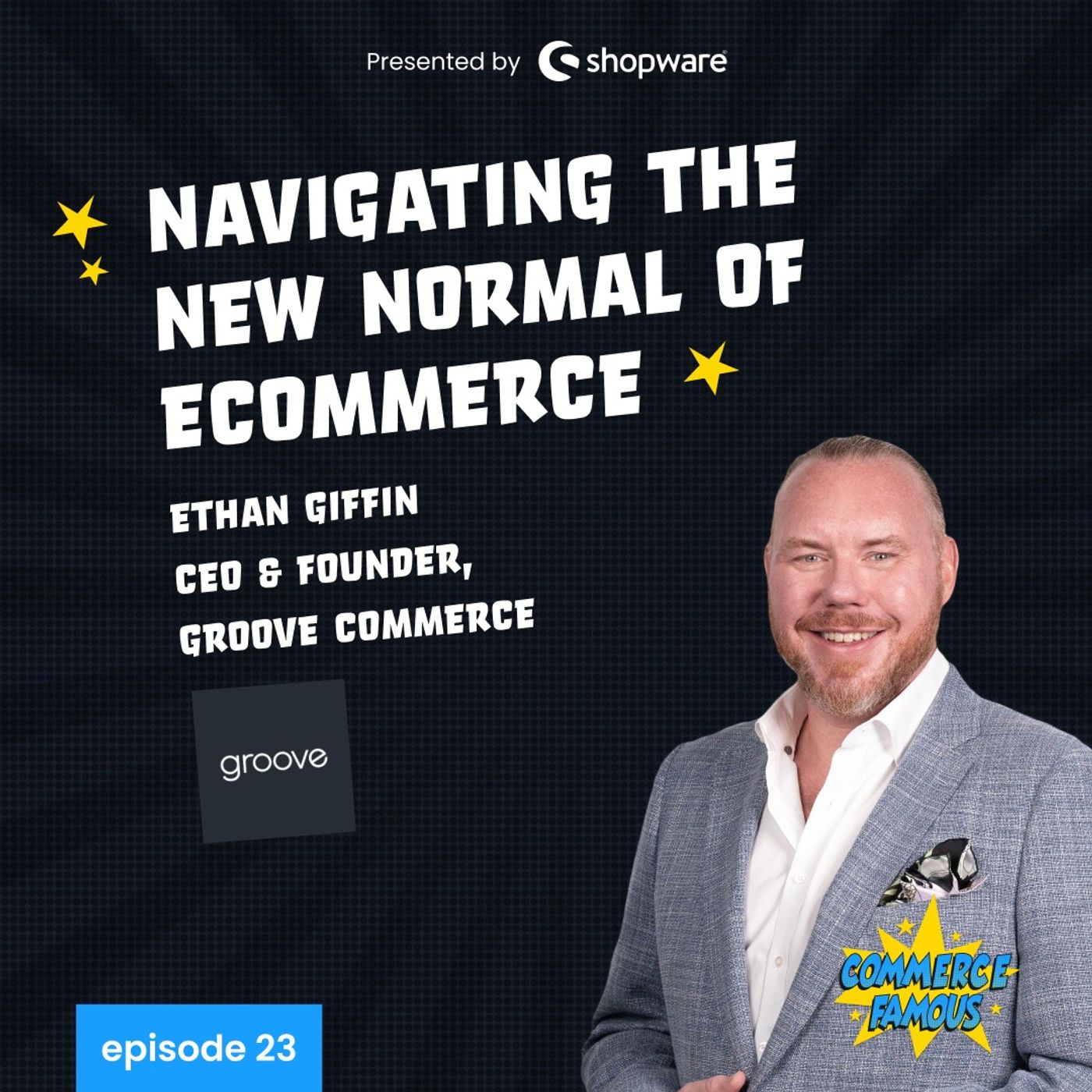
023 | Ethan Giffin | Navigating the new normal of ecommerce
Worum es geht
In dieser Folge von Commerce Famous spricht Host Ben Marks mit Ethan Giffin, Gründer von Groove Commerce, einem auf E-Commerce-Engineering und Growth-Marketing spezialisierten Studio aus Baltimore. Sie diskutieren die Entwicklung des E-Commerce, aktuelle Trends wie GA4-Updates sowie die Bedeutung von Site-Speed und SEO für Online-Händler. Ethan erläutert den ganzheitlichen Ansatz von Groove Commerce, der Design, Entwicklung und Marketing verbindet, und stellt seinen neuen Podcast Ecommerce Masters vor.
Autor: Commerce Famous Podcast
Zu Gast
Ethan Giffin ist ein vertrauter Berater für Hersteller und Distributoren sowie Autor und internationaler Speaker. Er ist mit der B2B eCommerce Agency verbunden.
Folge teilen
Transkript
Welcome to Commerce Famous, the biweekly podcast all about ecommerce and retail. In each episode, your host, Ben Marks, cuts through the clutter and takes you straight to the stories and experiences of those who shaped digital commerce as we know it today. While their names and faces might not be recognized on the street, each of Ben's guests are famous for commerce or commerce famous. Without further ado, your host, Ben Marks. Everyone, welcome to Commerce Famous.
This is your host, Ben Marks. And with me today is someone I've known for many, many years, Ethan Giffin. Ethan is the founder of GrooveCommerce, a, an agency doing a serving as a creative studio, doing ecommerce engineering and growth marketing out of Baltimore, your BigCommerce partner, Shopify partner, and also a Shopware partner. And, you know, got a host of, host of awards collected under the GrooveCommerce banner over the years. But, Ethan, welcome to the Commerce Famous podcast.
Thank you. Thank you. Thank you. Thank you. So excited to be here today with you.
It is, it has been a long time, that we've known each other. So always excited to sit down. There. Yeah. It's, you know, I remember when I got into the, particularly the Magento world around, you know, circa 2008, you all were in that space.
And, gosh, I mean, like, in the early days, I think you won you all won one of the first, you know, partner of the year awards. Right? Yeah. So we we won we did win, I think it was 2011, we won, like, best new partner, best up and coming partner for, you know, for Magento at that time. They had just launched the professional edition of the software, and we kind of just made a tear through, through selling those licenses and then on to the enterprise licenses.
You know, also funny, the guy that was the head of the partnerships over at Magento at the time, Scott Dahlgren, called me. He goes, Tiffany, we're looking to bring on, like, kind of a developer as, like, the developer advocate. Are you willing to kinda, you know, give your your guy up for that? And, you know, at the time, I was probably thinking small, and I was like, no. No.
No. No. I can't afford to lose this guy. Like, we finally, like, figured this this stuff out a bit. And, and then, you know, you know, no no nothing happened from there.
And then I guess Kevin raised his hand, and and, you know, let's just say the rest is history of, with I mean, this episode is about you, but the the the history there is actually, you know, circa '20 end of twenty thirteen, 2014, you know, Magento actually came out with a job rec that I mean, it was tailor made for me. And Kevin and I spent about two weeks, like, kinda walking around the office, giving each other the side eye. It's like and, eventually, Kevin, you know, being just being the the amazing guy that he is, he said, you know, we should talk about this. And, and his take on it was, you know, Ben, it's it's it's a tremendous opportunity, and I hate to lose you, but, you know, you really need to take this. And boy, was boy, was he right.
Yeah. Yeah. Yeah. I mean, you've done a great job advocating for, you know, from the technical side on on on platforms for for quite a while. And now that you're at Shopware, you're, like, doing a for quite a while.
And now that you're at Shopware, you're, like, doing a fantastic job with that. So and it creates, you know, just a high level of comfort when, you know, one of our tech leads can kinda talk to somebody that's done it before versus just one of the sales guys or sales folks, you know, so so to speak, you know, or the crazy partnership people. Yeah. There's there's a lot to be said for for, you know, for for, you know, having skin having or having or having had skin in the game and, yeah, just authenticity. I mean, because at the end of the day, especially on the technical side of the house, you know, we the job has to get done, and it only gets done if people really understand what they're doing and they understand the the the, you know, the software and the environment they're operating in now.
So that's actually a good chance for us to jump into, you know, how is it how does how does Groove, how does Groove approach, we'll take, you know, just the the ecommerce bucket of your, you know, your three service buckets. You know, how does how does what is your philosophy as you all as you all approach, clients and requirements? Yeah. I mean, I think for us, like, we started out day one into commerce. Right?
Like, so we've been doing commerce for seventeen years. We've worked through multiple different platforms. You know, we've worked through, as much as things change, things still stay the same, you know, in in terms of that. And so, you know, our kind of philosophy is that we wanna build, a, we want our clients to learn as much, you know, want our clients to learn from us, and we wanna learn from them in this process. Right?
Where we wanna be very transparent with how we interact. And I always felt it was important to kinda have the three legs, so to speak, to have kind of design, development, and marketing together. Because when I was on the client side, I had an SEO agency, I had a development agency, I had a media agency, I had a pay per click agency at the time because that was very separate, had a branding agency, and they all hated each other, and they all thought each other were full of shit. And I got tired of kind of arguing with the dev agency, you know, that, hey. We can't have, like, you know, six pages of source code when you view the source of of asp.net view state in in this thing because Google that's gonna Google's not even get to the actual content part of the of the page.
And so it was very important for us to have all of that kind of under under one roof. And we're kinda going through some of that right now, and and in terms of, GA four. Yeah. So there's just a lot of technical challenges in terms of getting the code to fire off right. There's just odd kinda gremlins and conflicts that are kind of appearing, you know, like, in, like, the in the interactions with these theme files.
And and so it really takes somebody it it really to kinda be successful and to kinda figure out those problems really takes somebody from our marketing team as well as from our development team to kind of work together, you know, to to get that to get that right. So that's really, you know, our philosophy overall. So the creative, the creative part of it influences the site speed, the core vitals based upon what's in the creative. It affects conversion rate. You know, it can affect SEO.
And so, you know, how it's built, you know, can affect, you know, core vitals and SEO and all the things. And so we wanna have all of that under one roof. So we're kinda working together as a team when we're when we're doing these builds or we're improving someone's store. Commerce famous is proudly presented by Shopware, the leading open source e commerce platform for mid market and lower enterprise merchants. More than 50,000 clients already process over $25,000,000,000 in annual GMV through Shopware.
Find out more about Shopware and the best value in ecommerce at shopware.com. So it's not even so what you you know, I I really I like the approach. Right? So because you're not you you know, you have these different service buckets, but they're, you know, truly cross disciplinary. Like, you actually are are are every discipline informs the other disciplines.
Right? So that you so that you have the the same outcome. And it's funny. You know? We we really like to talk about the history of of of commerce and, you know, and to some degree, that means the the history of the web.
And, you know, when you were talking about just the the extensive source, you know, you know, source code behind a a page, you know, that speaks it reminded me of of, you know, in the earlier days, you know, you you wanted to make sure that the key content was actually higher up in the page source, no, you know, irrespective of where it was displaying in the viewport because that at one point mattered. The, the algorithms were like, okay. Well, whatever content is first is probably gonna be important, and then, of course, it changed. Well, like, I guess, we know there's gonna be menu content probably up top. And then, eventually, of course, the the crawlers, like, Googlebot, evolved to, to to actually, you know, render pages in JavaScript and and actually understand the content as it as it appears to a human.
I mean, that's just one of the many, many changes that we've all, you know, and certainly Group Commerce as well, have had to navigate over the years. And with the latest you mentioned being GA four, you know, how is hey. You know, how are you solving how how do you solve these problems for your customers as they they come up? I mean, I think we're we're we're trying to get ahead of things as as much as possible. Right?
So we're, you know, actively, like, working on internal lunch and learns and communications and and creating processes around how we handle these things. You know, a lot of times when people come to us with one of those issues, it's often because, quite honestly, their, theme code or their their code base has not been updated to what whatever the platform has provided them, or they're they might be a year or three years off of of where they should be. So, you know, for, you know, some of it is like you've gotta, maybe they kind of hand pack their updates to their themes versus kind of doing a more, like, like, general one, and they're kinda missing other features and functionality that are kind of they're they're missing parts of it. So but we're really trying to get in front of this as much as we can and understand how the platforms are changing, you know, how the the partner tools, you know, are changing. How is Klaviyo, you know, Searchspring and other folks?
How are that was that code affecting, you know, what we're what we're creating? So we're really just trying to understand what's going on in the marketplace and and trying to get our take on things as early as early as possible. So, it's just important to us to create we, you know, we really want people that understand and know what they're doing to be a part of the agency here. Right. And so, you know, that that speaks to having, you know, a broader perspective even, you know, even for someone contributing within a certain certain service area, you know, having that broader perspective and understanding why okay.
No. I don't exactly know the nuts and bolts of how this might impact SEO, you know, because that's not my direct job. But I do know that what I do over here has an impact in being able to, you know, be able to formulate and ask those questions. I mean, that's yeah. It's a that that is a necessary approach these days.
And when I think about all of the other, you know, the related systems like like you mentioned a couple, Klaviyo, Searchspring, you know, and Klaviyo, I guess, particularly important for the for the Shopify world, you know, be being, you know, sort of being experts in what I call subdomains, or I'm I'm calling subdomains for now. I don't I don't mean that to be dismissive of their importance. But these you know, each of these vendors, as they have have have, you know, grown throughout the years and we see their solution become, you know, more and more fully fledged, you do start to see an expansion of scope, right, in in in, you know, what into even what, you know, an ecommerce platform might might do, especially when it comes down to anything involving customer engagement. These these platforms like Klaviyo and dot digital and others, you know, they do more and more, and they handle a lot of the, you know, the both the customer customer data as a platform and also, of course, the customer experience. Is there do you all have any strategies or or, you know, do you pick partners based on, how well they play with, with the ecom platforms, or do you do you look at the relationship from the other direction?
So I mean, we're looking for, and the answer is both, and quite frankly. So we're looking for things that are, you know, I guess the less friction in implementation or integration, you know, the better, generally, in this day and age. We're also looking for products, though, that are the best of breed that that, you know, help get people to the next level. And so sometimes it's, it's, you know, either pushing those platforms to create, integrations or or, you know, them hiring us to create the integration, you know, for them, which has happened on on multiple multiple occasions. So, we're really trying to to, the the biggest thing is that we need those platforms to perform for our clients, and we need them to be unique.
And so one of the biggest things, like, one of the biggest conversations, especially as there's been some kind of bumpiness in the economy, is really kind of evaluating what's in the overall tech stack for, you know, for a brand. We're having those conversations all the time. You know, many folks and we love our tech partners, so I just wanna, like, caveat this with with with that. But often people are kind of app, like, have an app frenzy or they had an app frenzy for a long time. And now now it's like, well, wait a minute.
You could actually get, you don't get the full thing, but like this other app that you pay for, it gives you 60 to 70% of what this other app you pay for gives you. And quite frankly, you're not even using it. Like, you're using it at a very kind of basic kind of level. So you're not even going any further than 60 or 70% of the functionality within that app. And so really kind of, reducing the amount of apps that are plugged into a store, reducing the amount of JavaScripts that are kind of Right.
Flowing through, whether it's natively, like, on in the code or through tag manager or whatever. Like like, it all has kind of weight. Right? And so we wanna kind of reduce that weight as as much as possible. And we try to evaluate that annually, like, with with with clients where we can.
Now sometimes, you know, when we do get, like, issues, it's funny. Somebody will come to us and they, oh, you know, I've I've I've got, you know, 26 integrations. And you're like, what in the hell are you doing? You know, like, you know, with all of that. And, and, you know, they wanna keep all of them.
But, you know, we, you know, that's definitely something that that we want to we want to look at. Or can it be done, like, natively, like, within the platform? People will pay for things that, you know, with just a little bit of extra dev work, can be done natively within the theme or the platform. Right? And so, you know, those are things that we we're trying to bring up to to to folks.
Again, we love our tech partners and and, you know, but in anything, there's good there's good products and and and bad products. And so, we're seeing a constriction a little bit. Yeah. And that's not, you know, that's not even a universal thing. It it it it can be very situational.
You know, a great partner, you know, a great a great integration for someone's operating environment, for for one merchant, may not be the best solution in that category for another merchant. And I I like this idea of, you know, set keep it simple, you know, to start. You know, let's let's reduce the surface area, the the number of integrations. And I like this idea of checking in. Like, let's let's look at things a year down the road every year, and let's see, okay.
Hey. Are we getting are we still solving the same problems? Do we still have you know, how has our audience changed? And do these solutions meet the need? Have new solutions come in, or have they have we grown out of this solution?
Yeah. It's really yeah. It's a really that's a really powerful approach. I assume your your your your customers must like that. They really like that.
I mean, some of the things that we do with our you know, about half of our business is kind of project based, new builds, etcetera, but the other half is really kind of our growth our growth services. And that includes both kind of our our complete care managed services, offerings as well as our kind of marketing offerings. And so, you know, from from my point of view, you know, I never I don't love the just the straight dollars for hours things. I think there needs to be value add. So, you know, when we're engaged with a with a brand or a retailer, like, on a monthly basis, we're doing accessibility scans.
We're remediating where, you know, like, when we get into a good rhythm, like, our clients just say, go ahead and just remediate what you find. Really kinda keeps it to a minimum, you know, at that point. We're doing kind of what we call QBRs with our with our clients where we're doing a full three sixty review of of what their service of of, you know, each channel and how it's operating. Of course, we're doing that to kinda get, like, more embedded with with them to help them be more successful or to kind of, you know, or to take over things like SEO or paid media or email. So we're doing that.
We've got a, you know, a custom dashboard that we give our clients access to. And then the cool thing is this year, we actually moved into a new office that shares a elevator shaft with a Marriott. And so, we're holding our first customer summit, this year in Baltimore. You know, having people come come down to Baltimore for two nights and, you know, having guest speakers and and and other things. So, you know, really, trying to figure out, you know, how do we create like a real kind of network?
How do we create you know, almost in my mind, I was like, how do we create some kind of cool, like, mastermind group except we execute on the work as well. You meet cool people. You learn stuff. You get, you get, more in-depth access with the software and partners by being associated with us. You meet you meet other cool clients of ours, and then we do the work for you and get you a return on your overall investment.
That could that could be a pretty powerful moment. I've seen that, over the years of my career when you bring when you bring, customers together. Right? And you allow them you allow them to network, interact, and talk about, hey. You know, what are the what are the problems that you've encountered in your business?
Or or just saying, like, hey. You know, we we had the situation, you know, with supply chain or with, you know, fulfillment or, accountancy. And, you know, we didn't really come up, you know, we didn't come up with and and, invariably, someone else in the room, they're like, oh, yeah. Oh, no. We had that problem, and we solved it.
And then, you know, the anyone anyone else paying attention gets to gets to benefit from some real time, you know, real time and really organic, input on on product and services. I mean, is, how big is this event gonna be in Baltimore? I mean, we think, it's our first one. So we're we're hoping somewhere, you know, 30 to 40 folks. You know?
You know? But we want it to be small enough. And, you know, having the hotel here on-site, you know, you kinda come, and we've got a bar in our office. We really built our all of our clients are remote. Like, a huge chunk of our staff is remote at this point.
So we really set the office up to be kind of a a hub, you know, and and it's set up to kind of it's set up to produce video content. This is our video studio that you can't see this if you're, you know, on the pod, but, I'm sitting in our in house video studio here. We've got lots of ways to kinda plug in with this thing. And so we did all that purposely when we when we, moved offices to be able to take advantage of that. And and so we've got all of that in house.
And, and, and so it's really kinda how we think differently, you know, about about things. You know, people are also really looking for you know, Shopware is a very, very extensive software product. There's a huge amount of features and functionality in there, and it takes a long time to figure all of that out. And so, you know, people are really looking to us to be, you know, experts in that. And so this allows us to spend time and think about and understand all the things, like, what does every button do?
You know, how do we work with it? And and, you know, it's a big complaint that we get, you know, when, you know, when we're talking to new prospects of, like, I just don't I feel like I'm way behind the curve or I feel lost with all the stuff happening here. And so it's like, alright. We got you. You know?
Like, what's important to you and and and figure out how to train them and and keep them up to date. So we really, you know, are actively trying to just, you know, again, stay ahead of the curve of what's happening. And that's one of the, you know, one of the things that I've have said for a long time is that, you know, it is on you know, the the the best agencies are the ones who, are the ones who, you know, you know, regardless of the the platforms that they that they use to solve problems, right, know enough to be able to evaluate customer requirements and and and and pick the right the right solution for that customer's, you know, basically, where the the the problems that they're solving today and then also problems for for where they wanna grow in the future. And it really is, you know, the I think big secret in our, you know, in in our industry, especially as you get outside of the pure SaaS players, is that, without, you know, without the without being able to, the merchant, like you said, they they feel they feel lost. They feel behind the curve, but it's really it's on the platforms to be building the right products and service and positioning, to help these customers, start to get oriented and make sense of things.
But, really, it comes down to the agencies. The agencies are the ones that are really, even for for the platforms, very often can be the the, maybe, our most important customer because you take what we do and actually help find the right the right customers and the right situations to apply that. And that has, I think that has all kinds of effects, done well or done poorly, on the industry as a whole. I'm a big fan of this holistic view where there are plenty of solutions. There are plenty of great people to tailor these solutions.
So we really should have we should be living in a situation where every merchant is on the best platform for them and with the right integrations and the right customizations because the better we are at helping them execute their business, then the better it is really for the industry as a whole. It sounds like you all, subscribe to a, you know, at least part of that philosophy. We do. We really wanna pick, you know, I'm, you know, I'm pretty easy to read. I'm transparent.
I say what I feel oftentimes to my own detriment on things. But, you know, like like, I remember being on stage at the the old IRCE conference. You know, it's changed the name a bunch of times at this point, but with a client, and he basically says they're not afraid to tell me when I'm crazy. Yep. You know?
And so, you know, we really try to be transparent and be agnostic in terms of platforms and kind of agenda with with all that. We wanna pick the right solution, you know, for, you know, for the for the brand or retailer to be able to succeed. Because if we do that, their longevity with us is so better. Right? And then back to your kind of point about partnerships, literally every major platform that we have partnerships with have very specific stats about, you know, how the churn is so much lower for accounts that have an agency attached for onboarding and ongoing kind of support with that.
Right? Because they're getting the care and feeding that they need to be able to be, successful. You know? Well, and then we we you know, talking about success, I mean, you know, success is not just about, what's what's going on today. It's also about what we see, what we see going on in the, you know, in the near future and then in the long term.
I mean, we can use GA four again. That was that was an update, thankfully, that was not just sprung on us overnight like a like a typical algorithm change, but, but something that we could all prepare for. Now those are those are things that are broadcasted, but are there any things that you'd wanna draw attention to, you know, coming in the next, you know, rest of 2024 or any, you know, broader trend that you see happening over the next couple years? I mean, I think we're kind of really focusing on things like site speed, conversion rate. They're all kind of intertwined.
I think SEO is very important. I think there's gonna be some shifts with that. But, you know, I think, you know, as long as people are looking for things, making sure that your site appears the way it should for search is, like, always gonna be people have long said SEO is dead. I don't buy that by any sense of the imagination. Has it changed?
Has it has it shifted? Has it moved? You know? Did it start with, you know, Northern Light and kinda move to Yahoo and then Go to and then eventually Google? And, you know, is Amazon a part of that now and TikTok?
And it's just kinda changed. Right? You know? It's it's it's just kinda changed. So those are things that that that we're thinking about.
You know, how do we how do we move people up the steps, so to speak? How do we kinda get them to the next kinda step of their evolution? You know, whether that may be, you know, you know, whether that may be revenue wise or order wise or or, you know, whatever that is. It may be kind of bringing product, like, some some product manufacturing in house to, like, create their own products that they sell. Like, we wanna assist with with all of those, you know, types of things in terms of helping to market them and and create sales, you know, with them.
So we're we're really trying to be engaged with our clients, ask more questions. We have clients that are getting acquired. We have clients that are acquiring. You know? And so, you know, we've gotta ask a lot of questions to be able to to support, to support.
And so it's great answer. And and, I guess before we close out here, I wanted to, you know, you've you've just launched the ecommerce masters podcast, and, you know, with a career like yours, you must have plenty of, you must have plenty of people that you, that you're you're having on and that you have invited. Can you tell us about how that's going? Yeah. It's going great.
And so, you know, we've got about a half dozen episodes in the can. We, we started a podcast called ecommerce masters. It's where, I am interviewing, brand and and the heads of brands and and retailers. So we're looking for kind of c level folks, founders if possible, but also, you know, in bigger organizations that might be a VP of ecommerce. We're really looking to kinda get into their stories, understand how they've kind of grown their careers, how did they evolve the sales within their stores, what are the mistakes that they've made, what are the things that kinda keep them up at night.
And, it's been great so far. We really are, you know, quite honestly, I don't know why I put off, doing a podcast for so long. I was on the radio as a, you know, as a young kid. I had a DJ company for a long time. I had a TV show, for a bit in the nineties that was on kind of regional television.
And I'm like, why in the heck didn't I, like, do this kinda sooner? So, we're we're actively looking for guests. You know, if you're kind of a brand founder or if you're a retailer, a v, you know, a c level VP level or above, you know, we're looking for kind of merchants that are 10,000,000 GMV or higher. You know, and interviewing interviewing you, it takes about an hour of your time, and and and, it's been a great way for us to talk to people and and learn things, you know, from from that. So, you know, and everybody has a different story.
Everybody has a different path or or evolution. And, and so I'm I'm really excited for for what we've gotten so far. And we're actually in the process of launching a second podcast called The Ecommerce marketer that's gonna be more focused on real deep dives into kind of the, both platforms and tools and and and and and SaaS tools that plug into platforms. And we're looking to kinda get into a real kind of, demo where we've got some, you know, lower level tips and tricks, but also some some real high level tips and tricks so that we can kind of help people kind of, you know, grow their grow their minds a bit with their marketing strategies. So, and as well, they're gonna be having some roundtables and other things.
So, we built this video studio in our off in our new office to be able to support all of that, and so we're, like, chomping away at, at at creating content. Well, that's, man, that's, you know, congratulations on ecommerce masters, and then, looking forward to, looking, yeah, looking forward to, some deeper dive into some of these, some of these, you know, dark and maybe semi dark corners, where where the where the integrations meet and, and you get down into the the the details of really directly Where the web where the webhooks connect. Alright. You can coin that term, I think. Well, well, Ethan.
That should be a dating site. Right? Like, you know, where the webhooks connect. Yeah. Dating dating for for for dating for nerds.
Love it. Yes. Yes. I I say that with with full appreciation that I am still kind of a nerd. Me too.
Well, Ethan, you know, it's it's been, you know, it's a pleasure once again to to cross paths with you here, and I'm sure I'll see you, probably see you at, another trade show at some point out in the world. Best wishes to you and everyone in Baltimore. I guess traffic has become a little more complicated. You know, it's I'm I'm glad the tragedy wasn't you know, it's I'm I'm I'm glad the tragedy wasn't worse. I'm sorry for the tragedy that it was, but I know, if I know anything about Baltimore, which is a fantastic city, everyone, food and culture and everything, Baltimore will pull through.
Yes. Yeah. We'll pull through. And, yes, it's a crazy, crazy thing. We're, you know, very sad for the folks that lost our lives with the bridge, but we, you know, we'll we'll get through this and and kinda get on the other side of it.
So thank you for your your comments. And, also, thank you for for having me on the show. I really appreciate it, when you when when you asked me. Well, it's a pleasure to have a, an industry veteran on anytime. So, Ethan, I'll see you soon, man.
Take care. I'll see you. Bye.

Veröffentlicht mit CiteCast