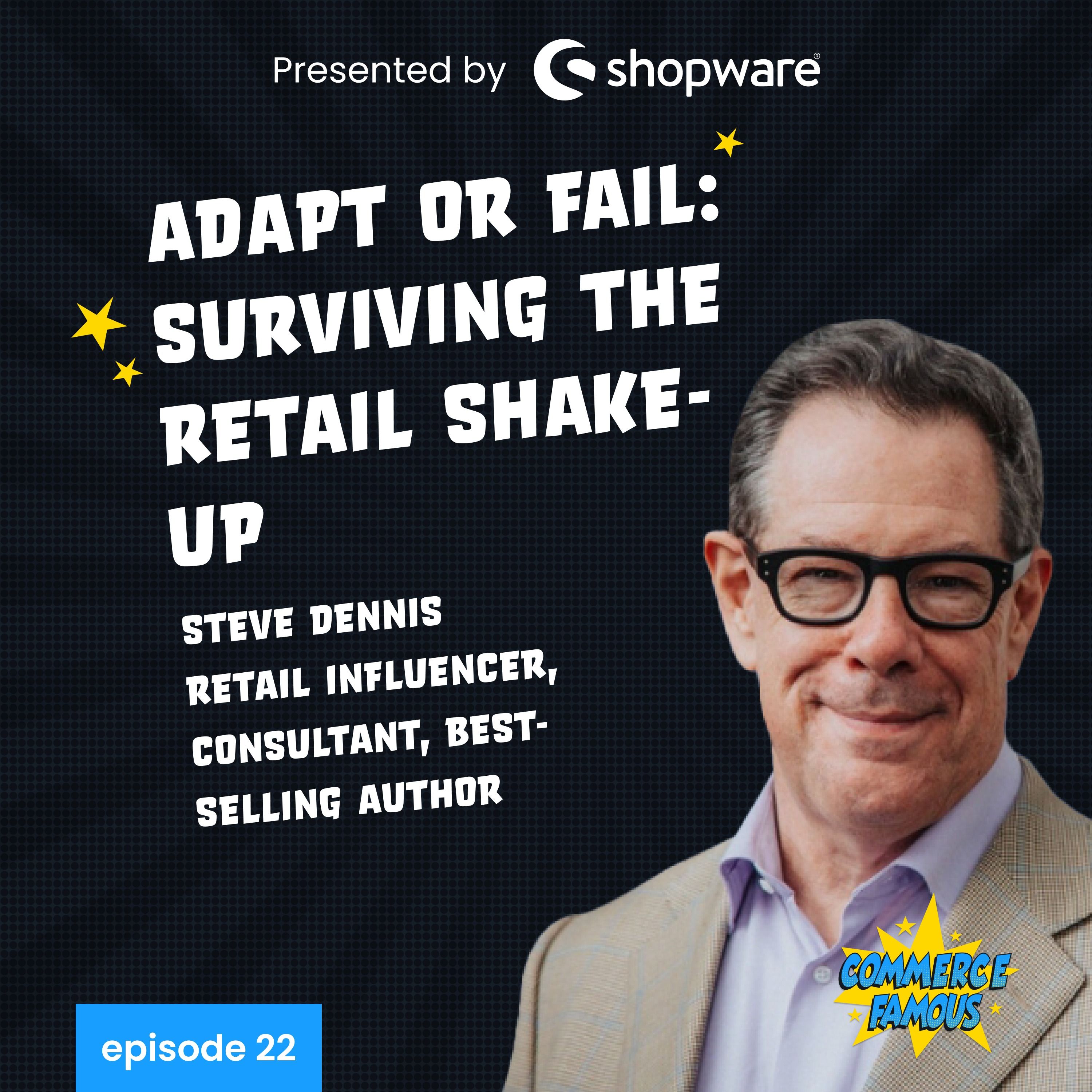
022 | Steve Dennis | Adapt or fail: surviving the retail shake-up
Worum es geht
In dieser Folge von Commerce Famous spricht Ben Marks auf der Shoptalk 2024 in Las Vegas mit Retail-Experte Steve Dennis. Steve blickt auf seine Karriere bei Sears und Neiman Marcus zurück, diskutiert sein Bestseller-Buch "Remarkable Retail" und stellt sein neues Buch "Leaders Leap" vor. Im Zentrum stehen die Bedeutung von Anpassungsfähigkeit und Führung sowie das Potenzial von KI im Handel.
Autor: Commerce Famous Podcast
Zu Gast
Steve Dennis ist Bestseller-Autor von "Remarkable Retail" und hatte zentrale Führungsrollen bei Sears und Neiman Marcus inne. Sein neues Buch "Leaders Leap" behandelt Führung und Anpassungsfähigkeit im Handel.
Folge teilen
Transkript
Welcome to Commerce Famous, the biweekly podcast all about ecommerce and retail. In each episode, your host, Ben Marks, cuts through the clutter and takes you straight to the stories and experiences of those who shaped digital commerce as we know it today. While their names and faces might not be recognized on the street, each of Ben's guests are famous for commerce or commerce famous. Without further ado, your host, Ben Marks. Well, Steve Dennis, welcome to the, Commerce Famous podcast.
First podcast we're doing actually in person, live in person, from ShopTalk, 2024. Nice. Well, I'm happy to be here. It's, I'm loving ShopTalk. Loving ShopTalk.
And, you were actually I think I saw you, yesterday on the, on the big stage. You had a nice little panel going. Yeah. We, we kicked things off with a discussion on exceptional retail experiences, which I you may have heard me say that I kind of wish they had called it remarkable retail experiences, but I'm a little I'm a little biased. But, yeah, we had senior people from Abercrombie and Fitch and Saks OFF fifth and, a guy named Patrick McIntyre from Krispy Kreme who brought the, the house down with some free donuts.
So I think regardless of whether the content was good there, there were no donuts. Yeah, it's funny in high school, I, I actually worked at a music instrument shop, and there was a kid who took lessons there. And, his dad, I think, was of the SVP and then maybe later president of Krispy Kreme. Oh, yeah. And it's great because when his when the mom would come in to pay, she would hand out coupon books for just free donuts.
Not buy one, get one free, but just, like, here's a free dozen donuts. By the end of high school, I had most of Winston Salem, North Carolina in my pocket because all I had to do if I wanted to rent a video yes. That's how old I am, kids. You know, wanna rent a video, walk in with a dozen donuts, and I could take what I want. Instantly popular.
Yeah. So, you know, but you're you were on stage, as a, as a moderator because of your extensive experience in this place. I'm very old. You know, wizened. There there are there are many words.
But you spent I I did notice in your CV. So you, you know, you you spent time at, at Booze and then, and then, you know, you spent you had a long run at Sears. Yes. And that sort of that was that way up until, like, the early two thousands. Right?
Yeah. I started in 1991 and, left in the fall of two thousand and three, which in some respects was the perfect time to leave for many reasons. But, yeah, that's where I started my retail career. I had, like, 10 different jobs. And my last job was as I always say it's a bit of an oxymoron, but I was the head of strategy at Sears.
And, last couple years working on trying to to fix what was an increasingly broken retailer. Spoiler alert, didn't work out. Didn't, Wait. Should I sell my stock? Yeah.
And then you jumped you did If you need a lot of tackle losses. Yes. Yeah. Not really in a position to need a lot of to offset the NVIDIA gains. Yeah.
Boy, another another another near miss for me. And then you spent some time at, Neiman Marcus and, actually, in in a multichannel. So that was, you know, that this is o four to o eight. Yeah. And that was, that was a that was an interesting time to be in the space.
Right? Because that was the these things were going online, and people were figuring things out. It was, though. What's What's funny, actually, even before that was in 1999 when I was still at Sears, I was the vice president of multichannel integration. And one thing I used to talk about in my keynotes, it's not as popular anymore for a bunch of reasons, but, I used to put a quote up and that said, something like, the in the future, our brand strength will be determined by our ability to meet our customer needs anytime, anywhere, anyway.
And I ask, you know, who said this and when? And the answer is Arthur Martinez, CEO of Sears in February 1999. And so I often say to people, as much as we talk about omnichannel, frictionless, seamless, unified, blah blah blah. Yep. You know, we actually were working on that stuff.
You know, our mantra was silos belong on farms, the customers, the channel, and, you know, things I've been saying ad nauseam now. And then so I so that was one of the the things I started on. And then, yeah, I carried that over as part of my responsibilities at Neiman Marcus. And this, this very topic came up on stage yesterday, actually. I remember that, and, people were talking about unified commerce.
It does seem like we, we have these, themes that we have to revisit every so often. Right. What is what is what is old is a new lesson to learn again. And then you've actually in your time in the space, you've been, you've been kind enough, I think, to, to write a book now in its second now in its second revision, Remarkable Retail. Right.
And that now that that revision was, came post COVID. Right? Yeah. What happened? So this is actually, I mean, I'm glad I did it, but I would say it was it was extremely egocentric, which is kinda funny because my new book is a lot more about letting go of ego.
But in any event, yeah, I wrote I finished writing Remarkable Retail in the fall of, 2019. And as much as I like to think I have some ability to to understand the future, I did not see a global pandemic coming. Yeah. So the book came out, basically, like, three weeks into the pandemic. And it did okay, but as I was talking about it and doing speaking and working with clients and whatnot, like all people wanted to talk about really was the effect of the pandemic.
And of course, you know, early on, we didn't really know where it was going. But, the lack of having this pretty new book, well, brand new book, not have any reference to the biggest thing that's happened really in any of our lifetimes and the potential implications, which as it turned out, I don't think they've been nearly significant as a lot of people were worried about at that time, but that's another story. So yeah. So then I very quickly decided, you know, maybe I need to update this. And so about a year later, the we did the second.
Remarkable retail revisited. Yes. Commerce famous is proudly presented by Shopware, the leading open source e commerce platform for mid market and lower enterprise merchants. More than 50,000 clients already process over $25,000,000,000 in annual GMB through Shopware. Find out more about Shopware and the best value in ecommerce at Shopware dot com.
Well and, you know, so you've you've been around to see, you know, the massive transformation, you know, the the the whole the whole point of Commerce Famous is, you know, we like to think of people entering the industry today and looking around and saying, okay. Why are things the way they are? Sure. And some of these conditions, you know, predate even ecommerce, but you've literally been around for, for the shift, you know, at, you know, one of the, what at the time was one of the big, you know, the big retailer brands. Yeah.
And, you know, I was I'm kinda curious, you know, how much with everything happening today, of course, we we see, you know, AI has has entered the room, back in, October, you know, over a year ago. Yeah. So that that is just one one thing in in a in a series of things that are transformational. Yep. Do you see that that it is kind of this, you know, that well, oh, I've seen this happen before, and now it's happening again.
It's just now here's here are the elements, here are the players, or do you think you see things headed in a truly new and interesting ways? I'm generally of the belief, but I will my disclaimer is I'm I'm absolutely not an expert on on AI, in any regard. But, I do believe that AI is going to be the most profound disruption we've seen in decades, you know, probably relative to the invention of the Internet. Yep. You Al Gore, by the way.
But we've had many, many waves of disruption, and I think, you know, there's two big lessons, I think. One is pay attention to, you know, more carefully than most companies that have found themselves into trouble actually did Yeah. To, you know, I often talk about this idea of which is not an original idea of there's awareness, there's acceptance, and there's action. And I think many, many companies are plenty aware of what's going on. They don't necessarily accept the degree of impact, some of these changes are gonna have on their business.
And then, of course, if you don't have acceptance, you're very unlikely to get to action. So, so I think one one lesson is just you've gotta stay on top of what's going on. You have to really think carefully about your your business and be, you know, not be in denial essentially. But the second thing is, how are you gonna put together a learning plan? How are you gonna put together testing and learning, you know, experimentation?
I think the companies that typically do best with any kind of disruption are ones that are committed to discovery and exploration and testing because very few people get probably nobody really gets these profound shifts right early on. Right? It it's just too hard to tell how things are gonna play out. Yeah. The spoil I guess the spoils go to, to those who do, especially when you have this kind of, greenfield green greenfield minefield of, of AI.
Sure. And, you know, because it is doing something that really hasn't been we haven't quite seen before. Yeah. I think you also one other point I make in my in my new book, Leader's Leap, is that you gotta be really careful about what I call unreliable narrators because there's a lot of people and I'll use one example that probably is familiar to many people. It's actually sort of two sides of the coin.
So the first part is the idea that we were going through some retail apocalypse. Now since that became a popular narrative, physical retail has had positive growth every single year. Yep. And thousands and thousands of stores have opened. So if you listen to this idea that physical retail is dead or dying Yep.
You know, just as an investor, let's say, forget, you know, all the other people in the industry, but just as an investor, you would never buy Walmart stock or Tractor Supply stock or, you know, any of these companies that were, you know, overwhelmingly physical retailers. Right? Because it's going away. That would be just be stupid. Right?
Yeah. At the same time, there was this idea or around the same time, there was this idea that you could build big powerful brands online only. Yeah. You know, so we have all these digitally native so called digitally native vertical brands, right? So if you had then said, well, I'm not I'm gonna sell all my Walmart.
I'm gonna sell all my T. J. Maxx. I'm gonna sell all my American Eagle, Abercrombie and Fitch, whatever, because there's no future in physical stores. But, man, I'm gonna go buy Allbirds and I'm gonna go buy The RealReal and I'm gonna buy Stitch Fix.
Yep. Well, you would have lost somewhere between 9098% of your money because it turned out that you can't actually build, I mean, unless your name is Amazon and Etsy and, yeah, a handful of others, you can't build big significant brands online only. So, you know, to a certain degree, there was a really, a misunderstanding, yeah, fundamental misunderstanding. So you gotta do the work and really understand the economics. But also frankly, there were people like Marc Andreessen in the venture capital community that were promoting this narrative.
Yeah. Whether it was because they were just dumb and stupid about that or or whether, you know, it was in their own self interest, spoiler alert, probably the latter to promote that narrative. Yeah. I was gonna say, I was I was just assume, and now I'm risking maybe never having him on the podcast, but I'm I've already I've already been I'm you know, there's a few there's a few companies that, you know, I need to bring security with me, and I think, you know. Yeah.
But I just always assumed they had positions on the other side of whatever they were, you know, whatever they were selling. Well and, you know, and as we think about what's happening today, so, you know, you had, remarkable retail, and now you've got, you've got a new book coming out in April. Right? That's right. Yeah.
And that's a leader's leap. You wanna you wanna give us the skinny on that one? Sure. So it's, while I I draw on my retail experience and I talk somewhat about retail, it's not a retail specific book. It's really a strategic leadership, transformational leadership book.
And, you know, and what I, you know, people have asked me, well, what was the impetus for the book? And I said, I think there's like three things. One is some of what we already talked about was having started my retail career at an iconic retailer, once the most valuable retail brand in the world, Sears, and seeing how they were not able to make, you know, remotely close to a successful transformation. You know, that's just been part of my, I don't know, PTSD or something. Like Yeah.
And then as I see other companies, both companies that I've worked for or just study, etcetera, continue to struggle, there's just part of me which is like, you know, this shall not stand. You know, I wanna try to bring something to it. There's also this this part, though, of kind of this balance for fear of fear and hope because I have the fear that some of these great companies are gonna go away. Yeah. And we've seen obviously many of them, you know, Bed Bath and Beyond most recently, etcetera.
But also I want to try to provide a more hopeful message. Like there is a different way of doing things. Like you don't have to necessarily sink into irrelevance or extinction. And then the third thing, which is really what makes the book different than some other books that have covered similar somewhat similar territory is, what I've come to see is, yes, there are plenty of mistakes of strategy where people haven't done the work, misunderstand the trends, just like we were talking about physical retail. But ultimately leadership comes from the top and many senior leaders, I think, have a hard time even if they know the right thing to do.
Because part of the question is, if you knew the right thing to do, like at Sears, we absolutely knew knew what we needed to do. We just didn't do it or we didn't do it to the degree we needed to do. What's the reason? Well, what I've come to see, particularly leaning on some of Renee Brown's work, is a lot of that gets back to fear, ego protection. I use the word ignorance but maybe that's not the right word but it's it's kind of leaning into this, you know, not really opening the aperture enough to look more broadly.
Because, you know, for example, to use a non retail example, if you look at what happened to, say, the taxi industry or the hotel industry, right, Uber and Lyft are not a better, you know, it's not not a fast the fast proverbial faster horse. Yeah. They're an entirely different way of accomplishing essentially the same thing the customer wants, which is get me from here Yeah. To there. Right?
But they came at it out of left field marrying new technology, understanding, you know, how customers were responding to technology. Same thing you could say about Airbnb and Vrbo. Like they didn't, they weren't caught in this idea that, well, how do I make my Marriott or my Hyatt or whatever a little bit better? I'll put in a nice bra. You know, all these kind of incremental things, which might be okay, but they came out at a totally different way.
And if you look at the value that's been created in lodging, almost all of that has gone to air. It's a little hard to tell if Verbal because they're part of Expedia, but massive value creation, you know, Netflix, etcetera. You can go down the line and see where people took on a traditional industry in a fundamentally different way. So I think if you're gonna allow yourself, to understand that, you have to really think more radically about what's going on. You have to approach problems in different ways, but you also have to realize that you have to compete with yourself, which is also not a new idea, but it's still very much in play.
Well, it is sort of the, you know, you brought a couple points there. I mean, just when you get down to, you know, ego, is it hubris? Is it, you know, is it just intentionally leaving the blinders on? Yeah. You know, what what has worked before is working now.
Right. You know, I'm I'm, you know, coming from the technology side of things, I'm always of the mind that if you're if you're not probably if you're not innovating, I see innovation as a, you know, a forward movement. Right. Not always movement in the right direction, but if you're not innovating, you're effectively standing still. And if you're standing still, you're getting behind.
Right. Absolutely. Yeah. Yeah. One of the things I talk about in the beginning of the book is this idea of a transformation gap, which others have talked about in a similar way.
But basically, you know, if you think about the, on one dimension or one axis, the speed of innovation Yep. And I think it's and, you know, Gen AI is a great example. But I think you can look at the past twenty, thirty years and say that the pace of technology innovation at least is accelerating. Yeah. It's accelerating at an accelerating rate, more exponential in many cases than linear, not always, and you have Moore's law and a bunch of other things that we've known about for a while.
So so if you see what I call the speed of disruption, like you have to be able to change at the speed of disruption, which will be different I like that. Depending upon your industry. Yeah. Like, I don't know. In the dry cleaning business, probably not a ton of innovation.
Right? But lots of other industries, you know, massive changes that we've witnessed over the past decade or whatever. And then the other issue, which is a little bit leans into what I talk about in remarkable retail, is this idea that when when customers, whether we're talking about b to c businesses, b to b businesses, when when customers have way more choices than they had previously when they have ready access to all sorts of information. It's so easy to compare products, get pricing, what other customers say. Like it's completely different than back in the day when I started in retail where almost every transaction involves somebody, you know, getting their car, getting on the bus, or on the subway, going around to a couple retailers, right?
And that that was your set of choices. So the idea of being remarkable is to be intensely relevant and very clearly differentiated from your competition. So the bar continues to be raised to stand out. So in the battle for attention, just getting noticed, you have to do that. But to actually get customers to engage with you, ultimately buy your product, become loyal, give you high NPS scores, the bar continues to be raised.
So so my little mantra for this book is, you know, you have to aim higher, move faster, act more boldly if you're gonna be successful in the future. And that does require you to be willing to be wrong, you know, getting back to ego. Yep. It often requires, again, not an original idea, but one of the things I say is, you know, what got you here is not likely to get you there, get you there. And in fact, what I've seen, in many cases is many, I don't know, I'm not gonna name any names, but I think you can think about some retailers that are struggling, that have been around for a while, and they are leaning, you know, I come think about Liam Neeson, you know, I have a very particular set of skills, Right?
And and so it's like, well, if my business is struggling and I came up through merchandising, it must be I need better product. Or if, you know, we have a little trouble with sales associates, you know, we need a little bit more, you know, service or we need to paint the walls and what and those are all perfectly fine ideas. But if your fundamental business model is broken Yeah. That will be a lot of effort for very little return. And, you know, just to use the department stores as an example, this is, like, my favorite whipping post or whatever.
But, depending on the data you see, department stores peaked somewhere between 1999 and 2003. Mhmm. And since then, they have lost about 70% of their volume. Yeah. So from relative market share, it it's just been a bloodbath.
And if you look at just the recent results of well, we don't know so much about JCPenney, but it's pretty bad from everything I can tell. Look at Macy's. The Kohl's, Macy's, Dillard's, all, you know, have had sales decreases, very mediocre profits. You know, Macy's just announced they're closing a 150 stores, which at this point might be the right move for them. I Yeah.
I'd have to see more data to know. But but, very few companies have store closed and cost cut their way to prosperity. In fact, the list is approximately zero in retail. So the response is typically, I'm gonna take something that's I call it the slightly better version of mediocre. I'm gonna take something that's mediocre, which means you're not gonna be successful in this day's world, and I'm gonna make it slightly better.
Yeah. And I'm like, well, that's kinda what we tried at Sears, and that didn't work. And I think you can go through history, whether we're talking about Bed Bath and Beyond borders, you know, Blockbuster. That's just the bees, you know Yeah. That tried it, and and they didn't they didn't change for a new era, a fundamental new era.
Right. And that's, you know, I mean, it I guess, you you can have some empathy or sympathy, with the, you know, the the the collective folk behind these brands Sure. Because it is it can be awfully hard to, you know, when when you are in when you're when you're in a certain lane, it can be really, really hard to recognize what's happening outside of that lane. Absolutely. What do you do you so do you cover this in leaders' leap?
Just just not even just that that you need to do, you need to sort of step out of the lane? Or do you do you also provide maybe some recommendations for how to do that? I do. I I get into I mean, it's it's, you know, it's a little hard to be highly specific because of the breadth of the audience that I'm trying to approach. But what I do in in part two, which, I talk about these what I call mind leaps, which is really different ways to think about particular issues.
At the end, I have a series of kind of study questions, which I hope will allow readers to look at the material that I just covered Oh, cool. But now put it in the context of their own business, as opposed to me saying, you know, well, if you're in the pharmaceutical industry, here's the four things you should do. Do this. Or even, you know, within, like, if you just think about retail in particular, you know, what what Macy's needs to do is probably, you know, completely different than what The RealReal needs to do versus, you know, so I mean, there's such a vast number of different sectors. The one thing I will say and it's a caveat I try to make and this is why it's not very helpful, like people ask me all the time about Macy's and you know, because I've just spent so much time in the department store business and and have have worked in and around it for the last fifteen years as well is, well, you know, what would you do if if they made you CEO of Macy's?
First of all, I'm like, a, that's not happening. But but b is, you know, and I'm not trying to be funny about it. I would be I wouldn't take the job because I think it's an impossible job. I hope I'm wrong about that, by the way. Yeah.
Yeah. Of course. But but the or, you know, my my sometimes, you know, more jerky answer is, well, I'd get somebody working on a time machine because the problem is they started, like many of the things they're doing now, were really good ideas fifteen years ago. Yeah. But now, you know, and this is where it's not helpful advice.
It's like, well, if you get to a point, and this is what I'm worried when I talk about hope and fear, it's like there's many people that still have a chance to make a difference and I try to be hopeful about that. My fear is that it's too late because these brands watch the last twenty years happen to them. I call it sleepwalking through the revolution. And the other day I was talking to somebody and I'm sure somebody else said this, but I can't find the reference. So if you're listening and I stole it from you, tell me.
I'm fine. But, I said, I keep coming back when I look at some of these companies that have gotten themselves into a lot of trouble and they're still thrashing. My question is, and sometimes I mean like literally you the leader, but other times it just mean you the company, is if the world has changed so much, why have you changed so little? Because it's not news. Right, right.
Like you have to be really asleep to not realize how seismic the shifts have been in the past fifteen, twenty, twenty five years. And then we got this whole thing of what's gonna happen with Gen AI and all sorts of other retail media networks. There's plenty going on that's new and quite transformative. But, you know, if you've been in these jobs for a long time and you basically watched the last twenty years happen to you and you've done so little and, you know, okay, well, now you are where you are though, right, Flo? So that's like Yeah.
You know, you I you know, in the absence of a time machine, you gotta deal with where you are. Inertia is a hell of a drug. Right. And the problem is that for many of these companies that find themselves in these situations, their options are very constrained. I mean, the answer for Macy's might be, and they're actually kind of moving this direction, but, you know, I said ten years ago, Macy's needs to take a couple markets.
They need to blow it up and say, what does my ideal situation look like in the future? Which probably looks like one or two really powerful destination stores with really cool stuff. Like go go to Harrods and steal a bunch of things, you know, have food halls, have Yeah. Yeah. A ski slope.
I don't know. But, you know, have things that are really, really differentiated as well as some really exclusive product, amazing service, etcetera, but a destination store. Yep. And then you probably need a bunch of smaller satellite stores, which are advertising for your brand, maybe feature a couple of hot categories, like you happen to own Blue Mercury, so maybe Blue Mercury should be there because that's a distribution. You know, they're so out out outleted by Ulta and Sephora at this point.
So, like, blow that out. Yeah. And then have buy online, pick up in store because half of the stuff that gets ordered online is bought online. You can return stuff there, lower your cost. Right?
So I pretty like, that's my hypothesis for what Macy's should do. Well, since then, TJ Maxx has opened a thousand stores, Ulta's opened 500 stores, you know, Kohl's has opened you know, so so the degree to which you can now invest that kind of money, I mean, nobody's gonna give you $5,000,000,000 to pursue that strategy because it's too big and bold and their investors aren't, and their board are very unlikely to stand for it. So now you do, you know, they call it a bold new chapter. I'd call it a, you know, somewhat tepid new chapter. And, you know, I hope it works.
I mean, really, I'm not trying to be funny about it. I really do hope it works. I don't know Tony Spring personally. He seems like a good guy. People that do know him say great things about him.
He's done a really nice job at Bloomingdale's. Yeah. So I wish him luck, but, it would have been better to have started far earlier. So don't be Macy's. Don't That's first that's first Show title.
Page on the first book. Don't yeah, we you know, we're I've always enjoyed being on the sort of the open source, but kind of argue open side of e commerce platforms. And, but the reason one of the reasons I enjoy it is because it it it tends to, innovators show up. Yeah. And so there's tons of innovation and there's some there's some wacky stuff that I've seen over the years.
People doing all sorts of bonkers things. Yeah. But, you know, I love the idea that innovation, I think, in order to do that, you have to you you are stepping outside of what you know and what's comfortable, and it just forces you to look at things from a different angle, probably forces you to take in new information, listen to some new voices. And it sounds like, you know, if if that if that if that was something that that that, you know, Macy's or others were doing ten, fifteen years ago because they had the footprint, They had the they had the brand recognition, and you're right. Like, they could have taken a couple of those stores and just flipped it on its head and say, hey.
By the way, here this is the new era of retail. We are defining it. Yeah. And I think if if you if you if you come at the problem, that you know is always gonna happen, which is that things are gonna change, things will evolve, if you're if you're the one that is actually sort of pushing those boundaries Right. You're probably going to to ride the crest of that wave a lot further.
Sure. Well, I I yeah. Two two other things I'd add about that. One is, just quickly is that, you know, one of the great things about ecommerce, the risk of stating the obvious, is just the agility that you Yeah. Have built in, right?
Like, you're not going out building these big massive stores that you gotta live with for and at least for ten years, right? So so not that there aren't massive technology investments you sometimes have to make, but but the ability to respond, be more dynamic, test things more easily, have better, generally speaking, better data attribution, that's That's a huge advantage. So some of these companies are just constrained by the protection of the installed base. One of the quotes I have in Leaders Leap is, I forget the venture capital's name now, but he says, why was God able to create the world in seven days? He didn't have to worry about the installed base.
And I think, you know, this but you see, and we saw very much our situation at Sears was that, well, we got all these stores, eight seventy or whatever we had in malls mostly. Yeah. And, you know, we're losing all this market share to Home Depot and Lowe's and Best Buy, and it's pretty clear that there's very little we can do on the mall to to get that share back. Yeah. So we experimented with a bunch of things, but we never did the bold things and looked at, including buying Lowe's when we had an opportunity to buy Lowe's, because it was gonna cannibalize Yeah.
Our our core business. And this is some people may know this as The Innovator's Dilemma, Clayton Christensen wrote a great book in in the nineties. I'm trying to like, I'd love people to say this is The Innovator's Dilemma for a Digital Age, because I'm very much calling back some of his work. But his, you know, his work was really in a pre digital world Yeah. Or in smart connected world and etcetera.
So but, but no, it's a pretty common problem. And so you really have to change your relationship to risk. One of the things I talk about is this idea that safe is risky. Yeah. And, you know, it often seems like these incremental improvements are the smartest things you can do because you're sticking close to what you already know how to do.
It's easy to predict the ROI or easier to predict the ROI. Doesn't require you to take these big bets. But to your earlier point, you know, you're you may not be literally standing still, but you're going 10 miles an hour when the world is going 70. And then that just means you're falling further and further behind. And then it turns out that this slow and steady trajectory is actually the riskiest thing you could do because now you're irrelevant or maybe even extinct.
Yeah. So, yeah. So don't shuffle your feet and, and just, you know, do the hard work. Do the hard work is the Do the hard work and take smart risks. I think, you know, one thing I don't want people to think and I mean, I deliberately call it leaders leap because I'm trying to get the sense that you need to take big, bold steps, but it's not about taking moonshots.
Sometimes we get really confused. It's just like, well, here's my betting strategy. I took all my money and I put it on one number in Vegas, right? And every once in a while, right, somebody, becomes extremely rich doing that, right? But you know that's a dumb strategy just statistically, right?
So it's not about these big bets necessarily or falling in love with, you know, something that Elon Musk did or whatever, automatically saying, well, I should be more like Elon Musk. Kids don't. I would recommend against it. But, also probably impossible. But, but you know, the companies that are most successful in innovation, from what I've seen and experienced directly, they're not it's not like they've found some magic formula Yeah.
Of how to innovate. They have a culture of experimentation. They understand that innovation is central to their business and they try more stuff. And they're good at saying, okay, you know, this is not working, stop. Some of this is working, reshape, you know, kind of pivot and see what we can salvage from it.
Yeah. And then, or stepping on the gas when when there's a lot of promise. Well, Steve, we're gonna leave it there. I appreciate you showing up. So, ladies and gentlemen, Steve Dennis, remarkable retail podcast, book.
And then coming in April, Leaders Leap. Sounds like you have, you'll have a lot of good advice in their actionable strategies and really just a way for people to get out of their comfort zone and actually do the hard work. Well, I hope I hope so. Get ready to leap, folks. Alright.
Enjoy the rest of Shoptalk, Steve. Thanks very much.

Veröffentlicht mit CiteCast