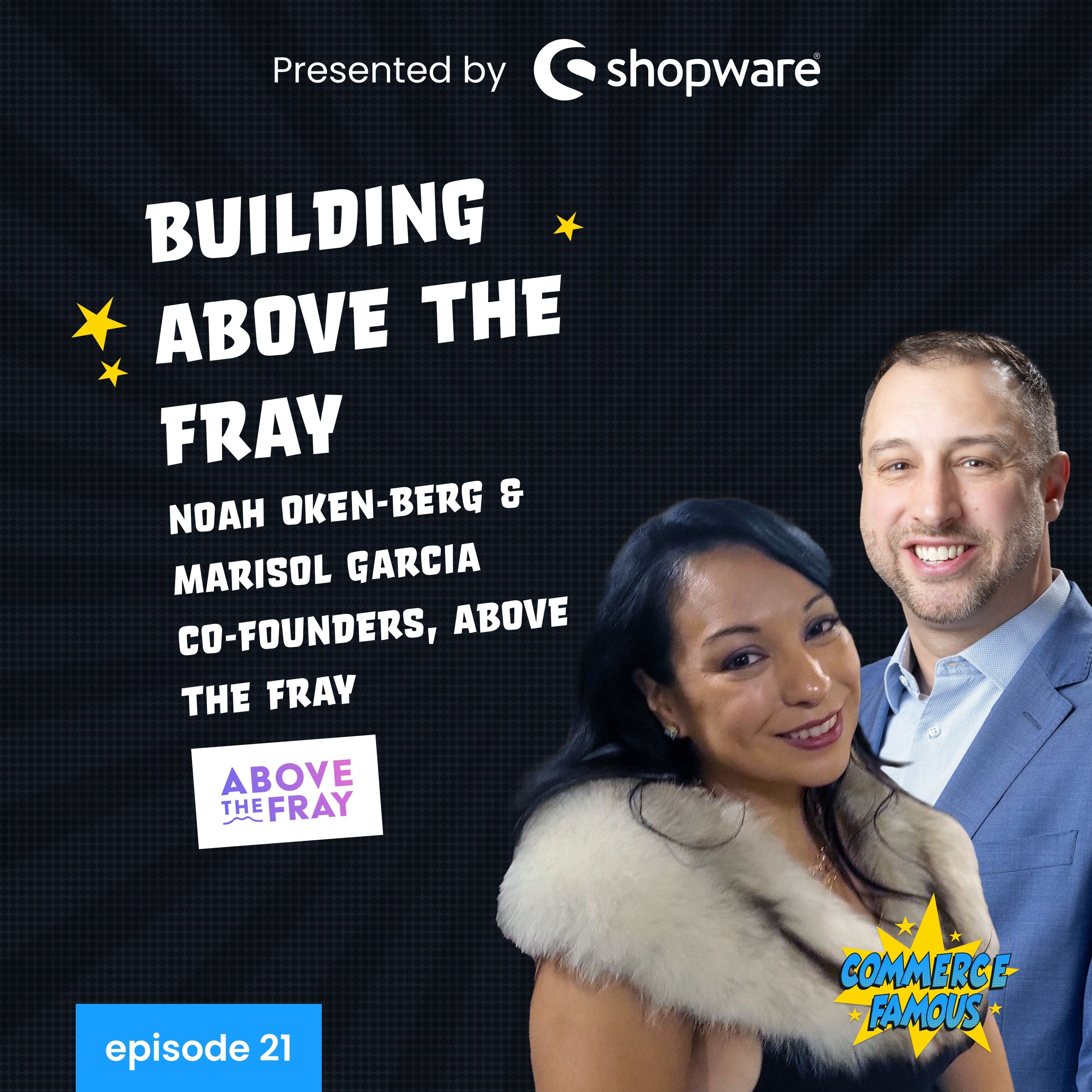
021 | Noah Oken-Berg & Marisol Garcia | Building Above The Fray
Worum es geht
In dieser Folge von Commerce Famous spricht Ben Marks mit Noah Oken-Berg und Marisol Garcia, den Mitgründern der Agentur Above The Fray. Sie erzählen von ihrem Weg in den E-Commerce und wie ihre unterschiedlichen Hintergründe – Noah aus der Wireless- und Agenturwelt, Marisol aus dem Rechnungswesen – die Gründung ihrer Agentur im Pacific Northwest prägten. Ein Einblick in Agentur-Dynamiken, den Wert eines globalen Teams und die finanziellen Entscheidungen hinter ihrem Erfolg.
Autor: Commerce Famous Podcast
Zu Gast
Noah Oken-Berg bringt Erfahrung aus der Wireless-Welt und dem Agenturbereich mit, während Marisol Garcia eine erfahrene Fachfrau aus dem öffentlichen Rechnungswesen ist. Gemeinsam gründeten sie die E-Commerce-Agentur Above The Fray im Pacific Northwest.
Folge teilen
Transkript
Welcome to Commerce Famous, the biweekly podcast all about ecommerce and retail. In each episode, your host Ben Marks cuts through the clutter and takes you straight to the stories and experiences of those who shaped digital commerce as we know it today. While their names and faces might not be recognized on the street, each of Ben's guests are famous for commerce or commerce famous. Without further ado, your host, Ben Marks. Hey.
Hey, everyone. Welcome to Commerce Famous. I'm your host, Ben Marks. Now with me today, we actually have a a twofer. So we have, Noah Ockenberg, who is, actually have a a twofer.
So we have, Noah Ockenberg, who is the CEO and cofounder, along with his wife, Marcel Garcia, who is a CFO. Now they have, above the fray, an agency operating out of the Pacific Northwest. I've had the pleasure of working with this team over the years. So without further ado, Noah Marsal, welcome to Commerce Famous. Thanks, Ben.
Thank you. I really appreciate you you both taking time. I realize I'm taking two leaders out of, out of the loop for for about thirty minutes here to to bang out this podcast, but it's it's a it's a real treat to actually have, to have two people on the podcast at once and then, you know, a couple at that. And I, I'd love to just I'd love to to go right in with Noah, like, your your background. I mean, you came up, you came up, I saw, on your your CV.
You did, you were in the the wireless world back in the early the the early aughts and then eventually kind of found your way into some of the agency space. And then at some point, you know, you found Partners in Crime to build, put together, you know, 2017, yet another, commerce agency. Now I've had the pleasure of working directly with you all, in my my, my my previous work at at Magento during, during some interesting times in commerce we'll get into in a moment. But I wanted to just ask, what convinced you or showed you that there was an opportunity for both of you, for your experience leading a company and then particularly finding something that was, a a different kind of offering in this space? I mean, it was kind of born out of, I guess, paternal, maternal instincts.
Yeah. We had, we had I we'd been in that world before. Aaron Hunt and I, who's, you know, our cofounder, had worked at another agency for a few years together. We had always talked about doing something, and then, I was working, you know, my at a at a company that was in software development, web development, web design, but not competing necessarily directly with ecommerce. So it was more of an area that augmented it, and we were trying to get a SaaS platform off the ground.
It was a little slower to launch than it expected. And, we we were getting married. We got married. We had a baby on the way then, and it was just sort of like everything kicked in. It's like, you know, gotta go hunt and provide and gather and, you know, feed feed the children and stuff like that.
And so we started a company on the side to to kinda accelerate accelerate that. I guess it was just, you know, pure pure instinct I I could say. Okay. Is that is that, that your experience as well, Marisol? It was born out of necessity, I would say.
Yeah. As, you know, I I come from a public accounting background and, really always looking at those finances and where we headed and as a family and budget and everything else. And we're gonna have a new child and where is that going to lead us? And really trying to, you know, we've had had conversations in the past about where, you know, our future goals were going to be, and it seemed like this was a great time to kind of dip the toe in the water, so to say, and kind of see what was happening. We both had, stable careers at that point, with that wonderful monthly paycheck that you always get.
So kind of diving into that, business world can be, at least for me, who's a little bit on the more conservative side fiscally, a little concerning. I like that consistency. So, I thought this was a good well, I shouldn't say just me, but we thought this was a good opportunity where we both had that, you know, steady paycheck to kind of see what else we could do. Commerce famous is proudly presented by Shopware, the leading open source ecommerce platform for mid market and lower enterprise merchants. More than 50,000 clients already process over $25,000,000,000 in annual GMV through Shopware.
Find out more about Shopware and the best value in e commerce at shopware.com. Okay. So because kind of on the the strength of that reliable stream of income, you know, you get to you get to take the chance out. I've had the pleasure of working, you know, working with or at least being, you know, in the same kind of spheres as, you know, some great founders out there, including including, you know, the amazing founders in in the agency space. You know, I've recently had Kevin Eichelberger, who's a founder of Blue Acorn and, you know, basically the person who helped make my career possible in in the first place.
You know? And I know, even even someone as as rock solid of of an operator as he is, you know, there were there were there are times. It's never it's never easy. There's never there's never a set formula for success. So, you know, you all you all embarked on the above the fray adventure, and then, you know, not not too many years later, we wound up in this pandemic situation.
I have to ask if you if you don't mind sharing, what was, you know, what was what was that experience like for you all because there was this this this rapid, you know, compression of compression might be a generous term, right, of of of of of cash flow, you know, and and then and then sort of the the the reverse, in extreme. Like, came that that came true not even a few months later. But, you know, but, again, this was about the time that I really feel like I got to know got to know you, Noah. What was what was that experience like for you all? So, you know, Marisol mentioned how she likes the stability, you know, or was mentioning the comfort of a consistent paycheck.
I'm in sales and business development. There's no consistency is an illusion. Right? Like, when you're in when you're in business development and sales, you're on the front lines, and you're there to help build that illusion for the rest of the company. And so I've always been in that role.
So that it's I mean, yeah, that that was that was a really intense time, and it was, really difficult for a lot of folks, ourselves included, everybody on the planet, especially those in business that was watching it shift and unfold in front of their face. But by the same token, you know, we work with also a lot of other business owners and entrepreneurs. You know, our focus is b to b. You know, the the ways that the, our platform partners, the way that our clients and the merchants and manufacturers that we work with responded, was what I would expect and what I really love about, you know, sort of the the the community, the extended community we work in is that it's like, alright, great. Change is the only constant.
Changes can you know, it's neither good nor bad. Inherently, it just is. And so it's really up to us to to grab the the bull by the horns and figure out what we're gonna do together. You know, how do we roll up our sleeves, get creative? How do we tackle this new sort of landscape that's in front of us?
And there are the folks that kind of threw up their hands and said, you know, the world is ending and, you know, I give up. And there's people that really got affected and didn't have the luxury of a lot of the things that we did, being a remote, you know, you know, virtual organization. The work that we did was not brick and mortar necessarily, though we do did work with a lot of folks that are brick and mortar, so they were affected. But, you know, we were able to, you know, help push the the the tools and advantages that we already knew existed for, you know, remote virtual digital commerce, to the folks that maybe hadn't embraced those as much. And we kind of we instantly knew, like, there was a responsibility on our shoulders to and and all of us.
I mean, you probably felt this too, I'm sure. I know you did because we worked together during this time. Yeah. Yeah. And and we got creative and we figured out some stuff together that helped, you know, keep all of our organizations, you know, not just afloat, but really thriving coming out the other end of it.
But that's what it took. It took that sort of the the standard entrepreneurial vision of just like, hey. Things will get thrown at me at any given moment. You know, let's be ready for it and let's let's adjust. And Marisol, I mean, you, you know, you must have had a particular view on this.
Now I can I can empathize because I, I actually took accounting in college? I mean, I dropped that shit after two weeks because, you know, it was an 8AM class, and I'm sorry. I just I couldn't wrap my brain around it. And I that's why today, I actually pay decent money for someone who can wrap their brain around it. But for you, like, you, you know, you you must have experienced that, you know, in a very particular way.
You know, were you, and I and I get that it is amazing that because you were remote first, that became that just became, like, such an advantage that you weren't paying for facilities that you couldn't use, that you already had everything set up for your company, to be able to operate, you know, at a distance virtually. Were there were there any takeaways from from from your perspective, Marisol? Yeah. Really, what I thought was interesting was we were able to pivot really quickly, because of the way we are structured and kind of the things we have in place. We were able to really focus on what was going to keep us afloat right away.
Mhmm. So while other people were kind of struggling, like, we don't have the infrastructure, we have to figure out what to do with our lease. What are we gonna do with all this office space? We didn't have that. We were able to pivot quickly and really respond to what the environment was at that time.
We were also able to kind of take some of I don't wanna say advantage, but of some of the programs that were out there, you know, from a financial perspective, there was a lot of assistance that were out there for businesses, small businesses, emerging businesses. You know, we had PPP loans. We had, you know well, actually, you know, the employer retention credits, things like that. While we weren't able to capture on everything, you know, piecing things here and there together to make sure that we had that safety net, kind of was, I don't know, for me monumental, just for my comfort level. Even if we weren't specifically having to dip into it at that point, we had something that, you know, we were able to plan for future and growth.
Yeah. It was incredible. I mean, I, you know, and I should probably share with with folks, you know, the colleague of mine at I was I guess this was Adobe at the time, but coming out of the Magento days, Peter Sheldon, who's over at, Marago now. But Peter came up with this idea because we were hearing about we had some fantastic partners, and these businesses, thankfully, are still around, many of them, who overnight as sharp as a lot of these founders are, hardly anyone figured on a pandemic that would shut things down so drastically and essentially just dry up CapEx overnight. Right?
And so we a lot of businesses were faced with, you know, going from a position of strength and and, you know, nothing but a, like, a history of success to literally some of them were wondering if they could keep the lights on. Like, and this is, you know, in the in the in the span of about, you know, a month to six weeks. And Peter had this this great idea like, hey, well, you know, we let's put people to work on the core product and let's help let's help, you know, let's help reinvest into specifically into the ecosystem, that has has has, you know, enabled the business for all of us. And I think that was that was a great demonstration of of a well curated ecosystem. And then watching how quickly, though, things turned around, went the other way as as e commerce really took off.
It was interesting to see you you really you really did see the businesses that were, whether they had planned it or not, had that agility, had that flexibility, had that, you know, pivot mindset. And it seems like that's been that was the case for ATF as well. Now, you know, now that we're in a thankfully steadier, slightly steadier time, what do you all, you know, what do you all see these days? What are the big trends for you? And then, might as well, I have a specific question I'll ask you just about your advice for others in this space given your given your specific set of skills.
But but just, you know, for for for either of you, what do you see as, like, the important trends today? Do you see anything interesting coming down the line? Yeah. I mean, I guess I'll I'll go first so you can ask the specific question of of Mari, there. Since she has much more of a specific, skill set than my generalist, you know, college studio background, but, you know, I I think, and it it's it's something that we've always kind of held as as as a given, but I'm starting to see it become a lot more accepted as as the way it is.
And, you know, I feel like there was this huge buzz around, like, sort of like buzzword and, like, oh, b to b is this this new thing and it kind of evolved into, well, b to b is just like b to c and, you know, really now, I I feel like it's starting to come around where it's it's just understood that that is just how business is done. I mean, be the the sort of b to b mindset, the the the nuances, it's no longer sort of a a trim, like, or sort of like a a shiny thing or like some kind of like fashionable thing to talk about. It's it's people have settled into where we've been at for a while, which is understanding, you know, the way that that businesses interact with each other, support each other, help grow each other's business, trade with each other, you know, sell to each other. You know, and I think that in some of those ways being in this world of ecommerce that that we've been in for for years together, Ben, you know, we're we're seeing that, like, a lot of these folks, especially that we work with manufacturers and things like that, you know, you say b to b and they just, like, kind of their eyes gloss over there, like, oh, you you you think that's just a buzzword, that's our lives.
And we, you know, we we get that a lot of times ecommerce doesn't have that that ring to it. There are, you know, folks' eyes will just glaze over. You say ecommerce, you say, you know, web design and web development, digital engagement, dealer engagement, you know, distribution channels, things like that, all the you know, all the other business systems. And I think really viewing the the world of ecommerce is a lot less of specifically the the sort of traditional mindset of ecommerce and understanding that it's just part of commerce. It's, you know, folks like yourself and and myself and, you know, we've we've known that for a while, but there's people sort of fringe operators and folks that are sort of just coming into that fold that still think it's something that's sort of like this new hot trend b to b, and and those those folks are becoming fewer and further between and really understanding that that's that's where it's at.
And I remember when I started out in the agency world, I mean, this is like, you know, really getting in 2008 up through, like, 2012. I'm I'm still shocked to watch, like, spreadsheets going across the wire or, I mean, literally, there were some, you know, there's plenty of EDI and EDI is is still a thing. Yep. But, you know, even even orders coming in on facts. I mean, I remember that from some of the early RFPs and going, wow.
And so it is it has been interesting watching it keep up now. I just felt like the the the thing I wanted to ask you because, it it's it's pretty rare that I think I have someone on the podcast with, your financial acumen. Right? What are you know, are there are there are there is there are there any, like, perspectives or, you know, tools or resources, ways of thinking that, you think would benefit the the the different kind of operators in the space. And I'm thinking about your fellow you like your fellow agency owners.
I'm thinking about maybe maybe at some degree the the the tech vendors in the space, but but but also certainly for, you know, what you see happening with with merchants, you know, over the last several years. Yeah. It's been really interesting to kind of see the development of our clients. Right? You know, when we started off, the clients were very, you know, the smaller, the data, how things kind of all, work together, the information, how it was transferred from, you know, front end all the way to the back end.
What was the client really wanting and needing, and how could we take that information and really help them grow? Right? Where I think, there is still, room to grow amongst agencies and our clients is that data at the end. What information can we provide you with the tools that we give them to really be able to make business decisions that will impact them for the future growth and development? And so where I really I really enjoy working is looking at that stuff.
So what that person or what that order looks like at the beginning really can provide essential information and tools for, those business owners to be able to figure out, is this a line we wanna continue? Should we be adding new things? What what is that data that the that information is providing us to grow and develop? Okay. Well okay.
So, I mean, it's and that that to me, that seems in keeping with, you know, you I would my how I conceive, you know, your role is, like, you you have very specific inputs, and there's a certain discipline about how you look at those inputs, how you measure them, probably how you set them up in the first place, and then, of course, the outputs. So it makes sense that that that would be your sort of how you look at, the business operations in general. And that's that's, that seems like pretty accessible and achievable or actionable advice. Right? Just get some clarity around what you see going in and understand what's going out, and then you can figure out everything in between.
Now you all have a business. Now how big is ATF these days? How many how many employees do you have? We're just about 40 globally right now. So 40.
And you you, you know, for is it have you have you always had, people working at ATF who were not based in The US? Did that start from day one? Day one, yeah. Yeah, so we, we had, you know, we've, we started off, basically we were all contractors first of all, and so that was a beautiful time, and I remember when we first had to figure out like health insurance and and $10.90 nines are compare comparatively easy. Yeah.
Exactly. It was like, wait, oh, man. Now we gotta wear, you know, big kid pants on and and actually do business stuff. But, you know, we, you know, we we have our model has always been to find the best and brightest on planet Earth wherever they happen to put their head down at night or sometimes in the morning, depending on what your sleep schedule is, but, you know, and that's that's been, you know, from working at other organizations, other agencies, we've made connections in various regions, you know, it's an international community as you know better than anybody, and so, you know, to take full advantage of that has always been part of our model. But it's it's not you know, we we know as an industry, it's not easy to pull off.
I mean, I think there there is a bit of a a selection bias, you know, or depending on how you're thinking about it, an an availability heuristic, you know, because, you know, I you do see people who just who who think offshore work is always bad, always. And and I I I've I've done my best throughout my career. I mean, first of all, I had to figure that out for myself and, and then even go back and and actually amend slash apologize for for indulging a shitty take like that because it's really you know, we only hear about the projects that that don't work well. Right? The the great projects are great projects, and they stay wherever they were.
But we know it's not easy to operate across across, you know, multiple time zones, across, you know, across multiple cultures. And you all seem to have found that formula. And I remember even there were some, you know, there were some real trying moments during the pandemic with your team, you know, but you were able, you know, you were able to keep a good chunk of the team there and together, you know, and I have to believe I have to attribute that to really the culture and opportunity that you put in front of your team and above the fray. And and then if I if I take, you know, Marisol's point about watching, you know, sort of understanding, watching, and and and really using the data going through, that has to be part a component of the success to effectively running a team that is not collocated. I mean and that's whether colocated in The US or in North America or, you know, spread out around the world.
Is that is that is that, am I on the on the money with that? Yeah. I mean, definitely on the money. I think that, you know, as you were talking, I was I was kind of boiling it all down to sort of a root, you know, differentiator. I think we're all kind of products of of the trauma that we've experienced, right?
And like not to get too esoteric here, but Wow. Taking to pull Marking I'm I'm marking the tape there. No. I mean so listen. So hear me out here.
You mentioned, you know, we've had those bad experiences. People we've worked with merchants, manufacturers, agencies that have worked with overseas teams. They see something go off the rails, and they they place that blame on the the language barriers, the time difference, the the the cultural differences. But, you know, if you've done this enough, sure, those are all factors, but those are all excuses for things not working out. I've also seen people that work in my own very backyard screw things up way worse than anybody halfway across the globe could have done it.
And it doesn't matter if you can go kick in their door and and find them who's really gonna go I mean, maybe I know a few people in our in our industry that might go kick in a door, but, you know, people usually don't do that. So it doesn't really matter if if you have the right system set up, if you if you're encouraging the right behavior, if you're finding the right people, if you're putting in the right process systems and tools around those people, it's it's just a it's just a consideration, location and and those things. So, you know, that being said, sure. Are there are there, places where, you know, in the world that have I mean, you know, we've seen how, like, like, different platforms, you know, certain regions have been built out of those regions. And, you know, so there's definitely areas where a community or a culture is built up around a particular, you know, type of work and be that software development, web development, e commerce, but by the same token it's, you know, it's it's not using any of those things as I think an excuse and I think that's where, you know, when you when you when you touch one stove and it's hot, you know, then and then and then every you don't touch any more stove.
I guess that's probably a good idea. Bad analogy. Don't touch stoves even if they're hot or not. But the point being is don't, you know, don't draw a correlation, you know, from causation. Right?
I mean, there's, you know, there's ways to accomplish these things, and and it's also if you don't know the answers, find somebody who does. I I struggled for a long time building our overseas team until we got some of the right people on board here that were able to sort of see through all the noise, see things that I didn't. I'm a sales guy, we had an accountant, a designer, you know, those are the people that started our company. It wasn't until we got, you know, true we had amazingly talented engineers, but we didn't have true engineering leadership until we had certain people on board, and they don't care where you're on planet Earth. They they know how to to to manage that and organize that to success.
I mean, that's a that's a yes. That's a tough one. I I should actually just go ahead and mention. I remember, I vividly remember, somewhere around the age of six, wondering how quickly the eye of a stove gets hot, and I tested this with my fingertip. It turns out it gets hot really quickly, and that is hopefully a lesson you learn once.
Yeah. So so I think that that that makes sense. I do wanna ask, so, you know, there's so many people in this business. I think, you know, so many, founders, leaders, there there are a lot of of I think there's a lot of shared context. There there can be a lot of, a lot of a lot of knowledge that that it gets it gets learned sometimes the hard way, you know, if you as you go from company to company.
Do you all interact with other, other agency owners and and just just to compare notes and and get it you know, take advice and the like? Yeah. I mean, we, I I had something going for for a few years. We actually started it, back, I think it was kind of pandemic era, the shutdown era, but it was we were doing something weekly or monthly, I should say. I think it was on, like, second or third Thursday where it was we called it rising tide, but it was literally just getting together with a bunch of other owners or or business leaders to, you know, compare notes, compare, you know, stories from the trenches, cigars.
I think it's a huge advantage that I get to work with, two other cofounders, Marisol and Aaron. Yeah. I'm I'm I'm really blessed and privileged that way because I'm not isolated, you know, when the the proverbial shit or even the real shit hits the fan. You know, I got people that I can sit down and, you know, I got people I can sit down and and consort with. Are we getting, connection issues here?
Is it all good? Nope. Nope. All good here. K.
Cool. Yeah. So and I and I acknowledge that a lot. You know, there's a lot of professional organizations where, you know, like locally and other chapters of things where, you know, solopreneurs and, you know, solo founders and things like that get together and I and I made me realize, I was like, I got something I'm a little bit, you know, lucky to have, which is other people to commiserate with, to to cry on their shoulders, to, you know, bleed on their shoulder, whatever it might be, the the the stuff that you go through. Yeah.
Probably, if you have if you have great founders in the room, they, yeah, you all compliment. Yeah. Mara, go ahead, please. Oh, yeah. Just to add a little bit on top of that, I mean, we all kind of, you know, come you know, when you look at business and you think about, you know, a board, you know, everybody has a little bit of different perspective, different background, and having those different ideas can really bring together solutions and things that just one person wouldn't be able to talk about or come up on their own or better collectively.
And so it is really nice to have the three of us. But on top of that, that rising tide, I think during that pandemic era is when it was it started. It was nice to know that you aren't on an island. It wasn't just ATF who experienced these issues. You know, shortly coming out of the pandemic, you know, all of the issues with, finding talent, and how that was going on.
And still to this day, it's difficult to find talent, you know, kind of going back to the question previously, you know, it starts with the interview process and really trying to figure out if you're the right fit for ATF. One, we we're kind of hope everybody has a skill set. Right? But really, do you have that, extra little piece that can really thrive in an ATF culture and environment? So it's really nice to know that you're not on an island and, you know, going to different conferences, meeting other agencies, having conversations.
I come from a little bit of a different background, so they kind of look at me like, you don't know anything about ecommerce. It's like, well, I can talk to you about it. Can you hear me? But but it is it it is nice to have that, camaraderie. Yeah.
Well, I mean, I I would I would think, woah, woah, woah, to the person who wants to dismiss you because, you know, you're you're, you know, you're just a finance person. Right? There is there's clearly a discipline and a perspective there. In fact, I'd love to, I'd like to to end this this conversation with a with a question for you, Marisol. If, you know, if there's is there is there, you know, one thing maybe it was one weird trick or no.
Is there just I I I can imagine that in in the space, just based on the, you know, hundreds of agencies I've met and chatted with over the years, Is there one thing or resource or perspective that you would want to impart to that group if you had them assembled, you know, in front of you at a keynote just that would make, is something that you think would make a material difference in how they run their business and hopefully help them have, you know, experience more stability or more success, what would that be? And you do this for me on a daily basis. These are big. She's throwing at me on a daily basis. I think when I think of it, and it's not just, I guess, unique to the commerce world, is just staying on the offense.
Do not, settle for what is happening now. Always thinking about growth, always thinking about that future opportunity, invest in yourself, as a company, and just really, you know, we're we're get so caught up in the day to day transactional, putting out fires, making sure that this, client's happy or whatever we're doing on that daily task that we don't necessarily look to the future. And so always looking for that future, that next product, that next opportunity. How are we gonna continue to grow and sustain? I love it.
Look up and out. Does that mean if you're approving that headcount that I've been asking Phil for a while? Is that is that what I just heard? That'll be a later discussion. Man.
That'll take a lot. I thought I had interesting, you know, dinner table discussions with my wife. Yeah. Our our son our son often is like, can we talk about something besides business at dinner? He's six.
He's six and you know? I get it, but you know what? It's probably gonna end up being a founder that'll that'll out outpace all of us just because of that. Well Hopefully. Noah, CEO above the fray, Manasol, CFO above the fray, cofounders along with, with Aaron, Aaron Hunt, who I guess I should probably get on the podcast sooner rather than later.
Oh, yeah. I really again, I appreciate you both taking, taking time. It's not often that I get to, waste waste the time of of two c suite folk at once, but I, you know, I appreciate the conversation, and I look forward to the next time we all get to see each other out and about in the world. So thanks again. Thank you.
Yeah. Thanks for having us on, Ben. It's been fun. Far from a waste of time. I was hoping this get, like, a little, like, Emilio Estevez, like Young Guns, Billy the Kid, like, I'll make you famous when when this came on.
Like, I was thinking there'd be a little sound by it or something like that for Commerce Famous, but You know, I haven't I haven't hit stop yet. So, I mean, if you wanna do Young Guns quotes, we can go there. Oh, you're huckleberry. Yeah. No.
I am Do you not see that chicken? Yeah. Oh, yeah. All right. That's beautiful.
You know? We gotta have a good ending. I love it. That's that's, yeah. We could, maybe I should do another podcast, you know, movie movie quotes.
No. But, guys, thanks again. Really, it's, it's a it's a pleasure to work with, it's a pleasure to work with real capable operators, I find. I learn a lot every day in this business, and, today was no exception. So I'll, I'll see you soon.
Thank you. Beautiful thing. Thanks, Ben. Appreciate you.

Veröffentlicht mit CiteCast