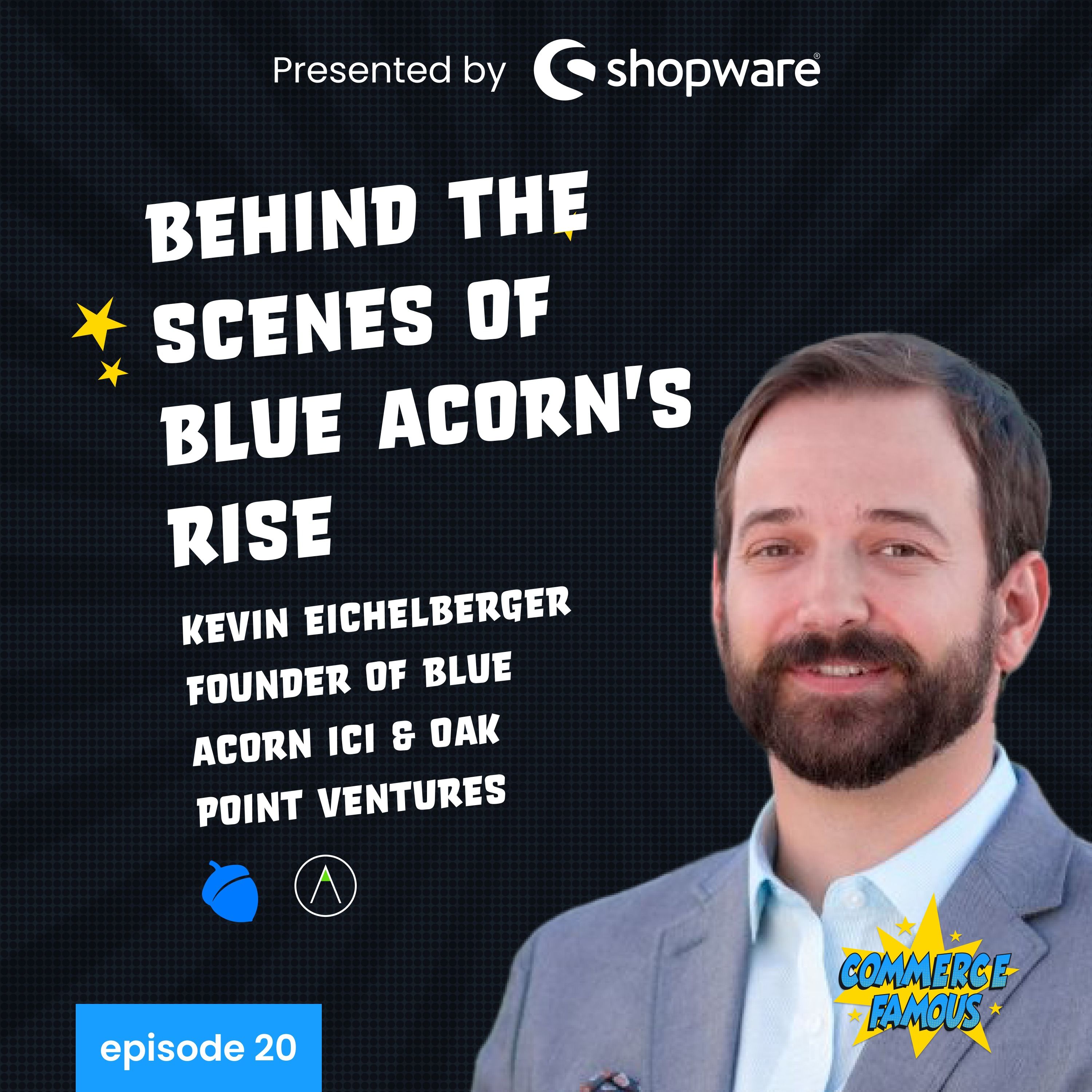
020 | Kevin Eichelberger | Behind the scenes of Blue Acorn's rise
Worum es geht
In dieser Folge von Commerce Famous spricht Host Ben Marks mit Kevin Eichelberger, dem Gründer von Blue Acorn, bei dem Ben einst Mitarbeiter Nummer eins war. Kevin gibt Einblicke in die Anfänge von Blue Acorn, die Herausforderungen im E-Commerce und die Entwicklung der Branche. Das Gespräch beleuchtet Themen wie Social Commerce, verändertes Konsumentenverhalten und unternehmerische Chancen im E-Commerce-Ökosystem.
Autor: Commerce Famous Podcast
Zu Gast
Kevin Eichelberger ist der Gründer von Blue Acorn und teilt in dieser Folge Einblicke in den Aufbau des Unternehmens und die Entwicklung der E-Commerce-Branche.
Folge teilen
Transkript
Welcome to Commerce Famous, the biweekly podcast all about ecommerce and retail. In each episode, your host, Ben Marks, cuts through the clutter and takes you straight to the stories and experiences of those who shaped digital commerce as we know it today. While their names and faces might not be recognized on the street, each of Ben's guests are famous for commerce or commerce famous. Without further ado, your host, Ben Marks. Hey, everyone.
Welcome to Commerce Famous. I'm your host, Ben Marks. Today's episode, we have a guest near and dear to my heart. Kevin Eichelberger, founder of Blue Acorn, now Blue Acorn ICI, part of Infosys, hired me as employee number one back in 2008. So if there's anyone responsible for unleashing me on the, world of ecommerce, it's really this guy.
I'm sorry, everybody. I believe the the origin story for me at Blue Acorn started with, I sent you what I believe may be the world's worst cover letter. I argue the best. And, and I stayed with you from, what, o eight to 2014. Six years.
Yeah. And then, you know, then Blue Acorn went on to become, I think one of the one of the biggest biggest agencies, you know, in the Adobe Commerce space, and and I think even some other some other platforms as part of, now part of Infosys, if I'm if I remember correctly. That server is correct. Do you miss it? Absolutely.
Miss it every day. Every day. It's it was a good it's a good I mean, and some some of the people that even I worked with back in the day, they're still there. Chris Guerra, Emily Wilhoite, and and more. And then it's interesting, you know, when we get together in Charleston for our, little commerce collective, I think pretty much everyone there is, you know, at most one degree removed from Blue Acorn.
That's pretty remarkable to see the impact everyone has had, like, people like yourself just in the ecosystem, you know, just kind of taking what we started and rolling with it and running with it and just the impact had by so many people has been amazing to see for me. Yeah. It's it's, I mean, you know, when you were so what you know, you know, let's see how much I remember about the the backstory here. Because it was, you know, for a long time, it was just the two of us, and then we had, then we had a third, we don't talk about him. And then we had, you know, Luis, TFSN, Thomas Slade, you know, and it just it kinda it kinda grew.
But did you have, you know so you were you were you were you were a bartender in Atlanta. You you had some, you actually you were a retailer yourself. So, yeah. If you in fact, booze and gear is still around, is it not? That it is.
My brother, continues to run it to this day. Right. So, you know, Kevin figured out and I'm a I'm a reformed bartender myself and, you know, it was always cool the the distributors would come through and, like, you they have the cool swag and your your regulars are like, hey, how do I get that hat or that shirt or that bottle opener or whatever? And you just have the insight to say, well, let's go to the people making this stuff and we'll just sell it until someone tells us we can't. That started when someone wanted to buy the hat I was wearing on my head when I was bartending.
And I knew I bought it for $5 for my brother because he worked at a distributor. And I was like, this is pretty cool. People wanna buy this stuff. I'd like to buy this stuff. I wanna wear more of it.
And there was really nowhere to get it. Yep. And so it was great because you had so you had the you had the retail side of the experience, which I think was pretty helpful. You dabbled in I mean, you also dabbled in some some coding. Right?
Because you were working with what was it? B b b commerce? Oh, yeah. It was a dot net platform. And then I also had originally launched the site on a custom built PHP platform platform Oh, right.
That I made from scratch. Right. Because you were so pissed off because you couldn't get the it couldn't do the, the SEO stuff that you knew it needed to do. And the analytics stuff and OS commerce just seemed really wonky. Yeah.
It was before, you know, more modern open source platforms came around and, yes, at that point, it was early in the days of build it versus buy it and Yeah. I built it and then realized what a shitty developer I was. And, yeah. It led I mean, it lasted several years. It was surprising how long I made that thing tick.
I'm glad you never realized how shitty the developer I was. I once that's that's not true, Ben. I once brought out the code that I still had to some of the Blue Acorn employees and showed them so that everyone could have a good laugh. Yeah. And I was setting that up for, like, you to say, yes.
I I did know how bad a developer you were. So, and then as time goes on, we we there were some interesting approaches though in the beginning. I remember we, you know, we partnered with, you you had some interesting arrangements with the customers where there was a bit of, like, you know, hey. We'll we'll handle not only the, you know, the the custom coating side of the business, but, yeah, we'll we'll also handle marketing, and, you know, we'll and and, basically, the arrangement was we'll take a share of the increase in in revenue, which which, you know, for me, I'm I think I felt lucky that I started out there because it taught me it taught me to really, respect and value the a relationship focus in the space rather than just a, you know, sort of, you know, a puppy mill. Like, just, you know, just build the site, push it off on someone else, don't really care about the results.
Yeah. That was largely the norm. And, you know, what motivated me was driving results in numbers. And I knew that design and development were part of that equation, but not the full equation itself. And if we wanted to help our clients drive revenue, we really needed to help them in a variety of ways.
And generally, you know, when we started off, smaller clients would prefer to work with less vendors and have them do more things. And as we moved up markets, you get more specializations and people that are trying to find the best SEO agency, the best PPC agency. Yep. And so over time, we kinda narrowed our focus to just the things that were on-site. So that brought us into a lot of analytics and AB testing and more of the sciences behind commerce.
And, you know, that to me was I'd rather see results in numbers and just here's a before and after picture of the website, you know? Yeah. Yeah. Yeah. Absolutely.
Right? Because it's really the true measure of whether what you did made a difference or not. And, and then, you know, as time went on, we, you know, the the the clients the clients got bigger, the builds got bigger, the scopes got certainly much more substantial. You know, you graciously shared me with, with Magento starting in 2011 and then started splitting my time, you know, doing education for them and then coming back and usually sneaking up behind new hires, and there were always new hires, sneaking up behind them as they were watching the videos of me doing the trainings. How's it going?
And then, you know, and then enter, you know, circa 2015, Magento two comes out, you know, a whole kind of a seismic shift in that world. Those were interesting days. I still, I still encounter people with who who who describe it themselves as still suffering from PTSD from those days. It was it was, you know, as a as the industry was getting, you know, more and more advanced to to where it is today, which I'll I'll ask you about in a minute, it, yeah. There was a, arguably, a worldwide bloodbath, around Magento two.
And I mean, and I, you know, I certainly have a little culpability there because I was at the developer betas. We we kinda knew. We heard the complaints, but we, yeah. We didn't we didn't steer things. I'm sure that wasn't your decision in the end.
Not not my decision, but I I could've I could've yelled more. I could've yelled more. Yeah. Those are I mean, it was definitely rough. And I think as an agency owner, what it did for me was shine the light on how important it was for us as we scaled our business to have diversification in our portfolio.
Because being solely dependent on any one platform, which we were, you know, Magento specific for the first nine years. Yeah. And so it really, you know, showed a light to me that we really needed to have some other platforms that we would work with. And so we, you know, brought in Demandware, which became Salesforce Commerce Cloud. And, that became a great partnership for us as well.
But, yeah, those Magento two days and I wouldn't even say the early Magento two days. I'd say the Magento two days for years were pretty rough. Yeah. They're pretty brutal. I mean, it wasn't it probably wasn't until, you know, 2018, 2019 that the product matured into the release quality product that it should have been, you know, in the years prior.
But challenge was, of course, there wasn't there weren't a lot of other alternatives that did what, you know, what it did in that space. I mean, and that that I think if we, you know, take it away from Magento and just talk about, you know, the quote, not to be self aggrandizing, but the, you know, the open commerce approach. You know, you even see some of the SaaS companies like BigCommerce have branded themselves in that way. You know, was it, so I guess it was a deliberate decision to branch out into, you know, into other technologies, you know, sort of take take start spreading the eggs out of out of one basket among and and into being in many. Commerce famous is proudly presented by Shopware, the leading open source ecommerce platform for mid market and lower enterprise merchants.
More than 50,000 clients already process over $25,000,000,000 in annual GMV through Shopware. Find out more about Shopware and the best value in ecommerce at shopware.com. You know, did you you know, how readily so I was I was more or less I think I was pretty much gone by then. Was, you know, how was that how was that taken inside the company when you made that when you made made the decision to say, hey. We're gonna take on this project, and it's gonna use this as the platform.
And I think pretty much everything was probably a different language, different, you know, certainly a different set of skills. Definitely, your team was highly supportive of it. I think everyone was thirsty for learning new technology. You know, a lot of engineers are really always interested in, know, what's new, what's different, and learning something new. And, you know, work with with any platform for any number of years, you kind of get thirsty for some variety.
So, I think the team was really, ready for it and open to it and supportive of it, which was great. And, you know, it was the right business move to make. And as I think back, I actually think we did it right before Magento two came out. But the hardest part was, Demandware held their annual user conference a week before Magento's, both in Vegas. Oh, wow.
And we announced our Demandware partnership one week before Magento Imagine. And at that Magento Imagine, we were awarded the North American Partner of the Year. And the flames that were being fanned inside of Magento because of that announcement and the timing of that announcement in particular, there was a lot of damage control we had to do inside of Magento because, you know, obviously we're happy about us being Magento only for so long, and then our announcement of adding a highly competitive platform for them Yeah. A week before we were announced as a partner of the year was was tough. Well, you know, I've I've from my platform perspective, I would say, well, you know, if you guys built a better platform, wouldn't need to branch out.
Right? Yeah. And then as time goes on, you know, you've you've, we're actually having a we're having a, you've you've called together was it, you know, Avengers Gather, tomorrow. We're having a Blue Acorn alum get together, you know, happy hour here at, here at Mandalay Bay. Looking forward to that.
Looking forward to seeing, seeing Tedrick, who's gone on to have just, you know, one hell of a career Oh, yeah. After his start there. And, you know, the the journey that the team has been on, you know. So you're you're you're fully out of the business now. Yeah.
And, now but there was, you know, after a little while, you you eventually, I think, had the wise decision to, you know, to to sort of lock in some of the value that you'd created there. And, you know, and that got you involved into a consortium of businesses, that you had to go and and organize. What was what was that decision like? Was it, was it taken well, of course, it wasn't taken lightly. But, you know, was that was it a challenge in those days just to to to sort of split your attention among several companies?
Or was it just kind of an an interesting reprieve and and, you know, everything at Blue Acorn was just sailing along smoothly? Yeah. Well, I think, you know, a lot of entrepreneurs get, there's been some research that says by about year eight, they get an itch to do something else. Yeah. I don't know why it's year eight, but that's kind of the average.
So for some people might be year one, they wanna do something different. Some people maybe they'll do it for twenty years and never look back. And I think for me, it was around year nine or 10 where I was like, I'm just ready for a a new challenge, something different. So you know you I'm building the agency scaling it, but it's a lot of the same stuff over and over again. Yeah.
And, so when we partner with private equity and acquired a couple other companies and merged them all together, you know, when you think about it from an entrepreneur standpoint, something different could mean I leave and go do something else or start another business. Yeah. But this was the equivalent for me. This was a totally new, different thing, going through mergers and acquisitions, going through the integration process. You know, you've got four different businesses with four different sets of processes and internal systems that they use and different ways to approach their p and l's and trying to unify all that when, you know, everyone rightfully thinks their approach is the best.
How do you break down those walls to get people to be open to trying, hey, out of these four systems, we're gonna use this one. Everyone's gotta go along with that. So getting buy in and change management was a a new skill set that, really had to be sharpened during that period. But it was a lot of fun and and building what we built at Blue Acorn ICI, which is what it's known as now. Yeah.
And then selling that to Infosys was quite a remarkable journey and, mistakes along the way for sure, but, you know, wouldn't change a thing looking back. Yeah. How did the how did the Infosys deal come up? I mean, you know, Infosys is what the biggest tech firm in the world. Yep.
And, you know, how did was it a surprise, that when when when did they approach you? Did you approach them? Or We had a process. So we hired an investment banker and went to the market, and they did a great job of, you know, packaging up the business. And we had a lot of interested parties, which was really amazing to me to see, you know, the the biggest players in the ecosystem and beyond, like, you know, the Infosys of the world Yeah.
All, you know, interested in what we had built and and what we had put together and wanted to take it forward. And, you know, Infosys was a great home for the team. Everybody loves it there. Like, the mostly executive team is still there, and, I really see them thriving in a new environment. And, you know, it's it's got its own challenges like anything, and, you know, you you're part of a much bigger company and lots of layers of bureaucracy.
Decision making can be slow and hard, but, you know, the team's been treated well. They they enjoy working with Infosys people, and, I'm really happy to have found a great home for them because I knew my time was up ready for someone else to kinda to take over. And fortunately, I had Chris there who worked with me side by side for so long and, you know, he was ready for a new challenge too. And so for him to step into my shoes and and take over from there, and I knew Chris always treated the business like it was it was his own. Yep.
I always treated the employees so well and his team, and, you know, I was I was really happy to see him kinda carry the baton forward and still to this day. So it's it's been amazing to watch it happen from the sidelines. Yeah. Over the stands, I guess, now. Not from the stand.
You get to cheer you get to cheer from the stands. You know, and and we've seen, of course, tons of consolidation, in in the space. You you definitely these, these transactions happen in at a good at a good time in the history of of, you know, e commerce agencies. You know, when you look at when you look around the landscape today, so you're now you're you're here visiting ShopTalk, officially, unofficially. We don't we don't comment on these things.
But, you know, you, it was great seeing you last year and then seeing you this year. You know, and you so you you still have plenty of friends in the space. And, the kind of conversations you're having, I mean, it's, was this this it started off interesting for me after I picked up my badge yesterday. It was chatting with the team from, from Vue Storefront who actually are now announcing a rebrand today because Oh. Yeah.
I can go ahead and drop it off. Former former Blue Acorn employee. Jay works there. Yep. Yep.
I actually was he was he was there. And in fact, it was Jay who who we got into this discussion and, you know, they're talking about their, by the time this podcast airs, the news will be out that they are, they're actually sort of expand it's it's not storefront anymore. So they're just they're basically going to be a a, you know, a technology. I'm guessing a front end tech, but we'll know more later today. But they kind of see the the ecommerce space as pretty, pretty tilled over.
And Jay was just saying, you know, just looked at me and said, man, we're all farmers. Like, this is just it's it's everything is such this is such a a well developed commodity at this point that, you know, the peep the people who are in position to extract the most value, I mean, they're there. Those rails are locked down. So you have to look look at and look for new things to do. Are are you happen are you happen to have any of these kind of conversations, with other other people?
Yeah. I mean, I like the you know, as I've thought a lot a lot about the ecommerce ecosystem, and I I came to the realization fairly recently that it's an entrepreneur's playground. Yeah. No other industry that I can think of has it's relatively new industry. Right?
Mhmm. Thirty years maybe, but, you know, not even fully mature yet. And this is right for entrepreneurs to build businesses, software, technology, services, brands. You know, all of these things have been developed by entrepreneurs over the last thirty years, and it's such a unique ecosystem to be a part of because of that opportunity. And, I think that's why you see so much energy.
It's why you see a lot of collaboration. It's why you see a a lot of excitement and energy in the space still to this day. But the conversations I have with people, there's still tons of opportunity, there's still a lot of growth ahead of it. Mhmm. I mean, I don't see anyone thinking it's slowing down, but the farming mentality is for sure, but I like to think of us as like 40 niners in the in the Wild West, you know.
We were out digging for gold. Now a lot of people have been in the same places digging for the same gold, and so the gold is maybe harder to find now, but, there's still plenty out there. It's a it's a perfect metaphor to invoke, you know, one of the classic stories of, Levi Strauss, you know, like, you know, like, well, you know, you got the people running out to to find the gold in the hills, and then you have the really smart people who are like, well, I'm gonna supply those people. And, it's actually yeah. It's a pretty apt metaphor because we, you know, businesses built on that and then the whole thing basically got got kicked off and it just it's it's been going.
It just it changes quite a lot, over time. Is there are there, you know, are there anything, any businesses or technologies out there that are kinda blowing your blowing your mustache back? Mhmm. The mustache reference. Yeah.
You know, the the thing that always intrigues me is and I I try to avoid using the buzzwords, but Yeah. The social commerce aspect of things and what TikTok has done with the TikTok shop. Yeah. And because we've I mean, I know I've heard about social commerce for, like, fifteen years. And, you know, you think of social media as a gathering place of people to talk, to engage with each other, and it's you know what I mean?
Like, you think about it, like, not virtually, but physically. Like, you're in a room full of people talking to each other, having a good time, you know, and then someone walks up with some Tupperware to try to sell you. And it's like, it's an odd place to be selling Yeah. Yeah. In that in that environment.
And but I just kinda always knew inevitably at some point, that will change. Yeah. That will start to become more integrated and more fluid in the conversation instead of, like, standing out like a sore thumb. And, so that's the probably the most intriguing thing for me is where that goes outside of the obvious AI stuff and everything else that's going on. But, that to me is something that I've always been wondering who and when are gonna figure that out.
Yeah. Because I see that as a huge opportunity because if you if you just think about how how commerce has evolved, you know, the whole reason e commerce exists is because of how people shop and how to make it easier for them to buy the things that they want and to be where they are when they are at the moment that they think about buying something. And a lot of that happens on social media. Like, the influencers are just one step away Yep. From selling things themselves.
And, I think you see the the flattening of, you know, the the supply chain. Mhmm. And as that happens, like the Timus of the world and everything else, like, people buying direct from manufacturer now overseas and getting even products shipped directly from overseas. That to me is probably more fascinating because it's just the entire shift from a consumer behavior standpoint. And, to me, e commerce is all about how do we use digital technologies to meet that shift in consumer behavior.
Yeah. It's funny when, you know, when I was here at Shop Talk last year and found out about the the whiteout party, and I'm like, wow. Oh, man. I I need to get something to wear because, you know, I don't really travel with a lot of white clothes. I'm a very messy person.
And, yeah, it was like I went from, I think, three days. I ordered a a white suit. Now this is not this is this is not nice material. It it it's not particularly well made, but it was from, Shein. Right?
So and then and that that sucker, I ordered it. I didn't expect it to get here in time. Three days from China in three days. Damn. That is that is interesting because, you know, I we still see the classic the classic, real world model applied to, you know, online store space.
You know, you have you have effectively you have product categories, virtual aisles. You place things into a cart, and you have these experiences. But then, you do have these moments, on on social media, in the Facebook stream, especially if you're like flipping through videos, which is, you know, I do that kind of mindlessly when I wanna just take a little mental break. But then you have these ads pop up and Facebook Facebook seems to be pretty good at understanding what it is that I want or understanding a problem that I didn't know I had. And so now I have to have this product to to solve it.
And, yes, and I see, you know, I see the same on on TikTok. And, and even Facebook, I think, is now, forcing in fact, you're basically not even gonna be able to to to go off-site. They're really forcing everything, from a Facebook storefront to to to sell through, you know, right through their own, you know, the browser port that they're owning at the moment or or the app. And it does seem like we are we are seeing this iteration. And and this is on the back of, I was, hanging out, playing some music with one of my old bandmates, a few nights ago.
And he had just gotten back from a trip to New York with his middle son, who I think is probably about, you know, 15, 16 at this point. And he was telling me about how they how they were navigating New York for for the few days that they were there. He's like, yeah. Well, you know, we wanted we love pizza. We wanna stop.
So we, you know, we're just looking on TikTok for where to find the pizza. Just follow Dave Portnoy's recommendation. Well, you know, yeah. Dave Dave Dave the obvious, well, in fact, I think they ended up at one of his restaurants in somewhere somewhere in in in New York. And then it was a and then it was a similar thing for, like, dive bars.
You know? So looking up he's looking up dive bars to go hang out, and but it was all on TikTok. And I'm, like, looking at this guy who is you know, he's not a Luddite, but I I just it was interesting that that I would think in that in that moment, I would always go to Google, and I would like I would try and find, you know, address, map, reviews all put together. But it was just natural for him to, you know, having the having the kid around just, you know, they just hop into TikTok and look at this. That for me was like a strong indication that we really are starting to see this shift that maybe those of us in the industry were always trying to to to jump on and claim the new hot thing, but it maybe it's taken a little bit longer.
Like, I remember social commerce being, you know, being the hot topic several years ago. Oh, yeah. But it just turns out that, you know, it's it's it's sort of an aggregate it's an aggregate space, and you have to you have to get people into that mindset. And now we just have kids who have, have always had, you know, the Internet and Well, they grow up with their phone in their face. Yep.
And, you know, for them to see a product to buy in stream of a social media platform is not foreign to them, where it might be a natural to us. Yep. So they're, you know, developing around this world that it's it's native and natural and normal now. And so as those become the major consumer base Yeah. You'll see a lot more of that behavior happening, and I think that's when social commerce will start to really take hold.
Man, that's, I didn't come here today expecting to talk about social commerce. This is weird. I I you know, I that's what I do, man. I I I just I pull the truths out of my guests. Sometimes I really think I help the guests really meet meet themselves, or maybe maybe not at all.
Well, that actually takes us to the end of the, the end of the recording session. And I, but, you know, it was a pleasure watching you play craps last night. It was a pleasure of me not playing, so, I didn't lose any money. We'll see if I can continue this trend of not handing Vegas too much more money. I try the same thing.
I just, you know, try to also make some money too. I could give you I'll I'll stake you and then I don't gamble with other people's money. Well, alright. Looks like I'm gonna have to stay employed and recording podcasts for the near future so it can pay off my house one day. Kevin, man, yeah, thank you for everything, and, and, thanks for taking time to, jump on the podcast with me.
Always a pleasure, man.

Veröffentlicht mit CiteCast