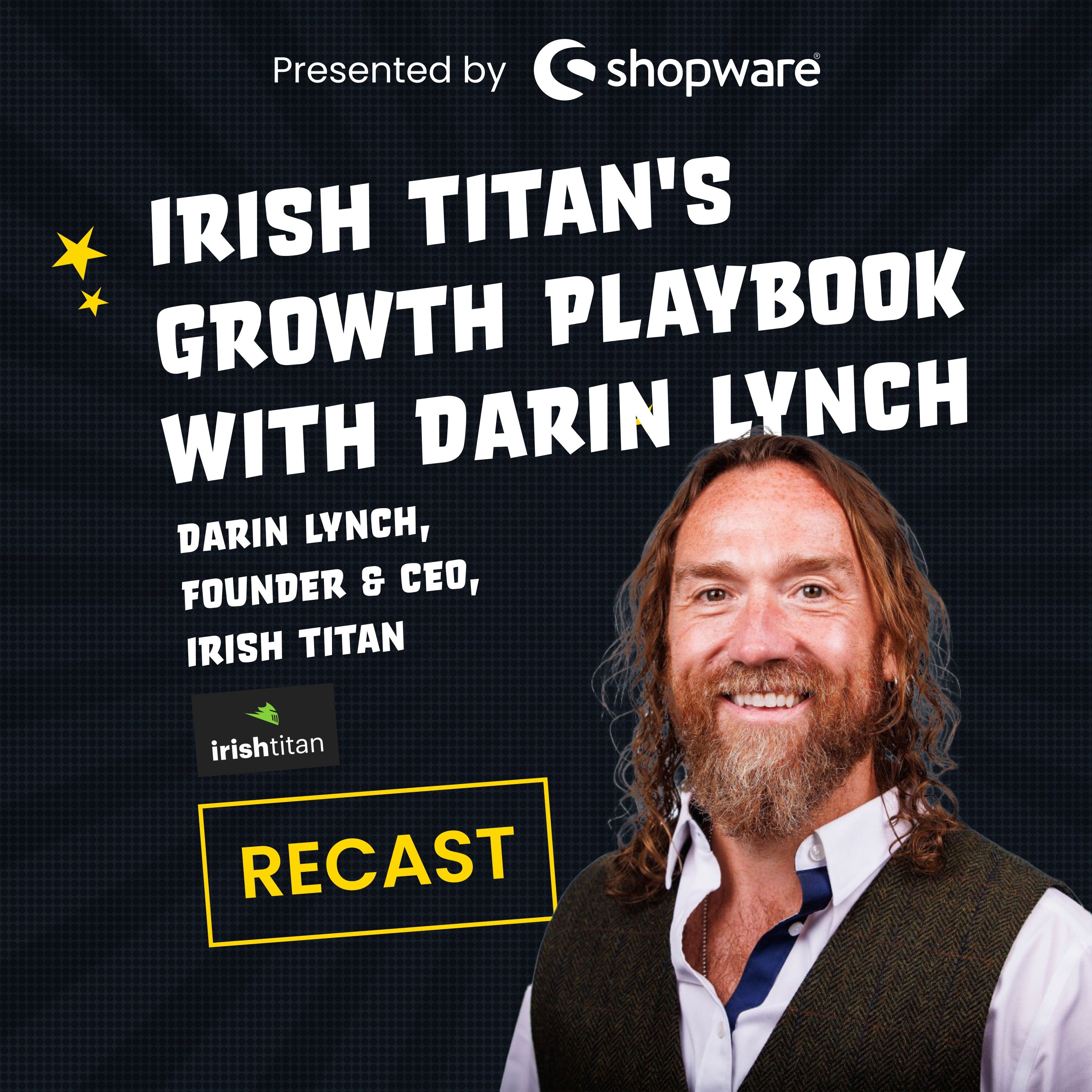
Recast | Darin Lynch | Irish Titan's growth playbook
Worum es geht
In dieser Recast-Folge (erstmals August 2023) spricht Ben mit Darin Lynch, Gründer und CEO der Minneapolis-Agentur Irish Titan. Seit 2004 baut und skaliert Irish Titan E-Commerce-Kanäle nach einer eigenen Philosophie: „Business First. Online Second." Darin teilt seine Sicht auf partnerschaftliche Kundenarbeit und ein Modell, das komplett auf eigene Mitarbeiter statt Freelancer oder Offshore setzt.
Autor: Commerce Famous Podcast
Zu Gast
Darin Lynch gründete 2004 die Minneapolis-Agentur Irish Titan und führt sie fast 20 Jahre später weiter. Sein Team baut und skaliert E-Commerce-Kanäle nach dem Leitsatz „Business First. Online Second."
Folge teilen
Transkript
Hey, everyone. Ben Marks here. As we prepare to launch season two of Commerce Famous, we're revisiting a couple of our favorite episodes from season one. In episode six, I had the pleasure of chatting with Darren Lynch from the Minneapolis based agency, Irish Titan. We delved into the future of ecommerce, including commerce anywhere, and Darren's take on ecommerce three point o.
Darren shared his unique way he's built a thriving company culture from mandatory sabbaticals to a fun office batpole, which I've still yet to slide down. We also touched on evolving consumer expectations and how technology is making shopping more and more effortless for consumers and more efficient for merchants. Enjoy. New episodes launch in June. Welcome to Commerce Famous, the biweekly podcast all about ecommerce and retail.
In each episode, your host Ben Marks cuts through the clutter and takes you straight to the stories and experiences of those who shaped digital commerce as we know it today. While their names and faces might not be recognized on the street, each of Ben's guests are famous for commerce or commerce famous. Without further ado, your host, Ben Marks. Welcome to the Commerce Famous podcast. I'm your host, Ben Marks, and with me today is Darren Lynch from Irish Titan.
I've had the privilege of getting to know Darren over the years, and I don't know that there is anyone more intensely focused on the culture, the company, and really when it comes down to just the community that where he's built it and the community that exists in this ecommerce space. So I'm looking forward to getting into, digging into some of this community focused conversation that we're gonna have today. So, Darren, welcome to the podcast. You know, it's funny. I've I've known of you and finally get to meet you, you know, a few years ago in my my previous life.
But it was interesting to dig into your background a little bit on, on LinkedIn. You know, you'd like like a lot of us in this industry who are, as as you and I were talking about in Toronto just a few weeks ago, you know, a little bit a little bit old and wise, and we didn't necessarily start out in ecommerce because it didn't exist back then. But, you you know, you you you got your start. You were at Principal Financial Group, you know, 9397, you know, working in a mainframe environment, you supporting about 15,000 users. I mean, mainframes probably unless unless some of the kids out there were working for some banks, they may not even know what that is.
Right. And then I even I was I chuckled when I saw Y2K compliance. That was that was also a blast from the past. You went through a few roles over the years for almost a decade, and then you you got into, Wilson's Leather. Right?
And that seems to be where you really kinda jumped, made the made the crossover into what was then. So this is, like, ninety nine zero four, getting into the world of of of bringing, you know, like a brick and mortar business, you know, to this new thing called the Internet. And you were responsible for merchandising, marketing, and, really, I guess, realizing the the ecom dream of Wilson's Leather. Let's just start there. What was that like back then for you all?
Because I guess you were kind of you were writing the playbook for him. Right? Right. Well, thanks for the introduction, Ben. I've been excited for our conversation since we started to schedule it a couple of weeks ago.
And, you know, a lot of the things you said, I could say in reverse. It it is funny how long we've known of each other at first and then just in passing with hellos and how you doing at conferences and stuff. And then I think was it Dallas a year or two ago where we finally had a chance to talk at length, I think, for the first time ever? That's right. At retail summit, coincidentally, another Darren.
She, you know, she runs that whole series, really well with small team. Retail summit, by the way, folks. Great series of events. Very small, very, like, sort of regional local. Boutique feel.
Yeah. And now, you know, I really like that event. I went and talked I spoke with every single vendor there that was that was exhibiting, and every single one of them really, really liked it. So if you get a chance, if Retail Summit is anywhere near you, go ahead and check it out. Yeah.
We're big fans. We've we've supported them for a couple of years now. It's been good for our business and good for the community, which probably a bit of a hint of foreshadowing for some of what we'll talk about. But it is nice for us to have, been building the relationship in more depth over the last years after being in the space for a long time because we're both grizzled veterans. I said I said wise, and you said grizzled.
Well, you know, I think so. I I'll I will circle to your question here, but I've been in ecommerce actually since '98, and you've been in it for a long time too. Yep. And so I used to say because I do a lot of pad podcasts. I do a lot of public speaking, and I used to say, so I'm a dinosaur by ecommerce standards.
Right. And then I realized, well, dinosaurs went extinct, so I should probably come up with a new analogy, and that's when I said, grizzled veterans. So that's now the way I I I catchphrase it. I like it. Yeah.
So I started a principal financial group. I'm not gonna spend a lot of time on my bio, but I grew up on a farm in Northeast Iowa in a small town of 1,800 people and the quote, unquote big towns of 50,000 people were each in a little over an hour away. And even in my tiny little hometown back then in the mid eighties, I think I graduated '89, but in the mid eighties, I started to program. We had a great computer lab. So I was I was fortunate enough to be exposed to that.
So I went into technology even with that sort of personal background, went into principal financial group as one of the I had to be amongst the last crop of CICS mainframe programmers. Right? For sure. And I had a great experience at principal. The best boss I ever had was my first boss at principal, and I had really good bosses after him too.
It was just really timely that my first boss was so great. Taught me a lot about leadership and management. Moved up here to The Twin Cities, and I ran a Lawson software. If if you ever knew of them, they were bought by In for. They were an ERP that was hit founded and headquartered here in the Twin Cities.
I ran their consulting practice that partnered with Lawson Software like we've done with many platforms since then, like Irish Titan does with Shopware now. So one of our clients was OfficeMax, and I ran OfficeMax's ecommerce launch in 1998. Wow. And so way back then, I was exposed to ecommerce, and I thought, I think there might be something to this ecommerce thing. So, when Wilson's leather emerged on my radar as my next stop, I think the single most thing that I found most attractive was the ecommerce opportunity because this was still even in the early two thousands, ecommerce was in its infancy.
And so when we launched ecommerce at Wilson's to now start to circle back to actually answering your question instead of rambling, it was actually more of a function of change management even than technology, which is crazy to say because you and I both been around this industry for a while now and know how much easier the technology is now than back then even though that's still heavy lift. But in the early two thousands, the technology was a real bear. But at that time, the change management around brick and mortars adoption and or resistance to ecommerce, that was a bigger battle. Wilson's has 750 stores at the time, and those stores viewed ecommerce as a threat a 100%. Wow.
Right? And so that was really a function in change management and channel conflict that you know, channel conflict is still a topic now, but even then, it was just emerging as a concept, the the the notion of channel conflict. And so the the place where we invested the most energy in that project was really navigating that. We had a we had a heavy lift in the technology because we had to integrate with POS and our our OMS in the office and ERP and all the different massive retail systems. But but our stores, our associates, our store managers, our district managers, they were resistant to ecommerce, sort of understandably.
Right? Because to them, it was a threat at the time. And now, obviously, it's much more integrated. Nobody can rightfully be threatened by it really even if there are issues of channel conflict to to work through. But those were the beginning the early days of of ecommerce.
Commerce famous is proudly presented by Shopware, the leading open source ecommerce platform for mid market and lower enterprise merchants. More than 50,000 clients already process over $25,000,000,000 in annual GMV through Shopware. Find out more about Shopware and the best value in ecommerce at shopware.com. Strangely, either I missed it, the whole OfficeMax launch on your, your LinkedIn CV. Well, in your defense, it might not be on LinkedIn.
I I haven't updated my LinkedIn bio, my CV in a long time. So the first thing I'm gonna do after this conversation is check it. I mean, yeah, I'm not always great at keeping up to speed on that, but I would I would kind of lead with that at least in your past. But you're right. It it is.
That's already an interesting an interesting point. Boy, it seems like we we spend a lot of time in this in this industry solving problems that that I feel like we've kind of solved before. Now it is the nature of commerce and e commerce and society to just kind of keep iterating and moving forward. I think you and I were speaking about this exactly, again, at the event in Toronto, Rachel Jacobs event. Right.
But the part of the whole purpose of this podcast is to is to take that the lived experience, the lessons learned from the past, see how they can inform what's going on. And then at the end, we'll be we'll be getting into what you see coming down the pipe. So, you know, you, you know, o four, you were done with Wilson's leather. Now, now when did Irish Titan start? So I started Irish Titan in in 2004.
Yeah. And so my ecommerce journey in 1998 launched OfficeMax as we talked about. I think it was 2001 when I launched Wilson's Wilson Leathers ecommerce. I went to second swing golf, And that was I'm not much of a golfer. In fact, I'm a horrible golfer, but Amen.
Love sports. And so it was fun to be at second swing golf as a sports fan, and that was during Tiger's run. So there was a lot of energy in the industry. Yeah. Launched second swings ecommerce.
Yeah. And that was a really interesting experience. So I talked about Wilson's and the the change management. And Wilson's was definitely where I really caught the ecommerce bug at, when I was running Kotelligent, which was the Lawson software partner. That's where I started to see an opportunity there, right, and wonder if this would continue.
Wilson's where I absolutely caught the ecommerce bug, and second swing was where I really doubled down on it and expanding and investing in my experience there. Because second swing, by that point, we had more sophisticated by standards of those times tools at our disposal. Yet it was still really challenging in that we really had a pretty advanced eBay integration at the time because second swing golf, a lot of used product stores mostly have new product. They claim to have used product as a little little bit of a loss leader. 60% of second swing golf product was actually used.
So we would That's like the GSI play. Right? Yes. Absolutely. So we would buy from eBay, which was really the only marketplace of any size at the time, and we would buy at our stores.
But then we had to integrate all of that product data to figure out where we needed to balance inventory at the stores or what to post online and how to configure the auctions on our site or that we're automatically being integrated to eBay and then make sure that we didn't sell on eBay and our site the same product on both platforms because then we'd have a customer that couldn't get the product. Right? So that was a whole different level of challenge. And after that was when then I fully committed to Irish Titan because I sort of knew from an early age, my parents would say this, my friends would say this, that I was gonna run my own thing at some point. I I already mentioned I was blessed with my best boss being my first boss at Principal Financial Group, and one of the lessons he taught me was to look at who you're gonna work for and work with, like your teammates, with more importance than the name on the shingle.
Because the people you're working for and with every day have more of an impact than whether you work for Target or Best Buy, for example. Right. And so I had a series of really great bosses, which I think sort of delayed me starting my own things. I never quite had that screw you. I'm doing my own thing kinda moment.
And so by the time I started Irish Titan, I'd accumulated some really good ecommerce experiences. I'd also accumulated a lot of exposure to leadership training, management training, strategic planning, and hopefully, knock on wood, that's helped divers tighten over the years. Well, I mean, I would say it has. It's a challenge to be competitive. Well, actually, you keep me honest because I I I was fortunate enough to work for a great agency founder, Kevin, Kevin Eichelberger at Blue Acorn.
And, you know, he was he hired me as the first employee, and, you know, it it it grew and it grew and it grew, and then that is largely a credit to to Kevin. So in the agency world, I would say these days, especially, it is really difficult to hire people in The US, you know, team that is that is largely or or entirely based in The US, hire, retain, and, I mean, really just just keep them engaged. And it seems like Irish Titan have really found and I say Irish Titan, I mean, I think that's you. I think that's also some of the people that you've you've grown the business with. But you've really found that secret, very green ingredient to to making a space where people can come in, be great at what they do, and contribute to the business in their own special way.
Can you can you talk about that concept? I mean, was that an intentional thing that you did, or was that just a byproduct of your leadership style? Probably a little bit of both. I think it was intentional in many ways. So I'm not a developer or designer by trade because as you know, we're not using CICS COBOL to build ecommerce sites.
Think about it. Yeah. Exactly. Right? The ecommerce space would be in a lot of trouble if that were the case.
So by the time I started Irish Titan, I already was aware that I couldn't be, the tactician. And so one of the leadership models I'm a fan of, and I won't go into depth of it, but it just talks about there are five archetypes to to leaders within a company, trailblazer, coach, architect, manager, and tactician. And tactician is someone who is really good at whatever it is the company does, meaning a developer or designer. And so when I started Irish Titan, I knew I wasn't a tactician. I wasn't a producer.
I was a project manager and the marketer and everything but the designer and developer. So I knew that I needed to build a team around me. Leadership and, sort of driving the bus had always been something that came sort of naturally to me. So I think there's some byproduct in my personality, but I was also already aware that I would would need to build a team around me. I was also already aware of the experiences that I enjoyed to the highest level when I was in the other side of the table, so to speak, because of the ecommerce experience I had I had already amassed, fortunately enough, by the time that I started Everest Titan.
Right? Because at Cotelegent where we launched OfficeMax, at Wilson's in a second swing, by that point, I had three pretty massive enterprise experiences where I had a sense of what sort of vendors we worked I worked with the best and had the best experience with and what I wanted to replicate, what I didn't wanna replicate, etcetera. So I think that it was a byproduct of my natural wiring that helped me shape what I intentionally needed to put in place with IRIS Titan. And, you know, I appreciate being, compared or thrown in the same circle as Kevin because Kevin's obviously impressive and had a lot of success. And so it's nice to be included in those sorts of circles.
And I have been intentional about building Irish Titan a little bit differently, and I think that that's really contributed to our culture. I think that as a founder, I can do things without having to go through a lot of committee. We're not a public company. Yeah. Right?
And so I don't have to answer to stockholders and governance boards like that. And so I sort of build and grow this company with my own heart and the way I think that I think the a company should be. One of the aims I had in starting Irish Titan was to build the kind of company I always wanted to work for. So that that helps. You know, I think that the most tangible thing we've done that I think contributed to our culture is our Titan only model.
And so we do all of our work with just our titans who are our employees, and we don't have any contractors, freelancers, or offshore resources. And there's nothing wrong with those models. I was just intentional about this model because I knew it was different. There have been times, I'll be a 100% honest, where I question that, right, because we have a higher fixed cost to our business and less variable cost, especially when we are smaller. That was more of a challenge.
We've reached scale now where it's not as much of a challenge, but we're still very conscious of that. So I think that specific lighthouse, I say we have two lighthouses in our business to guide us. That's one of them. I think that has been the single most tangible thing that's driven our culture because our titans are then working shoulder to shoulder or kilt to kilt, as I like to say, every day because of that model. Right?
And so we hire a little bit more carefully. We have great retention because of that. People sort of dig a little bit deeper to help each other, and that's really made a big difference over the years. Yeah. Well, I mean, you you it's it's it's evident from, from what you what you talk about in terms of of what to expect as an employee.
I think it's a anyone that goes to iristitan.com will see will see in the about us section. And I love the quote, you know, company culture is what happens between the meetings. Right? It's it's not it's not a definition on the board. I mean, it's great to have some some guideposts or some signs up to say, hey.
This is what we're about. But but at the end, it it really is about what the leadership sets in motion and then what the employees bring into it. And and you know why over the years, I was always fascinated. By the way, you are our first agency guest. So this is a real this is a real treat for me to to to to talk about things from the agency perspective, which I think is such a great orientation towards this business.
But, you know, one, every each new employee that takes the culture into a different direction. They all they all bring something in, and it is something that you well, I say you can't control it as a leader. I would even say probably you shouldn't try to control it as a leader. Otherwise, you're just going to push people out. Is that is that fair to say?
Yeah. It's fair to say, especially as you grow. Right? And grow can mean different things to different people. Right?
It can mean headcount, can mean revenue, can mean service offerings, could mean the the platforms and partners that you're in, in business with. But as you grow headcount and team, that's when it's a challenge, in terms of how culture is is managed, reinforced, policed, how accountability gets reflected in culture. You know, I think when when we were five, ten, 15 people, it was, quote, unquote, easy for that culture to be sort of naturally, and sort of almost unofficially embedded in the company because I was still running everything on a day to day basis. As we started to expand through that and I started to build teams of teams and started to build out a management team, that's where it became more of a challenge. And, you know, I think that we went through some definite growing pains with previous iterations of our management team, but I'll be really clear.
Some of those management teams that didn't work out are my fault to a much greater degree than any of, quote, unquote, their faults. Right? Because I don't think until I went through it a few times, I knew how to best invest in them and train them. And it's a whole different ballgame to lead and manage people who are leading and managing others. Right?
And so I think that one of the things that's really helped us over the last few years is I have a really strong management team that takes care of a lot of the things that well, if you go back to that leadership model I mentioned, trailblazer, coach, architect, manager, and tactician, you need somebody really gifted in each of those chairs. And for a long time, I played four of those five, and then I started to peel those away. And it wasn't until I had all of those peeled away except for trailblazer and coach a little bit, and had talented people in each of those chairs working well together that really knew how Irish Titan should operate between the meetings, that's when everything started to become much easier at scale. Wow. That is a a great point that it's one hiring is always hard.
Right? And then, you know, following on to that, leading those people that you've hired, leading leaders, just creating the space for them to then create the space. I mean, my I know about you. My definition of of of leadership is just is they are there to, you know, put in a little bit of structure and and and maybe keep a common thread and a common focus. But essentially, they're there to unblock and and and really Yep.
Clear the ladder for the people under them to grow. Yeah. I mean, you have a program, mandatory month long sabbatical after five years. I guess you've probably had a few of, a few employees over the years hit that. Yeah.
Yeah. So we rolled that out a few years ago. We've done two things similar in that similar vein. A few years ago, we rolled out that five year sabbatical, which was great. It was really well received and well deserved.
You know our space as well as I do. In our space, you don't have very many people reach five years at most agencies, and we've had a number of people now go through that sabbatical. Some people have said, well, aren't you worried that they're gonna take the sabbatical, and then come back and leave? Well, if if they're taking it sticking around long enough to take advantage of that sabbatical and leave, they're not leaving because of the sabbatical. They're gonna leave anyway.
And so I think that after five years, I can, in good conscious, feel pretty confident about that. Here's another program we rolled out, effective this year. Every Titan has, has to take a mandatory two weeks of pea consecutive PTO at some point in the year. Mandatory. Yep.
And we just rolled that out this year. We track it, and we put some parameters in place so we can't have too many people from the same team gone at the same time, you know, and some of those sorts of things. And, actually, to tie this to an earlier point, we couldn't have rolled this out until I had a strong enough management team around me to help troubleshoot and structure the program, etcetera. But I think that it it received a lot of publicity. I was on TV a couple of times and a lot of radio, around this program because, you know, I think over the last few years, there's been a a pendulum swing towards empowering employees and for good reason.
And so I think that it got some attention, this mandatory two weeks PTO. And the all the attention initially focused on the benefit to employees and how you could attract and retain employees, etcetera, which is a 100% accurate and true. But what was equally valuable actually, more valuable as a business or I shouldn't say more valuable. Attracting or training employees is is super important. But it forced us to invest in training and documentation and planning in to such a degree that we could be without anybody at any given two weeks.
And just a few years ago, we didn't have our act together to be able to do that. And so it also forced us to be a better business. So those two programs, if you will, have helped have helped elevate us in the eyes of our titans and in our operational efficiency. Interesting because, you know, you didn't necessarily have to do that. You could have you could have, you know, sort of kept plotting along billing hours and and, you know, and then keeping people happy enough.
But this seems this is this is aspirational and unique. So, so kudos to you all. I I I think we're seeing an evolution of work certainly in this country where people are, in a lot of industries, are empowered to take new roles, to go where their where their heart leads them or, you know, go where there is there's better opportunity, both from a work standpoint and then as a in a living standpoint. Now, you know, is your is your team all there in, in the Twin Cities area? So we have what we call a hub and spoke model.
So we're headquartered in Minneapolis. We have an outpost down in Texas, and we have a a flag in New York. So our first remote employee we hired, Becky Kohberger, we, hired her from the ecosystem. She was that partner we all know. She's in New York City, and we needed some presence there because of all the partners and all of her relationships.
But, Minneapolis is where the bulk of our employees are, at least now. Austin, we have a an a significant outpost planted there and growing there now. So we hire in our hub and spokes. So as we continue to grow, because I have significant growth goals, wherever we establish another outpost, that will be another spoke, and that's where we'll hire. Because, for example, we require everybody to come in the office two days a week on Tuesday and Wednesday, and we selected the days.
You know, I think that and this is less of a hot topic now, but during some of the the peak of remote hiring and work from home, etcetera, there were a lot of different opinions about where people should work. And if you had people in the office, how it should be structured, etcetera. And I know that some companies chose to say, well, you gotta be in the office two days a week. Pick the two days. And I'm pretty comfortable sharing my own opinions.
I think that is crazy because why have people in the office if they're not gonna be working together? They can work from home. Right. So if you're gonna have them in the office, the whole intent, theoretically, is for them to be working kilt to kilt on the things that either invest in culture and chemistry and teamwork and familiarity or the things that literally are done better together. Creativity, collaboration, whiteboarding sorts of things.
And so by scheduling everything on Tuesdays and Wednesdays, it invested in those activities. It also removed that dilemma of choice that people have sometimes about, well, I gotta go in two days this week. What day what two days is it gonna be, etcetera. So with the in office two days a week, Tuesday, Wednesday policy, hub and spoke works for us sort of naturally and logically. Structure creates room.
Right? That that's that's what that's what you're that's what you're getting. I I man, I I love it. I like to switch gears a little bit, so I'll pop the clutch in there. You're the boss.
You are Irish Titan are, a recent partner of of Shopware. Now this podcast is is presented by Shopware, but but really is is is focused on the industry. You are also partners with plenty of other, plenty of other platforms. What is it like just for the maybe for the other for the agency owners out there or for, the the agency employees out there? What is what is your experience?
I mean, how do you how do you make the tough choice? Because it's quite an investment to bring on a new platform and to introduce employees who are experts working with given tools. What's your what's your process for for choosing, which which platforms to go with? And I should say, I think if memory serves, you all work with with SaaS platforms, and you work with platforms that, have traditionally been on on premises. Yep.
Yeah. So we do have some, intentional approach to who we officially partner with in the ecosystem, including marketing partners, operational partners, etcetera. Platform partners, it's even more, I think, important to be sort of diligent and intentional about that because as you mentioned, it's a pretty big investment in time, talent, and treasure. Right? Like, we have to invest time in how we structure the practice, how we start to work together, how we lift it and build it together.
That means that we have to make sure that our talent, our titans are trained, and they get up to speed. We have to understand how to articulate it with our own positioning, etcetera. And so I think when we went multiplatform in '17, it was, a big step forward for us. And I think that here in 2023, we're smarter now about how we add platforms, and we keep that pretty small. We really have three platform partners.
And so I think that when we're exploring that, some of it's driven by my own natural wiring. Again, I'm really not ever satisfied. I'm trying every two to three years to not necessarily reinvent Irish Titan, but sort of a leap where every two to three years, we take a leap with the kind of work we're doing and the caliber at which we're doing that work. And so that involves sometimes adding new, platform partners or exploring them. I think that, also, it's really driven by scanning the ecommerce slash business environment and seeing where value propositions that are emerging are gaining traction and which ones I think are going to pay off.
Right? And so some of the things we look at are vision and strategy on behalf of the partner. I think Shopware is really strong there. This isn't a paid advertisement. I'm just being honest.
Right? One of the things that I've said to multiple people is that Shopware has hired really well. The team that's been built in The US is a very impressive team. I name check you and Jason and others, Mitch, in that when I talk about that with people in the ecosystem. And quite honestly, Ben, when I talk about that, people in the ecosystem are always like, yeah.
They have hired really well, you know, because you have a stellar reputation. Jason does, etcetera. So there's a strong team. That's part of it. I think that we look at the technology and where that sits in today's technology stack.
But we also look at the business proposition on behalf of the merchant because at Irish Titan, we're really driven by this notion of business first, online second. That's our why using Simon Sinek speak. And I think that that, that's what originally attracted me to ecommerce. It's a perfect blend of technology for business purposes instead of just a marketing website, which that's what we have as a marketing website. I understand those are important.
But when our work is driving actual revenue and actual profit that allows our merchants to create jobs and hire people so they're feeding their families and buying more products so they can sell more because of the work that we're doing. And then the suppliers that are providing that product need more workers, etcetera. We take it we take pride in that. That's business first online second. So we're looking at those, platforms that we think can help amplify that.
So there is quite a bit that goes to it, and then there's enablement, you know, how you how you invest in the training and all that. But I think I'll I'll end on that because those are the most important points that are top of mind. Yeah. I I knew I wasn't gonna have to prompt you to get to the, you know, for what for me is the main you know, me is the most important point, which is how is this tool going to benefit my current customers and my future customers? Because, again, going back to the agency model, it really is such a great orientation towards this business because it is all about how does my success enable your success and vice versa.
That that that symbiotic relationship between agency and and merchant is part of what I keep coming back to in the space. And the the joy of being on a on a platform side, this is the second time I've worked for, you know, ecommerce platform, ecommerce solution, is that is trying to drive that value from a, you know, tool strategic level, put the great raw material into the agency's hands, and then let you all, you know, find that fit, you know, project to project, merchant to merchant, and, you know, help continue the forward progress in this industry. So I wanted to I also wanted to get get into something you said earlier. So given your experience, I think it's it's a good time to get, as we start to wind up this, this podcast is your early experience launching OfficeMax in '98. And and, you know, I remember those early days and the fairly, the fairly pedestrian user interfaces that existed back then.
Not to blame the creators, but because we HTML. It's all we had. It's all you had. And and, yes, tape table based layouts were a thing. Honestly, they were a joy to work with, but, semantically, inappropriate.
But, you know, we we we did what we could. And it was and it was all about problem solving and change management. Now looking at that, you know, and and realizing and you said something early on, in this in this in this episode about recognizing, like, hey. This ecommerce thing is going to hit, and it's gonna it's it's gonna hit big. Looking at the industry today, as as as mature and developed as it is and as and as sort of deep down as all the different nuances go, deep down as all the the niches go, what's the next boom?
Is there a next boom in ecommerce? Or do you do you look at maybe other industries with health care or something else and see opportunities for people who have this kind of service orientation of finding the right tools and putting them in place. What what's next? Yeah. I'm I'm so I have a couple of frameworks that I think I have in mind for what I see on the horizon.
I don't know if I have a prediction around, for example, what vertical might be the next boom or, what world event might, occur that drives another sea change for us. Hopefully, quite honestly, there isn't another world event like the one that we just went through that quite honestly did kinda create a a sea change for us. But the two frameworks, the two models, the two sort of paradigms that I have in mind are, I think that we've been through this evolution of of of ecommerce, particularly platforms where there was ecommerce one point o, two point o, and we're, I think, in the early innings of this ecommerce three point o. And that's more from a technology perspective in that ecommerce one point o where all of the on on prem platforms, right, that we're all familiar with. Ecommerce two point o came along with the SaaS based platforms, and there was a pretty massive change there.
And when those started to be become a little more reliable, a little more robust, a little more capable, the one point o platforms were challenged because the total cost of ownership for the ecommerce two point o platforms was much, much lighter. Right? Because in those one point o days, a merchant even if you were really a global merchant, a merchant had to preserve most of their budget and most of their mind share for technical upkeep, upgrades, keeping the site running. You couldn't really invest in the marketing side of growing your channel as much as they wanted to, as much as like common sense and your gut would say, I should be able to focus more on that. Two point o came along and merchants, I think, to their as they deserved, I guess I should say, were able to spend more mind share on, hey.
I don't need to spend as much of my budget on patches and upgrades. Right? Because that's what the platforms are doing, and they're building the platforms better all the time. And so merchants have the luxury I shouldn't say luxury, but have the benefit of investing more time and energy and budget in the marketing activities for their site. And so I think two point o really contributed to the growth of ecommerce, and we're in the early stages of this ecommerce three point o from a technology platform perspective with the mock based platforms and the really open architecture that is in some ways similar to the one point o that was very technology driven.
Because I think three point o is very technology driven. It's just modern right now. What was old is now new again. And Yes. The principles there, you know, as as I mentioned, in the run up to this side, just recently had Kelly Ghesch from Commerce Tools, and Kelly is instrumental in founding Yep.
Really the the concept of Mach and founding Mach Alliance. And there's there's a ton of applicability there. And, you know, we all know this industry is headed towards commerce running, you know, however it's run. The architecture and the infrastructure, I think, becomes less and less interesting over time. I'm curious if if what your take on on on my opinion is here.
The orchestration is all taken care of. And and the great thing about this for me, for, really, for for for agencies and for for brands merchants is that it does free up enormous as it does, it should in its in its final form as if there will ever be such a thing in commerce, it frees up a ton of resources. And it's not just about capital. It's it's really and this is I there's there's an insidious side to to TCO, to total cost of ownership, and that is really it's easy to calculate line items. And I I know what you said about SaaS and how, you know, the t c the TCO there was lower.
And I would say it's, you know, it it at least is apparently lower. Mean, that's one of the things that that is good about a SaaS platform is it, or appears to be good about a SaaS platform is that, you know, you do have certain areas relative to, especially, the earlier days of of of on prem where you kind of derisk what your layout is gonna be because we know that that some of some some upgrades of systems were incredibly painful, and that takes time and resources away from agencies. It takes time and resources away from the merchants. So now we're moving to this place where we are making this business much more efficient. And and all of the vendors are whether wherever they are on the continuum of, you know, total flexibility to sort of black black box robustness.
We're all converging on this. You know, how can we make things more more, you know, rock steady, dead simple for merchants to build the unique experiences that they need to build? And that's where that's where I see this industry going. Is that something you're you're prepared to endorse? Yep.
I totally agree with that. I I think that an analogy that comes to mind is, you know, if you look at clothing from a 100 years ago, it's all relatively similar because the level, and, sure, there's some different colors and some different designs, but the level of effort that went into creating clothing was pretty substantial. Right? Well, now I can have I can go online through the power of ecommerce and through the power of just, industrialization and advancement. I can go online because I've done it and order a green leather trench coat that I'll have three days later, and it's hanging out right there.
You know, and so there's endless possibilities with how people create and design apparel now. I think that technology is like that. Like, in our early days in the industry, we didn't have the tools at our disposal to create an endlessly an endless aisle of of infinitely designed sites and spend time on how to best optimize for acquiring customers and converting customers and and getting them back. And you could spend some time there, but we used to have the tools at our disposal then that allowed us to spend as much time and energy on those acquisition conversion retention strategies because the technology was more limiting, and you had to invest more in keeping it up. Well, now we don't have to.
Right? And so I think that your analogy is spot on, and that's another that's the reason my my second paradigm that I mentioned. There was one about ecommerce one point o, two point o, and three point o. The other paradigm I have is I think we're moving towards this commerce anywhere sort of mentality on behalf of of consumers. And I think that as a consumer, people wanna buy from their phone or from their their branded site, which we've been talking about that for a long time, but also from marketplaces, also, shoppable video.
I think voice, especially with AI starting to blow up, I think voice will have a chance to grow as an ecommerce channel. That sort of commerce anywhere is being driven by a consumer's expectation for that. That's gonna drive merchants, and that's gonna be more easily empowered by these ecommerce three point o tools. So I think those two paradigms work together. And I love it.
Yeah. Meet the customer where they are. Right? And and and it really is in their hands. I mean, you do have these these sort of iterative moments where maybe one of the big providers for this marketplace or a platform pushes something out that just fundamentally changes consumer behavior, consumer expectation, the Amazon one click checkout.
Yep. As just one of one of many examples in the space. But, yeah, finding the customer and really meeting them and giving them exactly the, you know, the the scope of experience that they want, whether it's really, really tiny, like they just they see something they like, where, you know, whether it's on social media or in a video or whatever, and they just they can just click a button and something shows up and, you know, probably the next day or two days later. Or if they want that more a little bit more of a, of an engagement with a brand. It just it just depends.
And that is, again, why, one of the many examples of why this industry is well, it's always will always have a job, won't we? Because consumers are, are always changing their expectations, and we just have to help, we just have to help the brands meet them. People are always gonna be buying things, and it's our job to leverage the technology to make that easy for the consumer and profitable for the merchant. So, as we wrap things up, I always like to close with a well, I say always. Most of the time, I like to close with, just an observation or or two.
So I I totally get, by the way, no sweat pants shorts. Those are those are, you know, I wore some this morning, but I was I was taking the dog for a walk on the beach. Right? And that's a that's, I think, a suitable use because you can throw them in the wash there. But I have to ask, really, what's the bat pole?
So so I'm a massive Batman fan still to this day. Might get the comic books. Not embarrassed to admit that. And so when we first moved into our office here in Minneapolis, we were on the the this 3rd Floor, and we had justice for them kinda motioning out motioning at out here. Over the first year, year and a half, we started to approach outgrowing this space, and that was in 2017, if I recall correctly.
The only space left in this building that we're in that was open was beneath us. And so I got in front of negotiating a lease with, the ownership to take that. And so then I brought in the architect that had designed our our office, because we had a great experience. It took great care of us. HDR was the was the name of the architect.
And at at the end of the first meeting, I said when they started to draw it up, I said, by the way, put put a bat pole right there. And he kinda laughed and he joked. And I'm like, no. I'm serious. Put a bat pole there.
And so the backstory actually is growing up in the small little farm town I was on and already being a big Batman fan. Half the year, school bus would come to this t intersection about a mile and a half from my farm, my parents' farm. And if they took a right for half the year, then I was on that bus for another hour and a half. If they took a left, the other half of the year, I'd get off in, like, two minutes. Well, lots of times when they would take a right, meaning I'd be on the bus for another hour and a half, I would get off and run home so I could watch Batman, the old Adam West.
Adam West. Yeah. Batman. Right? Kapow.
And I remember watching an episode. And then during commercial, I went in the kitchen and grabbed some orange juice probably because I loved orange juice, still do. And my dad happened to be in from farming. My mom was home. She was a school teacher.
And I said, hey, guys. When I'm a grown up, I'm gonna own my own company, and I'm gonna have a bat pole. So from that age, I had, again, knowing I was gonna do my own thing at some point, and I wanted a bat pole. So when we expanded to take the floor beneath us, I said, hey. Put a bat pole there, and they thought I was joking.
Like, nope. Put it there. And so we have it. You obviously can't see it right now, but it's right out there, and people ride it. I I ride it.
It's faster. It's faster to get downstairs taking the Vapol than take the stairs. I was I'm already curious to come, to come visit you all, and rumor has it we, might be visiting your fair city, at the end of the month. But, now I'm I'm damn sure going to make make some time to make it into the office. That's, that's by the way, that's a real secret of my success kind of thing.
You know, coming back in your own jet, that's your bat pole. Right. Yeah. Exactly. And we have a bat pole waiver form for people to sign.
You know? So, like, we take our craft pretty seriously. We wouldn't be in business for almost twenty years now and have the relationships and reputation that we have. And, you know, I probably made a lot of comments that reflect that I listen to a lot of podcasts and do a lot of reading and invest a lot in trying to constantly grow our business and evolve and all that sort of stuff. So we take our craft pretty seriously, but we don't take ourselves seriously.
I'm not afraid to admit. I'm still a Batman fan. I'm not afraid to put a bat pole in that we call a bat pole. You know? And I think that some of that is what helps create a lot of authenticity for our brand, and our titans feel like that if they're a fit, they can be who they are.
Well, Darren Lynch, an absolute pleasure. Like many of the guests on this podcast, I feel like the conversation could go on for for hours. So there's a good chance, you'll be back for a part two, and we'll we'll get down deeper into some of these topics. But, I really thank you so much for your time, and I look forward to, to to working with you and the team in the coming years. Well, this was a real pleasure, Ben.
I'm I'm glad that we could make it happen, and I'm looking forward to all the work we're gonna be doing together. Thanks a lot, Darren. Did that give you what you were looking for? No. Let's do it again.

Veröffentlicht mit CiteCast