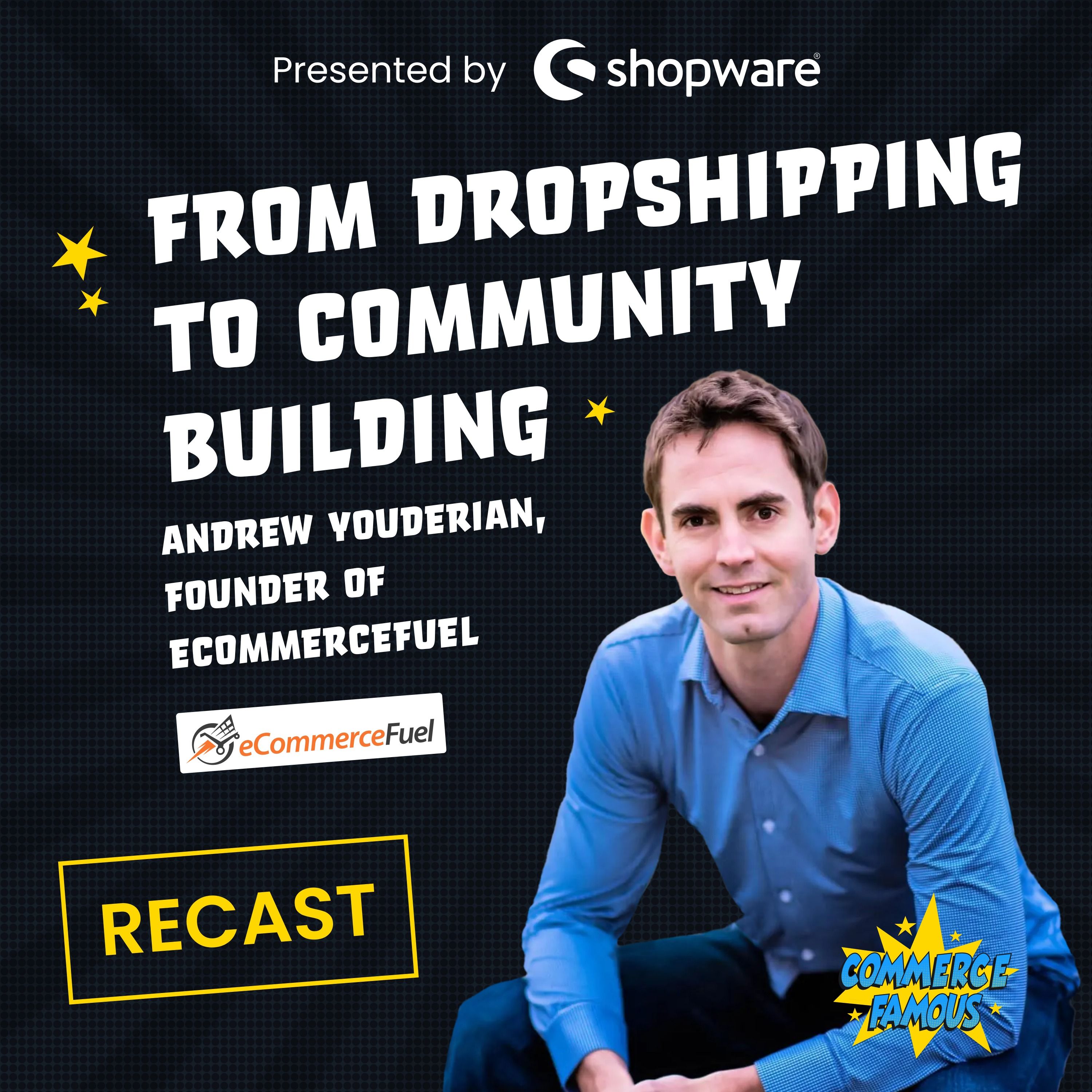
Recast | Andrew Youderian | From dropshipping to community building
Worum es geht
In dieser Recast-Folge von Commerce Famous trifft Ben auf Andrew Youderian, den Gründer von eCommerceFuel. Andrew erzählt von seinem Weg vom Pionier im Dropshipping hin zum Aufbau einer starken Community von E-Commerce-Unternehmern, die er zu seinem eigenen Geschäftsmodell gemacht hat. Zusätzlich bringt er ein spezielles Jobangebot für die Hörer mit.
Autor: Commerce Famous Podcast
Zu Gast
Andrew Youderian ist der Gründer der eCommerceFuel-Community für Unternehmer und ein Pionier im Drop-Shipping, bekannt für seine Transparenz und kreativen Marketing-Ideen.
Folge teilen
Transkript
Welcome to Commerce Famous, the biweekly podcast all about ecommerce and retail. In each episode, your host, Ben Marks, cuts through the clutter and takes you straight to the stories and experiences of those who shaped digital commerce as we know it today. While their names and faces might not be recognized on the street, each of Ben's guests are famous for commerce or commerce famous. Without further ado, your host, Ben Marks. Hello, everyone, and welcome to episode 10 of the Commerce Famous podcast.
I'm here today with Andrew Udarian, a seasoned entrepreneur, author, and most notably, community builder at Ecommerce Fuel, a community of vetted 7 and 8 figure brands boasting over a thousand members. Andrew, welcome to Commerce Famous. And I wanna start by congratulating you on episode 500 of the ecommerce fuel podcast, representing ten years of dedication to helping merchants grow by learning from experts and each other. Amazing. Yeah.
Thank you, Ben. It's also dating me here. It's pretty much just like a dinosaur in the space. You know, if you can, most likely, but, yeah, I appreciate it. Thank you.
And it's good to be on the show and excited to to geek out about community and ecommerce and and all this stuff. You know, it's it was interesting. I've I've you know, I told you in the run up to this. I've I've been listening to ecommerce fuel for, for a couple years now, and it's yeah. You know, you you you cover all sorts of topics, but I I did note as I did some of the research for this that, you know, you, you know, you got your start and you were you were big into drop shipping.
You actually wrote the book on drop shipping back in 2013. And even, and then just I'll I'll give myself a segue here. You had, you know, a whole, like, a whole host of of of businesses, one of which, trolling motors.net, still around today. And, but you actually did something interesting. You sold it in public, like, with financials out there, and you did it with a a Dutch auction, which was actually not even a concept I was familiar with, although I do a lot of work in The Netherlands and I love the Dutch.
Can you can you let's let's just start there because this is so this is this is back, what when what year was that? Oh, man. I don't maybe 2013. I think so. It might it might have I mean, ancient, like, archaeological history at this point, but, yeah, it was probably a decade ago.
So so and, yeah, I used the ducks talk a little bit. Yeah. And and so what you know, and people so there, you know, there there there are there are blog posts about this out there, but what what what was the inspiration for you to to to actually do this in this way? I think it was a couple of things. I think it was one, I was running through businesses at the time, ecommerce fuel, another ecommerce business selling radio equipment and then this business.
And and I feel like this was the least this was the least exciting opportunity in terms of potential. We can get into that why if if you want in a minute. But it was still a business that was it was it was profitable, had some value to it. And the other big thing is I was, at the time, trying to grow a platform and audience for ecommerce fuel. And so I thought, what's what's one of the ways that you could really make a splash to something differently and get attention, for for the the kind of nascent platform I was trying to build over there?
And I thought, well, if I sold the business, usually when you sell a business, people are very hush-hush about it. Right? Like, you know, like, you sign an NDA, you have to go through this whole process to see the financial sounds like, what if I just, I just opened up everything and, and, and sold it, but then also auctioned it off where the price would fall. I think it was every four or five days by $10,000 until someone bought it. So, I mean, it was high risk.
And that was for me, it was it was kind of killed two birds with one stone. Simplify and focus on the businesses I thought had the most potential, and also, hey. Let's see if we can use this to get some free marketing buzz for this brand. Yeah. And if anyone's wondering, you know, trolling motor.
I live in Coastal South Carolina, so I'm familiar with the trolling motor. Now I we had a trolling motor when we've been foolish enough to own boats. We had one really just as a as kind of a reassurance that I would be able to get back when the two stroke in, you know, in the back of the boat would invariably, you know, quit on me. At least you've got a very low power, bow mounted, electric powered motor that you can you can get back. But, yeah, that's that's a it's a very seasonal business.
It's not I mean and, yeah, it was a pure drop ship business. Right? That's pure drop ship. Pure drop the reasons I I wanna sell one is pure drop ship. The margins were it was high high order ticket, low low, low margin.
The shipping was a nightmare for it. Right? Like, you're sending $80.90 pound trolling orders through ups and I don't know, 15%, 20% of people would arrive and it would just, you know, beat to heck on the way there. So, and then it just, it was just, it was not, again, it was a not an awful business, but it was it was not gonna be what I wanted to spend the next ten years of my life. You know?
And then you had another business at the same time, Right Channel Radios. And that also, yeah, I think you ended up you ended up selling as well, but that was now, folks, this was this was CB, CB radios. Right? Yeah. And and, again, for the for the kids in the back, I had a CB, radio.
This this is what this is what Waze was back in the day. You you'd hop on a certain channel on this this special radio in your car, and you would listen to the truckers, and they would tell you, you know, that there's a there's a there's a smokey bear up at Exit 215, among other things. Now how did you how did you stumble into the, the CB radio market? On on the CB side, it was, it was complete completely a mercenary approach. So got done with college, went to finance for a couple of years, and very glad for that experience, but also very glad to get out of that experience.
And I was just looking for, like, what what can I do that can help me build financial independence and, like, has the probabilistically the highest likelihood of success? So I had all these criteria and ran all, you know, probably 50 different business ideas to those criteria and came up with CB radios. And I was like, really? This seems this seems terrible. And it was not gonna be the next, you know, the next $100,000,000 DTC brand.
But what it was great for was building for, especially for someone new to this space, a business that I could, you know, kind of, call the shots, you know, create, enough income to, to, to be on my own and have a small team. And so in that, in that facet, it was fantastic. And the real one of the reasons I loved it too, was it was in an industry where it's such an antiquated industry that all the people in that industry at the time, their websites were all 10, you know, just woefully out of date even by the standards back then. So that was that was kind of the approach and why I gotta do it. Commerce Famous is proudly presented by Shopware, the leading open source ecommerce platform for mid market and lower enterprise merchants.
More than 50,000 clients already process over $25,000,000,000 in annual GMV through Shopware. Find out more about Shopware and the best value in ecommerce at shopware.com. K. So so this gives you I mean, the great thing here is that you you took a very method methodological approach to getting into the space, I guess, knowing that there's this potential there. So you got to kick the tires, both from a from an operational standpoint, from a just from an entrepreneurship standpoint.
And that, I have to believe, that's that's informed you know, those experiences have informed so much about, and we'll get to the meat of this of this podcast episode, this this community that you have built and are building continuing to build, with ecommerce fuel. Right? Yeah. Absolutely. I mean, it's just that was what set the you know, building those businesses, a, autonomy about ecommerce.
B, it put me in connection with all these other people that are selling things and have a really difficult time explaining what they do to people at dinner parties. Right? So, which might be the strongest tie that binds this all together. But but, yeah, absolutely. That set the whole foundation for it.
It taught me a lot of things about the type of businesses I wanted to be in, the ones I didn't wanna be in. It was there's no way I could've done So that is and that's something I've seen in, you know, in in my career in ecommerce, just being out there at events all over the world. There's there are some common there are some common themes, common threads among, you know, merchant founders, and it can be it's amazing how lonely entrepreneurship can be. Did you did you experience that, as an entrepreneur? A little bit.
I've always been a little weird. My wife jokes with me that I'm a little bit of a robot, you know, like, half human, have, like, data on well, data is a 100%. Data is a 100%, robotic, but I I think to some degree, yes. Like, you always I actually I actually thrive and I enjoy working in a small, kind of, on my own cranking through stuff. I'm very binary person.
I love either like going, having a great beer, talking, talking about the mysteries of life, or being very just like cranking headphones on, like typing a 100 words per minute. I have these two modes. But eve even in that space, yeah, I think everyone entrepreneurship is just hard in general, you know, especially e commerce circa 2023. It's it's a challenging environment right now, and I think, mentally and financially, you're always having to upgrade your skills. So it definitely is a huge thing.
And I think a huge part of the value for community builders like us is is is you have to be tactical. Like, I always say that people join our community because they wanna solve something in their business or make more money, and they stick around because they meet people and they feel a sense of, like, connection and trust and belonging. So I don't know if you've have you experienced that on your side? Yeah. We you know, we, you know, my my pedigree starting in the agency world and then moving into platforms, it yeah, it's it's very much a, it's very much a, you know, come come for the problem, come for the opportunity, whatever, but then you you stay because of the people.
And, you know, it's interesting. Community has been a has, I think, as a word, has probably been brought up in every single one of my, you know, my my 10 episodes of this podcast so far. So that really it it does get back to the fundamentals of people people just wanting to be, you know, around, you know, adjacent to other people and ideally with some kind of shared context. I mean, my wife's a pilot. She drags me to air shows, and it's the same thing.
I remember the first time going, I'm like, I don't I don't even like small planes. We we have one. I don't like them because they, you know, they bounce around a lot if someone sneezes on the ground. But I so I go to this air show, and I'm like, I'm gonna be around a bunch of of av geeks. And you know what?
Like, after the first one, I couldn't wait to go back because it's the people, and it's the shared context of those people, and they're all coming together to well, in the case of an air show, it's to sort of celebrate aviation and, you know, watch f 20 twos, you know, blow your hat off at, you know, 500 feet above the deck. But, but in the ecommerce world, you know, I I I used to work for for Magento, and, Magento put together, honestly, had, I think, one of the best conferences, bar none, in across any industry. Imagine. Yeah. Did you ever get to go?
Yeah. I never got to go. I always saw it, and it looked like a really fun conference, but never really looked like a Yeah. If you ask anyone, who got it, who had a chance to go, I went to all but one, and if you ever if you ever talk to anyone who who went, they will they will almost certainly tell you it's it's it is one of the best, if not the best, conferences that that they that they've ever they've ever been to. It it went so far beyond just just content.
It really was about community. And I think that had a lot to do with, you know, the ecommerce is a is such an interesting space. I mean, you mentioned that that people have to constantly level up their skills. There is there is no there is no standing still in this business. Right?
Because if you're standing still, you are absolutely moving moving backwards. So it's, everyone gets together to, you know, share what they share their projections, to share solutions to problems, and, really to find, I think, to find support among their their peers, even to discover who their peers are. And I I'm I'm gathering, actually, that's that's probably a good bit of of what has helped, drive ecommerce the ecommerce fuel community so far. Is that a is that a fair way to put it? Yeah.
I I think so. I think I think the big thing that has been I think it's both those things, the community, but also one thing we try to do community is community is hard to build. It is so valuable. And I think one of the reasons it's so valuable because because it's it's it's rare, and it's rare because, like, it's very fickle. And it's you have a to have a community be able to thrive, you have to have a good balance among many of the members.
You have to have a kind of a shared, kind of decorum that people agree to. You gotta have people that are willing to contribute and and most people are actually able to contribute back in. So and it's hard to keep that that kind of stasis, if that's the right word, in balance and in check. So, yeah, I think that's one thing I think that has been helpful for any good community too is to have, like I think good communities have a really good set of who's in and who's out, and not to be exclusionary, but because that can help bind and create the identity that people can coalesce around. I think it also, like, the requirements, being unapologetic about your requirements.
Like, for us, we've got some experience requirements. You have to be 7 or 8 figure business. But even more importantly, you can't, like we say some of our our big rules are respect and reciprocity. Respect and reciprocity. We just don't put out put up with people that are dismissive or jerks or if if they do, we give them a warning.
If they keep acting badly, we throw them out. And then we also expect and ask everyone to contribute back to the community. So everyone who joins, we ask them to write up a a case study about something they contribute, and on ongoing basis, we have some requirements for having full privileges in the community. But, yeah, community is tough. I mean, for you, do you have you found it's been getting harder to build community on your side and, like, keep the community engaged, especially with the attention that just people get busier, their attempt it gets harder to reach them?
It's a really good point. I was just thinking, you know, what what is it? Why is it that that that a a well curated community, can, you know, can have such an outsize impact, you know, beyond just, oh, we're putting, you know, one one and one together and coming up with two. No. Well, a well curated community, you put one to one together and you get, you know, 200.
It's it's amazing what happens when people opt in and opt in with more than just I'm trying to solve a requirement or, you know, I'm working my nine to five headspace. You know, they they they can bring a lot more to it if you've got it well curated. And and in today's like, today, what's happening in the last few years, you know, our attention the demands on our attention, are are more and more. We you know, productivity is through the roof relative to, let's say, pre, you know, pre Webb, so pre 2000. And the interesting thing about having worked in the community space, I'm curious if you'd agree with this, is that we've actually community has always been about curation.
And and and these days, curation is more and more important because of this this all of the the you know, all of these different outlets for your attention, and because of all of this this information and the fact that we've been the businesses have learned over time how to better hook, how to better engage. So there really are a ton of demands on our time, and I I have to give full credit, to Andrea Hernandez, who's, the the the the brilliant mind behind Snackshot, which is just this sort of curated community of snack enthusiasts and the brands that are trying to, like, that are making sort of meaningful, like, not General Mills, not not that General Mills makes bad stuff, but, like, that are making these these really niche products, you know, whether it's, you know, low or no alcohol drinks or, you know, in in you know, using ingredients from far off places, but, this real community of people who who who want to have a meaningful, you know, snack relationship with with products. And and she's the one that but but but she's gone beyond this even from, you know, operating out of Honduras.
You know, she was the one I think a couple years ago, she started talking about, hey. Curation is, you know, curation is the new service level offering that people need to be paying attention to because they're all there are all these demands on our attention. So I I I connect that with the concept of community building because communities well built, intentionally built, or even self organized. They self organize around principles. And, you know, you you ideally, you have you have kind of a a filter on the top of the funnel, and then you have an ongoing filter that ensures that people adhere to those norms.
It sounds like we're we're probably in in, like, total agreement on that. Yeah. I think so. And it's I think one of the things with with community too is valuable even more valuable today is it's there's so much more information than there is, but it's also harder to discern the truth than it ever has been. Right?
Which is unfortunate and ironic. And so, you know, I use this example a lot. Like, you look at Yelp, like the Yelpification of everything. Right? You look at Yelp looking for a restaurant to go eat.
It's got 4.9 stars, it's probably okay. It's got 4.5 stars, it might give you food poisoning. Right? Because everything is just so so and you have to put it through that filter, and there's so many angles and so many so it's hard to so anyway, all that being said is word-of-mouth has become kind of, again, come full circle to be this the the really one of the few things that you can trust deeply when your friend, who you trust to watch your kid tells you, like, this is great, this product is great, this movie is great, this person is trustworthy, like, that has become, I think, so much more valuable. And communities where there's a high degree of people with your interests, needs, problems, situations that you share, that can give you, I mean, that's one of the things, I think, the reason people, the thing people love, like, the connections in our community, but I think one of the things that's just tactically most value for them is coming into a group where there's no BS, there's no agenda, real operators.
We have very few vendors and only ones that we've deeply vetted with deep subject area expertise. And they can ask a question about a platform, about an issue, and they get, like, answers with no bias and that they can trust. Like, that's so valuable, and I think that's something a community can offer today in giving the environment. That's yeah. All all great points, man.
I think that's that's part of what's kept me excited so long about, you know, I work in the the open source world, and and open source necessarily you know, I'm I'm fond of saying that that, like, that the code is the least interesting part of open source. It really is all about the community and culture around it, this this community of knowledge sharing of, you know, of of shared cultural context. And and and sort of in, I guess, implicit or inherent in that is is that you you again, going back to that curative effect, you have this you you you, I think, have more assurance that when you when you are when you are consuming content or you're having interactions in this community, that it's going to be it's that that kind of interaction is gonna be more meaningful, more relevant, and, you know, more applicable, more honest to, you know, to what your whatever problems you're trying to solve. Or if you're looking to give back, it's even easier to give back because there, again, you have that shared context. You have you know that you can put something out there without, you know, with with a pretty low likelihood that you're gonna get shot down.
And if you get shot down, ideally, it's it's, you know, it's it's more in the form of like, hey. You know, maybe you could say this differently or, hey. This interaction, clearly, you were having a bad day. Don't do it again. And then just just celebrating all kinds of contribution.
That's that's one of the things that I've tried to stress as I as I've advised community builders and especially open source community builders over the years is, you know, always look at I think Shopware, my employer, now does a really good job with with, with our community of just saying like, hey. You know, any contribution is meaningful, and that could be a blog post. That could be organizing a local meetup. That is these things are all just as relevant as, you know, your your time spent at a keyboard, you know, writing code that you're then submitting to, you know, to a product or to your peers. Let's let's all kind of join hands and solve this common problem.
The the the reason that this, I think, works so well in ecommerce is that that requirements are completely arbitrary, and they just evolve over time. So we we never are gonna solve the challenge of ecommerce. And and so if you bring a whole bunch of people together, they just kind of get to roll along with it and continue to solve and evolve and ideally, you know, create, you know, create that shared future. That's that's and and and that that kind of that kind of environment doesn't exist without a sense of of shared shared purpose and common, like, cultural norms. Yeah.
What was it about you mentioned imagine the Magenta conference. A couple questions if you're if you're Absolutely. Kinda jump in because I'm I'm curious. What what was it that made obviously, Magento's kind of evolved over the last couple of years from what it used to, you know, from what it was five even years ago. What was it that made them stop doing Magento, Imagine?
And then what was it about the conference that made it so good? Because we do we do an an annual kind of summit for our community And it's an in it's like takes up, like, a third of our year, if not more. And it it's it's but it's one of the, I think, one of the better things we do with our time, and it brings our community together in person, builds a lot of trust. What was it so I'm always thinking about ways to try to make that better. What was it about Imagine that you found so different and special?
Yeah. I mean, you know, part of it is just, you know, what kind of people are gonna be involved in, you know, just just just if you think complete top of funnel or, like, just a population that you point towards a funnel. Right? If we were if we were selling arms, we would have a very different, you know, would have had a very different kind of conference and experience and everything. Right?
I'll just I'll go with the comp yeah. I'll go with the complete, you know, left field reference there. And so, obviously, the organization. So so the the the great thing about ecommerce, let's let's look at the sort of the preconditions. The great thing about ecommerce is there's there's there's a lot of money flowing around.
And I think the the vendors that do really well are the ones you know, because look at who's not in the room anymore, like Oracle, not in the room anymore. IBM, not in the room anymore, unless you get back to, like, infrastructure, or, you know, being part of a stack. Right? So the the vendors that do really well have figured out that they don't need to rather than if you look at it from a from a pie, like a pie chart or a pizza pie, as a vendor, you can look at, I want to make more money and and have more influence. I'm going to grow my share of the pie.
So you were you were going to start to, like, cut in on other people's share of the pie, or you just grow the pie. And every like, your size, your your share increases everyone else's does. And I think that philosophy was was is is there as kind of part of the open source approach. It also helps to have, you know, extraordinarily capable events professionals. Like, the first imagine was planned, Bob Schwartz, former president, and, Roy and Yoav, the the cofounders of Magento, told the story of finding a just an absolute rock star of a of of of an event planning professional, woman by the name of Britney Mascara.
I think she was named as Britney Carnes back then. She they so this is how this is how far back that goes. She was, I think, like, '27. She they got her from Myspace. This was circa '20 like, late twenty ten, 2011 was the first imagine.
I think they they hired her, and she worked under Karen Aminia, and then they put on that first Imagine at the LAX Hilton, and they planned it in, like, three months and knocked it out of the park. And it was there's a there's a lot of human factors thought that went into it. Britney is actually and most of her team are still like, they're doing events for Adobe now. And and and their their care and attention and professionalism really helped the whole thing flow. Basically, they they created the place and then let everyone show up and put like, leave nothing on the table.
Everyone would always leave that conference. And and there there are other conferences where this happens too. I know you go home and you are absolutely just wrecked. You're destroyed because you gave a 110% the whole time you were there. That is that's what it's all about, is creating that environment, having a good, you know, good code of conduct, and then making sure that the programming is good.
I think I assume, you know, given given, your your vetting of, your community and the the the vendors that you allow in, like, they no one's getting up in front of everyone and just giving a direct boring pitch. They're they're probably getting up and they're talking about problems, and they're adding value. Commerce famous is proudly presented by Shopware, the leading open source e commerce platform for mid market and lower enterprise merchants. More than 50,000 clients already process over $25,000,000,000 in annual GMV through Shopware. Find out more about Shopware and the best value in ecommerce at shopware dot com.
Yeah. I think, like, I think vendors to there's really great you know, most vendors are, offering a lot of good value. There are some bad actors. But I think one thing that we've always tried to focus on, and I think it is important, is your attendee to vendor ratio. Right?
Like, because the biggest thing people go to these conferences for is to meet, at least in our experiences, to meet other in like, other professionals with exact, you know, very similar needs to learn from, to connect with. And so having a high, high ratio of people that you saddle up to with a drink or at lunch or whatever it is, and you can connect and immediately connect with the same issues, You know, having that be seventy, eighty, 90% of conversations, that's huge, you know? And if if if when you are at something that doesn't happen as much and you have more vendors than the ecosystem can support, that really detracts, I think, from the experience. So I think that's one of the things that's super important to think about too. Because it's easy to be like, oh, yeah.
We'll just take the money, but then you're always paying for a potential. Not always, but it's easy for that to, you know, kinda adversely affect the the attendee experience on the backside. Yeah. There's there there is the the money's the money is easy to quantify. The the impact is is maybe less so.
And and yeah. So is it and and it but it goes back to that. What's the what's the shared context? What's what are the motivations? Like, it's the vendors vendors, when they get involved, it can be it it you have to make sure that it's not they're not extracting.
They need they need they need to do the input, and it's more than just the cash input, their participation needs to be in earnest and fair. And and if they do it right, you know, if if a vendor sits down at a table of merchants, and if you are a table of whoever their their their target audience is, and they really just sit there and listen to them talking with each other, talking amongst themselves, yeah, boy, those are like, that's where some of the best product ideas on the planet come from. You're just saying you're you're discovering, oh, wow. I had no idea. That was a pain point for you.
And it's great to listen to two merchants hash it out, and one says, oh, I have no idea how to deal. Like, how do you handle this? We we have this issue with our supply chain. Or, like, accounts receivable is a real pain for us. And then someone says, oh, well, we had that same problem.
Let me be an expert in your story, and they offer their solution. And then you find out, oh, well, this person over here knows something that the other guy doesn't know. And and being a fly on the wall is is super, super powerful. So so, actually, just just keeping mouth closed and ears opened. And for what it's worth, I when I found out that that you all that EcommerceFuel has this annual conference, I'm like, man.
Like, I'm sure I'm not alone in wanting to just be a fly on the wall there because the insights coming out of that, probably could fill could fill a book, and that playbook could instruct, probably a lot of other a lot of other businesses how to succeed and and probably prevent some of the pain the the painful learnings that others have already gone through to to to build businesses of seven and eight figures. Man, well, too bad we'll never be able to to unite over imagine, but it sounds like a pretty pretty It was. It it was. But, you know, the great thing is, you know, like I said, there there are others out there. You know, that that was also it was also a moment in time.
It was also a moment in time. I mean, I know, you know, we have we do an annual conference like like you all, and then we have there are smaller conferences that are organized. Actually, even our community organizes sort of around around us and the self organized communities, and I spent a lot of my time doing, you know, participating, facilitating, doing this work. It's, yeah, it's it's it's fascinating when people start to take what, you know, your brand, what you have, what you built, and then and then evangelize that on their own. And that's sort of a that for me is a next iteration of a of a community.
And I I don't know if you see this in in your own ecosystem, if you see people going out and and realizing, like, oh, wait. I have something to offer. And I I learned that, you know, because of my participation in ecommerce fuel, and let me go and let me let me now host a meetup for other professionals in my area, that kind of thing. Do you do you see that among your membership? Yeah.
We do. We've got some really great I mean, we could we I'm sure we we could do a better job of supporting it and fostering it. But, yeah, we've got some usually every month, we'll have a meetup somewhere in The US from a from a kind of a member led meetup. Later this month, we actually have someone, a fantastic member of ours in in New York, reached out to Shopify and set up, like, a a Shopify ECF meetup at their offices. So we've got, like, a bunch of people coming in for that.
That's gonna be really well attended. And it's very cool, like you said, when when people take it, kinda catalyze that, that local meetup, and, energy and get people together. So it's it's super, super amazing and really thankful people do it. So that's that's, you know, you bring up Shopify, and Shopify is always an interesting case for me because, you know, what what what Toby and team built over the years, you know, they they, you know, these days, like, Toby and Harley get to announce an initiative, and it it can change the face of the industry overnight. Right?
You know, but their the mantra all along has been arming the rebels. Their, yeah, their their pithy communications are, I mean, just, I give a chef's kiss almost every time something comes out. But, you know, it it's interesting because one of the sort of principles of of of communities is, you know, especially from a platform perspective is eventually as a platform, your tendency is to always start to fold in and start to eat your own, eat your own ecosystem to a bit. You know? And and I'm I know over the years, I'm not gonna ask you to to to even begin to to offer critique of of of Shopify or anything like that.
But over the years, you look at the platforms like Shopify and and, of course, Amazon, which you've, you know, which you've spoken about in the past, And you start to see, you know, on the one hand, there's this this this tremendous enablement. There there are, you know, literally tens of thousands of businesses that don't exist. That's probably a a a gross under understatement, but tens of thousands of businesses that don't exist without those two platforms. But then eventually, you know, they they do start to have to monetize in new and interesting ways, and that's that's that's where they start growing their their piece of the pie out. What what kind of conversations do, like, do your community members, have around this if if you're at liberty to to share?
Oh, yeah. I think I think this is interesting area. So Amazon is is interesting, and I I have to I mean, I'll lead off the gates. I I have I'm not coming to this objectively. I'm a biased very biased on this and and always open for good, healthy discussions and debates on it.
I'm an Amazon customer. I use Amazon for some things, but I mean, if you look at this is very timely with all the antitrust stuff that came up with The US with with Amazon, but they I think they're the amount that they take from merchants has gone from, I don't know, 25% of fees to almost 50%. Maybe it was 30% of fees, but to 50% of fees ish over the last, you know, I don't know, five to ten years. And it's, I think, I think people it's interesting because because people have different very different perspectives on it, even even in our community. Some people look at it and just say, this is a huge toll booth that you have to go through.
It's it's two thirds of online commerce in America. Right? And and you're, you're paying a 50% tax for every order that you send out the door, right? So, and, and I'm a little bit more sympathetic to that view. And other people say, hey, look, like, I don't have to deal with my customers, or excuse me, I don't have to drive traffic.
They do the shipping and the fulfillment and, and a lot of other things, and I'm willing to pay that, you know? And so there's definitely different viewpoints. I'd say probably a little bit of a stronger viewpoint on the, this is becoming more onerous and more of an of a of a, you know, almost like an addiction. Right? Like, I know I shouldn't be addicted to coffee, but I can't get through the day without it kind of thing.
Right? But is this gonna help me long term? So anyway, that's a few, a few pins in Amazon we can come back to you on the Shopify front. I think Shopify is interesting because they are. Man, I would say they were almost as much of, I don't know if monopoly is the right word, because there's a lot of shopping carts out there.
But if you look at we we actually track this in our community, the the the software that people use. And if you want a hosted version for a shopping cart, for SMB, I mean, there's just there's they I mean, they're one of the main It's an obvious choice. BigCommerce. It's they have, I would say, five to one, maybe even close to 10 to one market share over their next, you know, BigCommerce or whoever it is. It's crazy.
And so, and I think that, I mean, that speaks to a few things, but I think they've done any big company gets big. I think you see this throughout the arc of human history and especially tech. You start scrappy, you earn customers, you get a little bit bigger, you get more corporate, you can't be as nimble, you can't be as attentive, and, you know, you start having more people to answer to, especially if you're public. I think that's just the story of any company that grows and has major success. So but but yeah.
But I think they've also done a really good job of of building building a pretty great product. But, yeah, to your point of eating eating things, like, I I would be I would be nervous if I had a recurring revenue app on Shopify. Like, that was my bread and butter business. Right? Or if I had some kind of because you're just like, how long is it gonna be until that gets brought in the to to Shopify's mothership and then your business just goes overnight?
Anyway, I'm sorry. I ranted there a little bit, but those are some of the conversations, thoughts, kind of things. That that that didn't even I've I've I've heard much more ranty takes on it. That seemed like a a well a well metered, well considered, position. And, you know, and and and all fair.
I mean, it's you could look at the the, like, the toll booth example kind of begs, for Amazon, begs the the if you have a toll booth, that's on that's on a toll road. And what what's paving the toll road? It's it's the body of it's the body of businesses who, you know, got too successful, and then all of a sudden, Amazon's like, oh, we're just going to tweak things, make that same product, and now we're gonna drive traffic to our own product. I mean, that's the that's the that's why they're in hot water right now. Shopify, you know, it's Shopify for what it's worth.
I mean, I'm happy I have plenty of ecommerce conversations, when I'm at, usually when I'm speaking at at conferences, and I often hand out Shopify as a starting point because it is it's it's turnkey. They solve so many problems out of the box. The challenge, of course, and and, you know, one that they're the the the SaaS platforms. Right? There's this continuum of solution.
Right? In my mind, you have the SaaS platforms that are that try and, you know, they try to be as flexible as they can, but but their their their real magic is, you know, you don't have to think about infrastructure. You don't have to you you all most of your effort can go into, you know, your business. You just have to adapt some of your requirements or maybe sometimes a lot of your requirements in order to fit in their box. Right?
That's something our our president, Jason, has said in the past that I thought was just was just brilliant that, like, everyone, like like everyone would want to be on a solution, a SaaS solution, but the problem space, again, it goes back to those arbitrary requirements. And as your business gets bigger, your problems become more, you know, more localized, and you can't expect one platform to solve them all. So you have to start moving across the continuum to solutions that maybe do don't offer the, you know, don't offer the kind of, like, turnkey and ongoing turnkey nature of of a SaaS solution, but the what you're trading for, you're trading up for flexibility there. That's kind of like where that's those are the solutions where I've I've tended to identify strongly just because I've always enjoyed solving problems for merchants. And then you get over into, especially like the enterprise space with your commerce tools and the like, and they have a, you know, they have a just this this open API approach to things, and and Kelly and team over there are very good at that.
But why I mentioned this whole spectrum is because we're all kind of converging on this the same sort of central balance between, you know, ease of use, turnkey nature, and that, you know, and and reliability of cost of ownership, right, TCO, while allowing as much flexibility as people need. And that's that balance is going to also evolve, I think, along with this industry. And and for me, it's one of the things that keeps me around. Now one of the things I wanted to cover before we start to wrap things up here, You know, you're you're in a I think you're in a a a unique position, you know, given given your history and then given all the time that you've spent facilitating these businesses and their success over the years. What are the what are the things that you see coming down the pipe today?
What are what are the I guess, maybe way to put it is what what are the trends of today that we will be talking about, you know, in a few years as like, oh, you know, that's that's what helped us get to where we are in '20, you know, '26, 2027. Yeah. I think that's a good question. I think one of the biggest ones I've thought about is this idea of this kinda kinda concept of working hypothesis around smaller but more durable brands. Because if you look at the last five years, I think the last five years was characterized to some degree by people coming in, really growing brands quickly with advertising.
You know, couple of things. One, there was a it was a much easier environment to raise money, so you had a lot of brands that came in, raised a lot of money, grew unprofitably. But but the ones that grew profitably, they also you know, if you look at the 100,000,000 plus e commerce companies, they most of them grew through grew through paid channels. Right? And many many of them on the cell phone at once through through profitably or at least breakeven.
But I think now, like, we're in an ecommerce environment where two things are different. One, it's much harder to get capital to just grow big for big sake. Like, that that ship has sailed. And secondly, like, acquisition costs are so much more expensive than they were even two or three years ago or at least at least at least more expensive. And so I think I think we're kinda entering this world where to be able to grow and build something and build a moat, you're gonna kinda have to do it the old fashioned way.
Great products, great product design, good word-of-mouth, still still supplement with paid and other good marketing channels, but, like, you've gotta have a really phenomenal product. You can't buy your way to the top as easily or you can't arbitrage your arbitrage arbitrage, excuse me, if I can pronounce your way to the top as easily. So all that being said, I think we're gonna have kind of a crap of maybe brands that are merging that are a little bit smaller, are more niche, or more targeted. They're not gonna be more brands in that, you know, $3.04, $510,000,000 ish range that, you know, maybe aren't gonna have the potential to grow as fast, but they're gonna be much more defensible because they're built on great products and great word-of-mouth and fantastic community and things like that. So which for me personally, like, from self esteem, from a consumer side, I think that's cool.
I like that. I think that's a more interesting area, but I also think we're gonna see a lot of fallout too, because that's hard, like building a brand is hard, building good products is hard, like sticking with something for ten years is hard. So I think we're also gonna see a decent amount of fallout of brands that that just isn't a good fit for our founders that isn't a good fit for. So that that's kind of a few one of the big things I see in the next three or four years is gonna shape our industry. That's and and I have to bring it up because it's been it's been the sort of the the the topic of the year.
But but it it does have, I think, it does have some influence and and relevance in into, you know, future trends. But, you know, do you all see AI? Like, do you are your members, like, are your members, like, actively is it is it a main topic of discussion? Is it just a was it just that the same as every everyone else? Like, oh, this was hyped for a moment.
Now we're getting down to, okay, like, where is this where is this actually delivering value? And then do you see because there again, like, one of the I think one of the powers of of a one of the the powerful sort of prospects of AI is gonna be is gonna be the curation. It actually can be that sort of trusted reference in the room, or it can at least be the a a, you know, a a filter to apply to this just this inundation of of information. And and so you you kind of look to you look to this this big dataset as a and then the interface into big data as, as a way to to understand what is what is happening, what are the trends, what are people talking about, and might entrepreneurs even be to start to discover some of these niches through these tools? Am I am I, like, too far out for this, or what do we think?
No. I think and I tried to I tried to stay away from the AI productions because I figured that was just kind of the, where everyone's maybe a little bit on the the hangover recovery from the AI hype cycle over the last nine months. But that being said, no. I think it's a meaningful a meaningful thing. Like, we had a an event in Austin last week, and we had these discussion corners to talk about all these things.
We had AI as one, and I thought there'd be a bunch of people there. There's no one there. The moderator was by himself for, like, five minutes, and then he got up and left to go to a different group because I think that there's been so much. So that being said, I think there's different things that come, they get overhyped, and then they disappear. I don't think AI's gonna be one of them.
I think I think there are so many things, for example, I mean, product photography and creative. Like, that that is gonna be what what people are doing with Midjourney for product photography is just cutting the the the time and the cost out of that so substantially. When you look at customer service, that's gonna only get better. I think we're not quite there yet, but when you look at holistically being able to run your business, almost think like Shopify flows or or automations within, you know, any kind of cart, I think that's going to really come into its own in the next two or three years. I think five years ago if you could run, you know, you think, you look at the story of Moyse when he built Native, and I think they had like eight people when they sold, I think they were like a 100,000,000, something like that, they were just incredibly lean, that was part of DNA.
That is an outlier. I think that is gonna become less of an outlier the more that we have this maturity happening in the AI tools because you're gonna be able to really just deeply focus on those things we talked about earlier that matter in terms of product design, in terms of branding, and stuff like that. And then a lot of the busy work will go away. So I think it's huge. And, but, again, it'll be great for the people that leverage it and and hard for people to know it as out.
Yeah. It to me, it feels very much like, it's you you you wanna ignore it because because everyone was talking about it, and there was just so much hype and, honestly, just a ton of fluff and BS about it. But, the the I I do believe that it's the the solutions that are additive, that that amplify, you know, what if I'm a merchandiser, there are going to be tools that that that, you know, quietly use this well and and basically amplify my efforts. And the businesses that ignore that over time, ignore it at their own peril. Right?
Because they will be they will either need to hire. They'll need to throw bodies, at the you know, whatever problems are being solved in order to to match the level of one person with the right tools, you know, or or or I guess, you know, or or just be lucky enough to be in a space where there's where there's no competition. And I think over time, that that is gonna be less and less as as you've kind of called out. So, you know, if if, if I'm starting if I'm looking to start a business day, we'll we'll we'll leave it we'll leave it here. If I'm looking to start a business today, like, if you wanna if you were just getting out of finance school again and you were starting all over, what's the what would you do?
Would you take the same approach? Would you just say, let me discover let me try and discover what what what doesn't what what what is what is underserved, or would you take a different act? That's a great question. I when I started, I had zero interest in passion. I was like, I'm passionate about being financially solvent on my own without an employer.
Like, that was what I was passionate about. So, I think that's a little hard I don't know if that's harder today. I think there is more of an advantage today. There's the whole cliche, like, you know, follow your passion. A lot of people, like, just rail against that and for good measure and I think with a lot of wisdom.
But I think there has there's been a little bit of a pen on the swing back to where it's an advantage because if you look at how a lot of people are building brands today, what you need is you need attention and you need trust to sell things. Right? And either trust in the person selling it or trust that the item is a really high quality good or it solves your problem. And a lot more people today are building those with content, with with a creator mindset, having an audience, and I don't think you have to do that, rely on that solely. But that even the websites I go to that I see.
We had someone who talked it again at that Austin event. Their website was so amazing because they had their, their team front and center. They all, you could tell they were stoked about their product. They really enjoyed it. They were local to the area.
They were building it like kind of that storytelling, but also the authenticity vibe at the risk of selling like a Hallmark commercial here. There's something to it, and it helps sell the product. And I think also entrepreneurship is ecommerce is harder significantly than it was even five years ago. So I think if you can if you love something, you're gonna know more about it. You're gonna connect more with people who are watching who are more discerning than before.
It gives you more fuel in a harder environment. All that said, if I was starting from scratch today for an ecommerce product, I would be more inclined to look at something I feel like I genuinely had an interest in. And granted, I would weigh that against the practicalities. Right? Like, just because I, you know, if you if you absolutely love rose gardening and, you know, you don't think about the implications for a business model, probably bad move, Weigh it carefully.
But if you can find something that even you have some interest in, I think it's gonna in today's the way you attract customers and sell products, I think that's gonna come through. I like how you snuck in a fuel reference there. That was, that was that was perfect. And, didn't even notice where I did it. I mean, whatever you You you basically it gives it gives you fuel.
Right? And Oh, I didn't even notice that. Total total Freudian Well, I think, you know, I I'd say, you know, given everything I've seen and given our conversation today, you know, your, I hope you know your your community, I'm pretty sure, is pretty pretty lucky to have you and the team that you've, that you've built and and and cultivated over there. So, Andrew, with that, I could certainly chat for quite a bit longer, but I really, it's been an absolute pleasure to to have this exchange with you. And I, I certainly look forward to, to running into you out there in the world and, you know, grabbing a beer together sometime.
Yeah. Thank you. I appreciate you having me on. And if if it's okay if I give a little shout out here, you were kind enough to help us looking for a director of of connection for our community. So if if you're someone who's listening, who is, you know, who loves connecting people, like, the idea of bringing people into the fold, connecting them, building community gets you excited if you've have a history of, you know, kind of bringing people together in the past.
And if you have an interest in ecommerce, that's not as important, but still a great plus. Yeah. Get in touch with me. We're hiring through kinda I don't know when to go live and may maybe too late, but that through the end of October. So ecommercefuel.com/doc for director of connection.
And then if you're a seven or eight finger merchant, in the space and, community sounds interesting, would love to Yeah. Love to have you Did you actually grab my concluding bullet point here about? No. No. It's it's it's it's much better coming from you.
I have actually right here at my, my last bullet point. Yeah. No. It's it's it's a hell of an opportunity. I, actually, I know I told you about this privately.
But, really, folks, if you are especially, if you're relatively young in your career, but you have, you have some skills in the space. Yeah. Look up look up the job spec, ecommerceschool.com/doc. This is a chance to really take your career in a new direction. This is exactly what I told Andrew in the email exchange, because this will put you, this will put you in a network of of just amazing people who are who know what they're doing.
And if they don't know what they're doing, whatever they don't know how to do, they're figuring it out. And that that that, being around people like that has served me well in my life and has taken me to all sorts of fun fun places. So well, Andrew, I, like I said, I hope to catch up with you, at some point in the near future. And, really, once again, thank you. Folks, in addition to subscribing to the Commerce Famous podcast, absolutely encourage you if you're in the space, ecommerce fuel.
It's really worth your time. Great. Well, thank you. Appreciate it. Thanks for sharing the podcast.
And, yeah, this has been a lot of fun. Thanks so much.

Veröffentlicht mit CiteCast