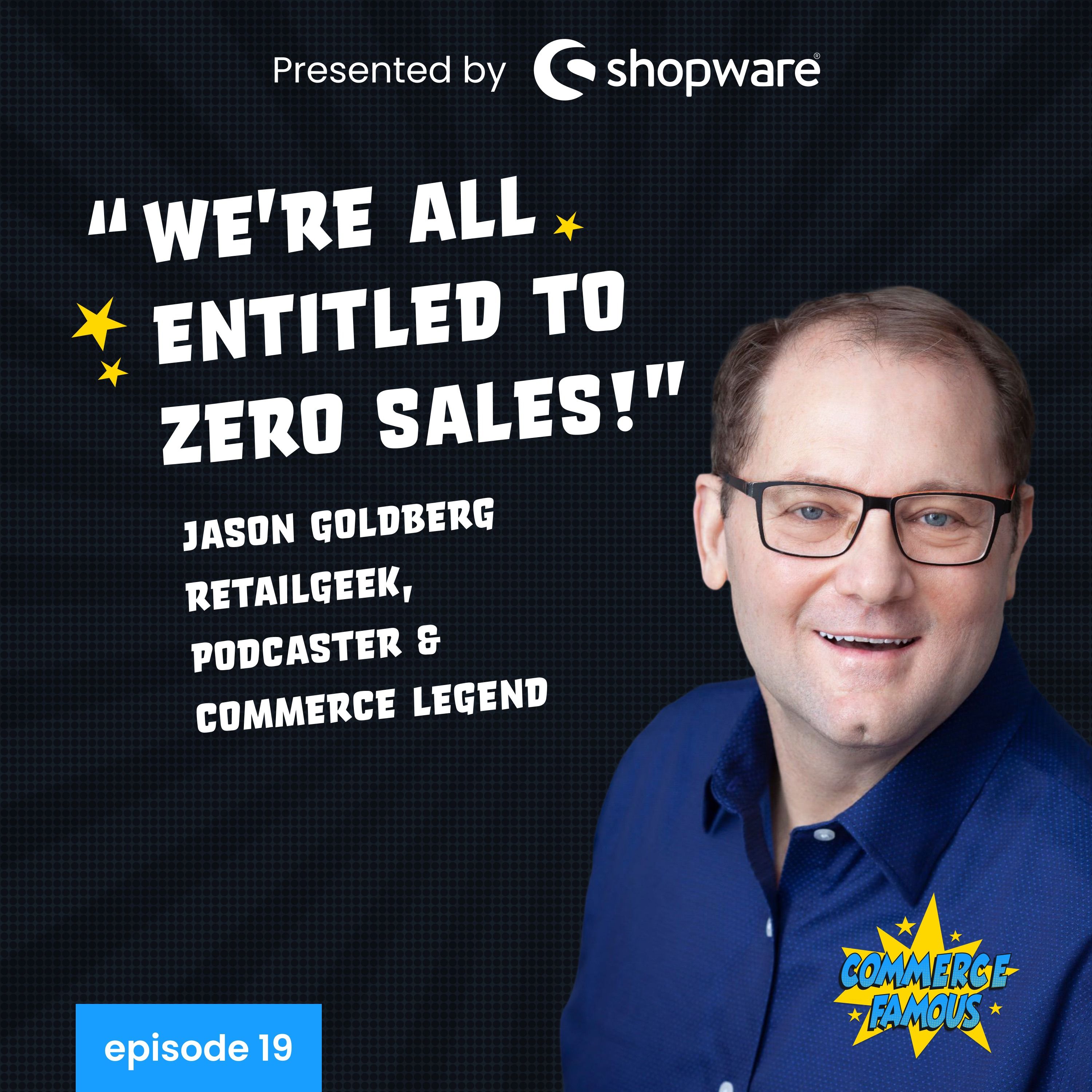
019 | Jason "Retailgeek" Goldberg | "We're all entitled to zero sales!"
Worum es geht
In dieser Folge von Commerce Famous spricht Host Ben Marks mit Jason "Retailgeek" Goldberg, Chief Commerce Strategy Officer bei Publicis und Co-Host der Jason and Scot Show. Jason erzählt von seiner Familiengeschichte im Einzelhandel, seinen frühen E-Commerce-Erfahrungen bei Blockbuster und ordnet die anhaltende digitale Disruption ein. Gemeinsam diskutieren sie die Rolle von KI, die Bedeutung von Discovery im E-Commerce und die Zukunft des Consumer Engagements.
Autor: Commerce Famous Podcast
Zu Gast
Jason Goldberg ist ein erfahrener Commerce-Experte und Co-Host des Jason and Scot Show. Er war in den frühen Tagen des E-Commerce bei Blockbuster tätig und blickt auf eine mehrgenerationale Familiengeschichte im Einzelhandel zurück.
Folge teilen
Transkript
Welcome to Commerce Famous, the biweekly podcast all about ecommerce and retail. In each episode, your host, Ben Marks, cuts through the clutter and takes you straight to the stories and experiences of those who shaped digital commerce as we know it today. While their names and faces might not be recognized on the street, each of Ben's guests are famous for commerce or commerce famous. Without further ado, your host, Ben Marks. Hey, everyone.
Welcome to Commerce Famous. I'm your host, Ben Marks. With me today is Jason, retail geek Goldberg, currently chief commerce strategy officer at Publicis and also host of the Jason and Scott, show, a podcast that anyone in this industry, if you're not already subscribed to, you really should be. Jason has just decades of experience, in in commerce and has been party to, you know, some of the biggest companies and biggest things that have happened. And you can regularly see him at trade shows and everything else.
So, Jason, welcome to the show. Ben, thanks so much for having me. I'm excited to finally make it. Well, yeah, if folks, if if you if you just happen to have been living under a, you know, sort of a commerce rock anywhere in in in the world and and don't know, don't know who, Jason is, well, he he has a he has a podcast you might wanna pay attention to, the Jason and Scott show. So a lot of really good analysis.
And, you know, I know retail's in the name, but the coverage is industry wide. The insights are, you know, more than industry deep. I'd actually be kinda curious to to hear about the origin story behind, the Jason and Scott show. And that's I think you guys you you're you're up around you're pushing around 400 episodes. Right?
It feels like it. It's only 320 ish. Oh, okay. It does it feels like there's the 80 that Scott messed up that, we don't talk about. And then I think what I heard the other day that that that there was something about I was gonna we were gonna be listening to the, the the Jason Bott and Scott Bott show.
Yes. Yes. Scott is very much looking forward to replacing me with a more agreeable co host. Yes. Yeah.
The the LLM that can have the, the parameters tweaked. So, you know, and that that's since what? 2015, I think? Yeah. It's crazy to say that.
Yeah. But it's, like, eight years. So I was, you know, in the run up to this show, folks, I was I was actually going back through some of the old episodes there, and I I got to listen to a, an episode from 2016 with my my old boss, Mark Lavelle, and and, and Peter on the strategy team, Peter Sheldon. And I was I was struck by how much a, how much of a time capsule that was. And I suspect if I if, you know, if you go back over over the the episode list, we could find similar, yes, similar similar time capsules.
Is there any is there any moment in your career so your career spans a lot, and your history actually goes back. Your generational That was a very generous way of saying I'm old. But yeah. Yeah. You don't look a day above however old you are.
100. Yeah. So well, actually, let me let me let me back up even further. You in your in your bio, you are a fourth is fourth generation retailer. What's the story there?
What what was, what was your family doing? Yeah. Immigrants from Russia came to The US, opened a fruit cart, selling bananas off a cart on the street, turned into a grocery store, turned into a pawn shop and jewelry store. These are all over multiple generations. And so for a while in the Pacific Northwest, there's a bunch of, jewelry stores, that people bought their their, engagement rings from, that had my family's name on them.
I wasn't very involved in that business, but several of my uncles started, at the time, a revolutionary new kind of business. You could go into their stores and you could rent a movie, that came on a magnetic tape called a a a VHS tape, and you could you could watch that movie whenever you want it. And they they, so they were video stores. I'm being sarcastic. That sounds like a blockbuster idea.
It is a blockbuster idea, and they sold it to a guy that had the blockbuster idea, named Wayne Huizinga. And the my family wisely included me with the transaction. So, if you've ever if you're a football fan and you've seen the, like, we did a trade and there's a player to be named later, like, that was me. I got traded Dwayne Heisinger and Blockbuster back in the the the very early nineties, when we had about 10 stores when I left. So two takeaways there.
Folks, I think we just found Nepotism. I think we just found the origin story of there is money in the banana stand. Mhmm. Mhmm. Or banana cart in this case.
And then two, I guess so your family was just trying to get rid of you. Yes. Yes. And still to this day doing that. Yes.
Okay. New new generations. Like, don't you have a trade show to go visit? Come on. Exactly.
You sound exactly like my wife. Yes. Okay. I I might have heard this phrase as well directed at me. So, you know, so you've you've been there you've been there since, really, for the for business even before, before online became a thing.
So you watched that transition happen. And I think your time at Blockbuster, if I remember correctly, was was actually just prior to ecommerce, and and Yeah. So I I was a director of marketing at Blockbuster, and, I was the one guy on the management team that had this thing at home called a, computer Yep. That no one else on the team had. And so, when when the this thing called the World Wide Web became popular, there was this new thing, a browser, which was text based back back then.
Yep. They they're like, should we have a website? And we're like, I don't know. Ask Jason. He's the guy with the computer.
And so that eventually, we said yes and tried to sell stuff on it. Commerce famous is proudly presented by Shopware, the leading open source ecommerce platform for mid market and lower enterprise merchants. More than 50,000 clients already processed over $25,000,000,000 in annual GMV through Shopware. Find out more about Shopware and the best value in ecommerce at shopware.com. Well, that's part of your origin story too.
I mean, you were you were a com a true computer tinkerer back in the day. And and, folks, again, this is before, you know, only only a small only a small corner of of of the relatively small population of people who had computers in their house, you know, would have been connected to the web in the first place. But there were certainly was plenty of of of of geekery and fun to be had playing around with with computers and and, you know, this was this was you were, I think, 14 years old. Is that right? I I didn't this did not come up in the rehearsal.
So I'm I'm a little terrified. What if you're referencing my sorted past with the FBI or Wait. Well, you weren't one of Mitnick's friends, were you? No. No.
No. So you but, you you know, early so early on. And then and then in the, in the eighties, you were Yeah. Yeah. You were at, you know, Computer City.
Yep. Yep. And Commodore, and you were, like, back when Commodore was, like, a new thing. Right? So you you've you've truly seen the genesis of this all.
And it is interesting for those of you who don't know. Like, there was a time even after the the web came around where, there was in the early days, there was this big question about whether commercial transactions should even be allowed, And it really took it took an agreement among the the people who sort of made the web possible. And then I think it was Netscape that released the SSL protocol right back in the, like, late nineties or early two thousands that actually enabled secure transactions to take place. And then, of course, the rest is history. Is that does that match your recollection?
Yeah. Yeah. That's somewhat, I I hesitate to ever say secure transactions, but more secure maybe. More secure. Yeah.
And then and then, you know, fast forward to today, you are, according to basically any any article or place that you're listed, you know, one of the top voices in, the top voices in in retail, top voices in commerce, ecommerce. You know, there's there's there's a lot that's happened between, you know, the beginning of the web and and there. Are there any are there any of these, any particularly interesting parts of your journey that you'd, you'd like to highlight? Yeah. I mean, I I think you get the gist.
Like, we again, we we launched a website at Blockbuster, and then it was, like, should we try to sell a Disney video on it? And, and, we tried to do that. It wasn't very successful, but, it was a year before Amazon. And then we eventually, this is a very important point for me. I work for a big agency where every PowerPoint deck starts with a slide that's a picture of Blockbuster next to a picture of Netflix.
And and the slide says, don't let this happen to you. And then they point to me and say, Jason used to run marketing for Blockbuster. So so I always have to chime in. We did sell Blockbuster for $15,000,000,000 five years before Netflix was invented. So I'd like, and so when we sold Blockbuster, of which I didn't get very much of that transaction, by the way, the the, is hopefully obvious by how hard I'm still toiling.
I Yeah. You must really love this. Yeah. Exactly. I, a bunch of other retailers are like, we're having the same question.
Right? And two of those retailers were, Best Buy and Target. Right? So I I was very fortunate to be sort of in the room when they were figuring out their early ecommerce strategies Yep. Up to and including, like, being in a meeting at Target on 09:11 when, we we heard about the Twin Towers going down and sitting next to Jeff Bezos who had just signed a contract to take over Target's website.
Well, so well, there there's a lot there's a lot to unpack even there, man. I could probably do a whole series with you. It's interesting, actually, the point about, specifically Target and this idea of, like, Blockbuster versus Netflix, because Target's doing some interesting things these days. I'm I'm not sure of the yeah. I'm I'm far from the the the commerce prognosticator and analyst that that you are, But it certainly seems it's a it's a it's certainly new directions for the brand and, new muscles in general, and I I I I mistrust the strategy there.
I don't know that I bring people on for analysis, but I I think you all even you you know, you you've even recently sort of discussed this a bit. Right? Are we talking about, Target Circle, the their new paid membership? Is that Is it Target Circle, the the this dollar brand? You know, this this, I forget the I forget the actual brand name, but the, you know, because Target was always kind of a you know, to to my mind, Target was, like, the the nicer Walmart or, this is the kind of the brand space for Affordable luxuries.
Yeah. Affordable luxuries. And and now they're they're going after it, and then I think they even have this this they're building in this longer return cycle for those these these items that are priced basically at at at, you know, throwaway prices. It's it it just for me, it it smacks of a of a of a, you know, a big brand retailer that is that is experiencing their growing pains and at least choosing to tackle them instead of sticking their head in the sand. But I I guess that also is kind of an indication for where, you know, where this industry is, especially the businesses that that that that that were successful or found success, you know, and then zero interest comes along, and everyone gets to indulge these, you know, these unnatural growth strategies.
And now we're back to, you know, either paying paying for, paying directly for growth at all costs or, you know, or or or feeling the effects of that by by proxy. It is an interesting time. This industry has been full of interesting times as I said, but it's an interesting time today. I mean, where do you where do you see what do you think is the are the the most important tasks for, if we could say there are common common things that brands, brands should be paying attention to today, brands large and small, what would your advice be? Yeah.
Well, I I mean, it's it's kinda boring, but I always still try to remind folks, that that we're still probably in day one of the digital disruption of commerce. That commerce is a sort of 8,000 year old activity that we all engage in. And, since since mister Jobs pulled that that first iPhone out of his pocket and said, and one more thing, we've all been trying to reinvent how commerce works in a in a digital world. And it feels so much has changed since then that it feels easy to say, oh, we lived through it and that's this is what it looks like, and now you just need to sign up for a Shopware account and you're all good to go, which is good advice, by the way, side note. But the, the, it I I still try to remind people that, like, we are in the the disruption, that it's still going on and what it's probably gonna look like.
I have a I have a nine year old son, and how he's probably going to consume goods and discover products and make purchase decisions in his lifetime is probably unimaginable to me. Like, I I I feel like we're just starting. Yeah. I'm I'm lucky. I, you know, I have a I have a 30 year old stepson.
So, I I otherwise, I would not even have any idea what Snapchat is. And I I'm 45, but, you know and I consider myself pretty in touch with with tech and everything, but it's it's it's clear to me as I when I start when I when I'm around anyone under the age of 30, just how different their reality is. And that's because, yeah, I think I was you know, we're among the last generation that that remember what it was like before there was always on, you know, always on connection everywhere. And I guess, you know, it even one of the things that's very telling there is that the majority, the majority of ecommerce experiences, you know, we're still walking walking down virtual aisles, with, you know, various spots being merchandised in certain ways, and we are picking things and putting them in a cart, and then we are checking out. And what what I think, you you know, you and I know and and others in this industry who've been here for a while know is that that that will be that will not be the case for, in the future.
So I would expect you know, so your son is it's going to be commerce everywhere, and moments are commercialized. Experiences are are just the the the commerce just flows seamlessly. But it is hard to imagine it is hard to imagine that future. And then, I guess, the part of the challenge is the people in the boardrooms and the c suites that have to make these decisions. I think it's hard for them to imagine as well.
What what's the what do you do there? Do you just do you just have to have children and watch them, or what's the strategy there to figure that out? I mean, I don't know if this is this is in the scope of what you do at Publicis, but, it'd be interested to hear that story. Yeah. Yeah.
I mean, my main scope is to talk about big, hairy problems and not propose a very tangible solution, and so this is right in my wheelhouse. The but yeah. I mean, like, I I do think we're we're very fortunate, in the commerce space in that there had been some, I think remarkably prescient and intelligent entrepreneurs in this space that we all get to learn from. And so, you know, I'm I'm annoyed how often Jeff Bezos has turned out to be right. But one of the the things that he he talked about very early on is that, you know, no empire has successfully predicted its own demise.
Right? And and, you know, he he used to joke that, like, my goal was never for Amazon to live forever. It's just for it to outlive me, which is, a, I feel like is a pretty pretty smart goal. But, like, you know, I think if you're in a boardroom, that that's what you really need to be thinking about. Right?
Is you know, there are all these these trendy stats about how, you know, companies used to be on the the Fortune 500 for for eighty years, and now they're on for less than twenty years. And, you know, the the the churn and the pace of change is so much harder. I get I'm lucky I get to do a little bit of work with Walmart and with, Doug McMillan, who's a annoyingly successful CEO. Also. I say annoying because he he's and he's frequent he's fond of pointing this out.
He is younger than me, which, I I remember a time in my career when I was the young hotshot, so it kinda sucks to now be Yeah. Older than all the cool kids. The, he has a picture on his phone of the top 10 retailers in The United States Of America every decade. Yep. And, you know, Walmart's at or near the top.
I guess that would be somewhat controversial if you were to update that picture today. But the because the math is hard. But the, he I I I feel like they're they're totally cognizant of the fact that, like, when he was coming up, Kmart and Sears were the most powerful, not just business retailers in The US, the most powerful businesses in The US. Yep. And before them, Woolworths.
Yeah. And so, you know, if you're if you're which they still exist, by the way. Foot Locker is Woolworths, which is super funny to me. Oh, I did not know that. Yeah.
Yeah. Weird inside, fact. But, so if you're in a boardroom today and you're you know, you you just need to know that you have innovator's dilemma. You just need to know, that our you know, everybody always does ask this question about all this digital stuff. Is it incremental?
Jason, if I open a website and sell something online, wouldn't I just have gotten that sale offline if I didn't have a website? Or today, it's if I buy a retail media ad or whatever, you know, if I roll out a AI, generative AI search engine, is that gonna be incremental sales? And implied in all those questions is that you're entitled to all of your existing sales, and you're just trying to get new ones in addition to that. And, of course, the reality is we're all entitled to zero sales. Right.
And so we've gotta re reearn all those those, those sales. And if you kinda take that perspective, my hypothesis is it puts you in a better mindset to start a sort of think about what the future might look like. I mean, I'm actually plea that that that I love that sentiment because it it certainly mirrors you know, my my career has been spent, you know, well, when I wasn't an independent developer. You know, after that, I've been working in, you know, particularly well, Magento and then, in Shopware, so on the platform side of the house. And I have the same attitude when it comes to the customers in this space, which is, yeah, you you you have to you have to earn that business.
You know? You you yes. You have you have you have customers you've acquired, and those recurring dollars or and euros are so so nice, but they have to be earned. And I I always love when I can find parallels from from one end of the industry one end of the industry to the other. And I I guess, basically, you know, what does that look like?
Is that is that, you know, recognize your, you know, your your bias and your hubris and and and just get past it and figure out what you need to do to earn earn that sale, that dollar today and tomorrow, compared to what you did before? Yeah. I so I don't know. The the answer is probably different for every business in every slightly different circumstance, but I I think you do have to start, like, the you know, you go back to Clayton Christensen and Innovator's Dilemma. You know, the all these businesses are fortunate to, like, live in a forest of super tall oak trees.
And, you know, what we we have to remind ourselves is there's some acorn, sitting sitting in our business right now that needs water. Right? And it's always gonna make more sense to put water on that on on all those beautiful oak trees that we already have. But, you know, a hundred years from now, that that new, acorn is gonna be more valuable and more powerful than than likely any of these current oak trees we're enjoying. And so, you know, there's something about plant planting some new trees.
Right? Or the you know, there's the funnel parable. The best time now to plant a tree is twenty Yeah. Twenty years ago. So you can enjoy the shade.
Best time is is right now. Yep. Yep. That well, and that is and with the I guess, maybe the good thing here is that the pace of change makes it such that if you are willing to even if even if you've been stuck, if you're willing to come at things, you know, from the outside or just from a different perspective, there's almost an expectation or permission to disrupt the flow. Right?
They're they're you know? And then we we we see nothing but a series of of of shifts in this industry, not unlike, what is it, our our president, Jason Nias, another Jason in this business. I don't know if you had All the good Jasons. That's the way to become commerce famous is just name yourself after other famous people. Other famous people.
I don't know too many other Bens in commerce. Yeah. But Jason, you know, Jason had a point, you know, not long moments after Chat GPT came out, that that, you know, like, this is this is an industrial revolution. Right? You know, this is this is actually this is like, okay.
Internal combustion has come out. This is, this is, you know, small bits being able to do an enormous amount of work that transforms how, you know, what work even looks like and what business is possible. And and, you know, and I would say the the web was another moment where where we have that. And so this is we're on this cadence where we have these these these these moments that change everything happening, you know, every at least every couple of decades, if not more frequently. So there's there's always something something new coming along.
Now as you look through to the end of, the end of this decade as we get into 2030, what do you what do you see the landscape looking like, in in five years? Can you even would you even wanna hazard a prediction? Yeah. I mean, I I I feel like it's a useful exercise to hypothesize what it might look like, and just be aware that it's almost certainly wrong. Right?
Yep. And so, yeah, I I'm sure the world in 2030 will be wildly different than I could possibly imagine. But But until then, I'm gonna paint some cool pictures of what I think it looks like. Yep. And hopefully, all the people that I show them to will be dead by 2030, and we'll never know that I was wrong.
The receipts are there, by the way, because, I believe you had an article back in 2011. Now I don't think you were you were necessarily saying that the e would be dropped from ecommerce. Oh, yeah. Yeah. But it is it is interesting to put that out there and to think about that because I've been I've been party to these discussions myself.
I mean, at first, it was like, how should we actually what's the convention there? Is it, you know, little e, big c? Is there is there a hyphen? But, you know, it does seem that, you know, we still talk about, quote, ecommerce and just the scope of what ecommerce means is maybe sort of taken over commerce as a concept. I don't see I don't know of anything I don't know of any industry where we've seen the kind of changes like we've seen in ecommerce.
You know, everything has changed along with the web. But it seems like, you know, you brought up you brought up the the that there's still plenty of there's there's still plenty of room headroom for ecommerce to grow. And even even with the the the massive, you know, pull forward of growth that we had during COVID, you know, that's fallen off, but it looks like we've just regressed to the same rate of increase. Oh, another controversial hypothesis about that. I had a feeling you'd have a thought on this, so I I'd throw that out there because that's, you know, just, at a high level, those were the stats that I was that I was seeing.
But I have a feeling you had a you have a perspective on that. Yeah. Yeah. I mean, they the labels thing is really tricky. Yes.
When when you get super old, one of the fun things, a game that my coworkers play with me now is we'll be in a room with a client, and the client will throw out some pithy, like, ecommerce saying Mhmm. That they heard somewhere. And then, like, a team, at Publicis will, like, go do the research on the old Jason Goldberg quotes and find out if I was the one that originally said that. And so it's now and occasionally, it was. Like, so now there'll be these funny, like, people finding my old old podcast from, like, the or or or blog post from the two thousands talking about some of this stuff because a lot of these themes go over and over again.
So I we used to have this, like, long conversation with clients. Used to be, retail, and then it was multi channel, and then it was cross channel, and then it's omnichannel, and now it's everywhere commerce or whatever. Like, I'll be honest. Like, I now have given up. I don't care what anyone calls anything.
And so, you're, like, you you rightly pointed out, like, hey, we we talk about the, our our podcast being about retail, and you're like, oh gosh, to my audience, they may not be aware. That includes e commerce. And I'm and it that it's like, yeah. I I mean, like, people selling stuff, for money, right, which I don't care where they do it. The, it you know, the the labels are are almost a a unwinnable game.
Well, there's and for me, there's a couple there's a couple more points there too. Right? So, you know, one, I I think it's I think it's actually it'd be unfortunate if you didn't wanna put something down, put something in writing, prognosticate, if because you might be proved wrong. Right? I mean, that just that that seems like a just that that's a yeah.
That would be unfortunate. It'd be just a loss of of of creative thinking. And, you know, we've got some friends. Like, I've got friends, Philip Jackson and Brian Lang over at, Future Commerce. Really, I've I've, you know, grew up with them in the Magento ecosystem, and I I love what they're doing in this space.
And, you know, probably some of the things that they're pulling out, what they're doing is truly beautiful. But I just I love the idea that they're putting they're putting it out there, and they're they're giving they're they're putting points, posts around, around which people can, you know, can agree and disagree. And we'll see. Well, it'll be interesting to look back. The other thing is I feel like, you know, you guys almost have could almost have a, a cards against humanity with, you know, with with your, with with the things that you've said over the years.
But, again, it's, you know, it's hard fought well earned, but I guess maybe at a certain point, you know, you don't you don't necessarily need to be right. You just need to be out there. No. I I Analyze. And again, well, yeah.
So a, we talk about commerce famous. Like, the most commerce famous person in our like, of the talking heads, is my friend Scott Galloway. Right? Yeah. And, and I would, hypothesize that he he's done a lot since then to expand his famousness, but he became famous for a prediction that Amazon would buy Whole Foods.
Right? Which, turned out to be quite prescient, and people, you know, people revere him for it. And and, he, you know, he sort of built a he already had a successful career, by the way, but he he he built another another career on top of that. And the fun fact, he's, like, he predicted Amazon would buy Whole Foods right after he predicted Amazon would buy Macy's and Amazon would buy a Kia and a bunch of people that historians may note Amazon did did not buy. And and so, you know, he he was wrong.
A bunch of people don't tend to remember the wrongs. Right. And they super admire the right, and he doesn't claim, like, I'm always right. Like, he he would he would say, hey, I feel like it's a real helpful exercise to think about who Amazon might buy or or what what might happen. Well, even I I mean, even even if those would have been perfectly, you know, reasonable, rational, decisions, yeah, business corporations are not always known for doing this thing.
In fact, I look at what's happening with Macy's right now. They might have really, really liked it if, if if Amazon Oh, definitely. There when I wanna make fun of Scott, I bust out. I have a great video of Scott Galloway before the the Amazon Whole Foods thing predicting that the future of retail is not Amazon because of all these intrinsic problems Amazon had at the time. Yeah.
The future of retail is Macy's. That's sort of today's sort of a humorous, a humorous quote because he delivers it with great great confidence. Well and and, you know, again, that's the importance of pointing things out because, you know, maybe at the time, they they they, you know, I'm sure I'm sure his analysis was not Yeah. You know, ill considered. No.
It wasn't wasn't flawed. And and, again, like, you know, some of his things turned out to be wrong in a very long time horizon. Like, my things that are wrong are often apparent, like, seconds after I said that. I I too I too know this burning feeling, you know, emanating up from my collar. Yeah.
So when you, when you're out there, what's your what's your favorite thing? You know, trade shows, I've been to hundreds. You've been to more, I'm sure. Yeah. What what's your I have actually all of my badges.
Yeah. I I I need to do something cool with them, but I I have thousands of badges. We just moved into a very small a very small house, and my wife has said, yeah. That box of badges from your, your previous employer Oh, fun. That needs to I mean, take a picture, send them away, and I've already restarted my my next collection over here.
Now I get, I mean, I get juice. I I really, really enjoy spending time with these people. And and and the the real secret for me is spending time around all these people makes me a lot smarter because they're all a lot smarter than I am, and I get to listen to them and and and, you know, understand what I don't understand. What do you do to get the most value out of a trade show? That's that's maybe that's maybe something that and, honestly, folks, I'm sorry.
That question is just for me. That's not for you all. Yeah. Yeah. It's, so it honestly, I do think it's tricky.
In my case, you have to do things that are, like, not my natural inclination. Like, I I do think, like, in the long run, by far, the most valuable thing we get out of any of these these in person events is the the relationships and networks that we build, the opinions we get from others on the spot that we get to use, like, that week. But but more relevantly in the long horizon, the the Rolodex we build, the people we can we can ask when we have hard questions, in the future. And so it's you know, you you go to the long days of these trade shows. There are all these have to have do things.
You you have to go to your company events. You have to, you know, go walk the exhibit hall, you know, because you're gonna write some some POV about what's going on in the exhibit hall. And then at the end of the day, like, there's an inclination to go take a nap or, you know, go to that that marketing event. Right? And and in reality, ten years from now, none of the the stuff you did, at at your meetings, none of the stuff you did walking around the trade show hall is gonna be very useful.
But those those friendships that you made, like, at that networking event are are likely to be a a super important part of your career. And so I I feel like it's making time for people that you don't necessarily see the advantage in making time for and building relationships is the way to go. Yeah. As I've gone on in my career and and and, now, embarrassingly, I've been on the community side of the business for a very long time. That was why Magento brought me on.
It, yeah, it was funny. Several years into it, I I reached out to my buddy, Roy Rubin, who's the, you know, the cofounder. The first guest. That's that was legit. That was when Commerce Famous was legit before you started I I had to and now I gotta sully myself over the barrel.
With all these randos. I know. I know. I know. I I think I'd have to get, like, Bob Schultz on too.
Right? Or Yep. Yeah. Shorts. Yeah.
Yep. And, but it was funny. I reached out to him. I was at, just at a small, you know, like, 20 person event in Germany. I said, you know, I and something clicked for me, and I just sent him a a, I think, a WhatsApp that was like, hey, man.
You know, it's, it's really all about your network, isn't it? And I think he was pretty dumbfounded. Like, yeah. No shit, man. Of course, it's all about your network.
And and, I mean, it is you know, where do you where do you find your your next job? Where do you find, you know, where do you find the or the opportunity, for your, you know, at your current job? It is it is in fact that network. I I really, yeah, I really like that point, and it helps, it helps me, you know, as I get ready to go back to Vegas for shop talk and and a and a couple other events. See you there.
Now if I may, so, I mean, I have the I have the fortune of working for, I mean, I really like the mission. I like our corner of the industry, and I don't need you to, to to to qualify it. But I do think it is important for for those of us. And I have I have friendships. I try and maintain friendships across multiple platforms.
Right? Because I do have this idea that, you know, we all are doing interesting things, but we're all working basically, you know, Yeah. Like you said earlier, people have been sort of figuring out how to trade and and buy and sell stuff to each other for, you know, almost ten thousand years. And and and they're you know, we we we find, you know, nuanced ways to do it, and that has to be accommodated, but the the activities are the same. So I really like to have these relationships.
And and I I wonder if if there is any if there there is anything or if there are any things that you think should be top of mind for, for those of us in the platform space. So that would be, you know, me at Shopware, you know, my my my friends at BigCommerce, Shopify. Well, Shopify is kind of in a league of its own as as they become, you know, what they're what they're becoming, which is which is certainly impressive, you know, with friends at Commerce Tools. You know, we're all solving different problems in different ways, and and, you know, different verticals and at different sizes. But it does I I do see enough I do see enough, common themes that I wonder if if there if there is any, any advice for us.
Yeah. Well, I guess so there's kinda, there's two that are fairly obvious that you guys talk about all the time, but, like, I do just like to elevate them. Like, I still I feel like we've started to get good at taking the friction out of buying stuff. Yeah. Right?
But we've we've actually, and I I think we're still gonna take more out, but, like, we you know, it it is starting to get pretty darn easy to or order toilet paper when you're almost out. What it's really hard to do is find new cool stuff that you didn't know you wanted but you have to have. Right? So so in this whole discovery space, like, there's a great quote, like, you know, ecommerce saw buying but broke shopping. That, like, you know, we we still have a a lot of work to do, in terms of creating discovery.
And if I had to guess what discovery in ecommerce looks like, it looks a lot more like TikTok than it does, you know, anything that anyone's doing on BigCommerce, Shopify, Shopware, Shop of you know, etcetera today. And so that is a super interesting one to me. Well, so that's so that's interesting. I've and I've I've I've I've dropped a name before. Andrea Hernandez.
She she's a Honduran lady who who just she saw what was happening with in the snack space. And so she created this thing called Snackshot. But but, really, if you pay any attention to her at all, seriously, if if even if you don't care about snacks, if you don't work in snacks, if you don't eat snacks, I everyone cares about snacks. I'm just trying to be polite. Yeah.
My nine year old most of all. Her, you know, her it's her analysis that just just reveals a profound understanding of of of sort of the psyche of the buyer and and what what people want and what they need. And she, a few years ago, you know, we were sponsors of of her, you know, this this this nascent thing that she was building because, actually, it was so cool to have someone, you know, just thinking novel in the space. And she came up with this concept of, like, curation as a service. Curation is a thing.
And I think what you're describing with TikTok is exactly that. It is both algorithmically and self selected advisement and discovery. That's an interesting point. Do you think that also one of the interesting things I've I've I've heard recently, and I don't maybe it was, it might have been Rick Watson's, podcast. But if you aren't maybe you guys.
I don't I don't know. Who's talking about the the like, you know, it's, like, 800,000,000 SKUs at at Amazon. And, you know, when I when I want when I need to buy a commodity, I hit Amazon. Right? Yep.
But, if I'm trying to find a solution generically, I'm thinking search engine, and this may be there may be a Gen X, there may be a generational difference here. But Google, everyone's got this kind of bad feeling in their gut about Google's direction these days. And it looks like, you know, AI is the next level, the next step of search engine that could be brought in, for product recommendation, product discovery. Now our friends in the, you know, in the the intelligent, search space have been dealing with with big data, and and trying to to do analysis on that. You know, I'm thinking of, like, the Klayvoo's and others.
But it seems like this is now going to become, like, this just orthogonal thing across the whole industry, or thing running orthogonally across the whole industry. Is that would you would you put those two things in the same bucket? Kind of. But I I I guess, like, that's a like, AI to me is a perfect example of innovator's dilemma. Like, AI would just just say, like, AI is tricky because it simultaneously is the latest overhyped Yeah.
Buzzy fad thing that everybody's trying to tattoo on their products, and the most important true disruptive thing that's gonna change all of our worlds. Like, I think both of those are true. And so it's hard. You go to a trade show, and the hot dog vendor is gonna be an AI hot dog vendor, and that you're gonna throw your your your garbage away in a AI trash can, which is, you know, just people trying to jump jump on the buzz. But there's also gonna be you know, the next Jeff Bezos is gonna be at that trade show in some crappy booth, you know, with some seemingly silly sounding idea about, hey, how AI is gonna change how people shop.
To me, we all go to our old paradigms. Right? So, hey. You've got this cool new new LLM capability in generative AI. Like, let's let's upgrade the search engine.
Right? Let's upgrade all the text boxes. And that's a worthy thing to do. Like, there's a lot of benefit we could potentially get from that. That's probably not how LLMs most disrupt commerce.
Right? And so I'm the least interested in the LLM version of search engines. Right. Right. I'm a lot more interested in what does commerce look like in a world in which all these LLMs turn into agents.
Right? And and, like, the it's not, oh, shoot. I need to go shopping. I'm gonna go on a website and do a an LLM search for toilet paper. Right?
Like, the the old search probably worked pretty well for that. What's gonna happen instead is I'm gonna say to my agent that runs my life, never run out of toilet paper. And that's that's the prompt. Like, and then where it gets it, when it gets it, how it gets it is likely to be wildly different. Right?
And if you think about that agent, it's probably gonna run a reverse auction for whatever, you know, toilet paper meets its criteria, and it probably knows well in advance when it needs more. We have retail stores because it was super convenient for you to go get all the goods at the same place. Yeah. But the AI agent probably doesn't care about that. Right?
So is that you know, does that put the put a fork in wholesalers and you're gonna get all your stuff direct from the source? Like, it super I don't know. But I I feel like those kinds of disruptions from from AI are a lot more interesting than the So search AI. Truly, we are, you know, we are the future I mean, would it would it be fair to say that, you know, you see a future where we are truly proxied through these agents. Right?
Yeah. Huawei is a very scary movie to watch. Yeah. The Well, I gotta you know what? I I I think that is actually a high I could I I truly could let this go on for a while, but I think you and I both have, have work we need to do.
And, but I gotta say, man, this is what an absolute pleasure for me. I you know, it's good to know that I have a long, long career ahead of me of of prognosticating and then being proved at least ribbed over it, you know, down the road. And I look forward to, to never never running out of toilet paper. No. Don't we all?
Well, Jason, retail geek Goldberg, it has been, yeah, it's been an absolute pleasure to have you on the Commerce Famous podcast. I reserve full rights to come back and ask you for a follow-up episode, you know, ten or twenty years, and we'll see we'll see how When I've actually become commerce famous, I'm gonna do it. I'm gonna do a victory lap. It's it's it's right there for you, buddy. If someone walks up to you and hands you, like, a, you know, a gilded, gilded toilet paper trophy, you'll know you've made it.
Alright, my friend. Well, I will, I'll see you in Vegas in a couple weeks. But until then, I look forward to, I I look forward to the next episode of the, Jason Scott Show. Thank you very much. And till next time, happy commerce ing, everyone.
Cheers, everybody.

Veröffentlicht mit CiteCast